
The Genesis Project Last studies
Gentle reader,
Last time we mentioned seven great men of Genesis. If we want to know the awful capabilities of the potential for evil which can be seen in the Adamic human nature, we need only to look at and trace the Cain line through its culture, earthly-mindedness vanity, violence and rebellion against God. Cain whose name means
kayn (ין, ḳayin, “spear” or “smith,” resembling in sound the root kanah, “get,” “acquire,” Gen_4:1 the Revised Version, margin, but not necessarily derived from that root; Septuagint Kain):
A possession; a spear.
The first-born son of Adam and Eve (Gen. 4). He became a tiller of the ground, as his brother Abel followed the pursuits of pastoral life. He was “a sullen, selfwilled, haughty, vindictive man; wanting the religious element in his character, and defiant even in his attitude towards God.” It came to pass “in process of time” (marg. “at the end of days”), i.e., probably on the Sabbath, that the two brothers presented their offerings to the Lord. Abel's offering was of the “firstlings of his flock and of the fat,” while Cain's was “of the fruit of the ground.” Abel's sacrifice was “more excellent” (Heb_11:4) than Cain's, and was accepted by God. On this account Cain was “very wroth,” and cherished feelings of murderous hatred against his brother, and was at length guilty of the desperate outrage of putting him to death (1Jo_3:12). For this crime he was expelled from Eden, and henceforth led the life of an exile, bearing upon him some mark which God had set upon him in answer to his own cry for mercy, so that thereby he might be protected from the wrath of his fellow-men; or it may be that God only gave him some sign to assure him that he would not be slain (Gen_4:15). Doomed to be a wanderer and a fugitive in the earth, he went forth into the “land of Nod”, i.e., the land of “exile”, which is said to have been in the “east of Eden,” and there he builded a city, the first we read of, and called it after his son's name, Enoch. His descendants are enumerated to the sixth generation. They gradually degenerated in their moral and spiritual condition till they became wholly corrupt before God. This corruption prevailed, and at length the Deluge was sent by God to prevent the final triumph of evil.
If we would know what can come from the same human natureand material when under the renewing and transforming power of Divine Grace, we need to follow the line of the men of faith.
There are seven such men in Genesis standing out in unmistakable prominence. They are able, Enoch, Noah, Abraham, Isaac, Jacob, Joseph. That these seven do indeed have a peculiar prominence and significance is indicated by the fact that, under the guidance of the inspiring of the the breath of God, the writer of this epistle to the Hebrews picks them out, as distinct from all others, for inclusion in that classic New testament catalogue of Old Testament worthies.
By faith Abel offered unto God a more excellent sacrifice than Cain, by which he obtained witness that he was righteous, God testifying of his gifts: and by it he being dead yet speaketh. By faith Enoch was translated that he should not see death; and was not found, because God had translated him: for before his translation he had this testimony, that he pleased God. But without faith it is impossible to please him: for he that cometh to God must believe that he is, and that he is a rewarder of them that diligently seek him. By faith Noah, being warned of God of things not seen as yet, moved with fear, prepared an ark to the saving of his house; by the which he condemned the world, and became heir of the righteousness which is by faith. By faith Abraham, when he was called to go out into a place which he should after receive for an inheritance, obeyed; and he went out, not knowing whither he went. By faith he sojourned in the land of promise, as in a strange country, dwelling in tabernacles with Isaac and Jacob, the heirs with him of the same promise: (Heb 11:4-9). By faith Jacob, when he was a dying, blessed both the sons of Joseph; and worshipped, leaning upon the top of his staff. By faith Joseph, when he died, made mention of the departing of the children of Israel; and gave commandment concerning his bones. (Heb 11:21-22)
Next time we will note the outstanding characteristics of these men.
To be continued...
Monday, June 28, 2010

Sunday, June 20, 2010
Doc Notes Lesson 2 Part 11
Last studies in Genesis
Gentle Readers,
Well as you might imagine we have been busy changing over to our “new” scriptural studies site! I told Marti that I wasn’t going to move any more but after more moves that Bobby Fischer (the World’s Chess Champion) I had enough! (But if the right offer came along....
At any rate we are going to look at Genesis one more time. Some have ask me why I don’t go into any depth that what I have especially with my background. The answer is to be quite frank, simple, most can’t understand what we are saying anyway, and the purpose is to educate those wanting to grow in their understanding, not those looking for quick answers to fit into their particular doctrinarian position.
After this study we (Marti and I will take a sabbatical our last for me anyway was in 1996 a very good year).
Thus far we have not given separate consideration to the four pivotal persons-Abraham, Isaac, Jacob, and Joseph, around whom the whole of the narrative revolves in the second part of the Book of Genesis Chapters 12-50. But in this present study they come under review, though as part of a larger theme. I will give here some final examples of the type-teaching in Genesis, and them make certain closing suggestions about the further study of the Book, along with your first set of questions for your personal study.
The principal personalities which are brought successively before us in the Book of Genesis all have a typical significance. That is so clearly shown by New Testament references such as that in which Paul speaks of Ishmael and Isaac as representing the two covenants “For it is written, that Abraham had two sons, the one by a bondmaid, the other by a freewoman. But he who was of the bondwoman was born after the flesh; but he of the freewoman was by promise. Which things are an allegory: for these are the two covenants; the one from the mount Sinai, which gendereth to bondage, which is Agar. For this Agar is mount Sinai in Arabia, and answereth to Jerusalem which now is, and is in bondage with her children. But Jerusalem which is above is free, which is the mother of us all. For it is written, Rejoice, thou barren that bearest not; break forth and cry, thou that travailest not: for the desolate hath many more children than she which hath an husband”. (Gal 4:22-27), and at the same time representing two natures “that which is after the flesh” and that which is after the spirit” (Gal 4:29). The priestking Melchizedek is another example (Heb. 7); and the first man of all, Adam, is declared to be a “figure (type) of Him that was to come. (Rom. 5:14).
Turning then, to the main figures in Genesis, we observe, that not only are some of them types of persons ( as for example Isaac and Juoseph are a types of Christ), but when viewed collectively they typify progressive stages of spiritual experience.
The first man, Adam, besides being (in his relationships) a type of Christ, is (in his fallen state) a type of natural man, or might we we say of unregenerate human nature. He is referred to again and again in the New Testament (Knowing this, that our old man is crucified with him, that the body of sin might be destroyed, that henceforth we should not serve sin. (Rom 6:6) That ye put off concerning the former conversation the old man, which is corrupt according to the deceitful lusts; (Eph 4:22) Lie not one to another, seeing that ye have put off the old man with his deeds; (Col 3:9). Now one of the leading purports of Genesis seems to be that all which springs from the first Adam-all that which can spring from him, both good and ill, both by nature and through the influence of Divine grace. So we come to the matter of what has been called by Augustine “original sin”! Which to Augustine was the deliberate fall of man. But in reality was the deception of Satan. Adam and eve were actually duped to believe that Satan was helping them when in fact it was a test of God. Would God rescue His own creation. The Word was given. And the LORD God commanded the man, saying, Of every tree of the garden thou mayest freely eat: But of the tree of the knowledge of good and evil, thou shalt not eat of it: for in the day that thou eatest thereof thou shalt surely die. (Gen 2:16-17)
Here too the man was to commence his own spiritual development. To this end God had planted two trees in the midst of the garden of Eden; the one to train his spirit through the exercise of obedience to the word of God, the other to transform his earthly nature into the spiritual essence of eternal life. These trees received their names from their relation to man, that is to say, from the effect which the eating of their fruit was destined to produce upon human life and its development. The fruit of the tree of life conferred the power of eternal, immortal life; and the tree of knowledge was planted, to lead men to the knowledge of good and evil. The knowledge of good and evil was no mere experience of good and ill, but a moral element in that spiritual development, through which the man created in the image of God was to attain to the filling out of that nature, which had already been planned in the likeness of God. For not to know what good and evil are, is a sign of either the immaturity of infancy (Deu: 1:39), or the imbecility of age (2Sam: 19:35); whereas the power to distinguish good and evil is commended as the gift of a king (1Kings 3:9) and the wisdom of angels (2Sam: 14:17), and in the highest sense is ascribed to God Himself
Why then did God prohibit man from eating of the tree of the knowledge of good and evil, with the threat that, as soon as he ate thereof, he would surely die? (The inf. abs. before the finite verb intensifies the latter: ). Are we to regard the tree as poisonous, and suppose that some fatal property resided in the fruit? A supposition which so completely ignores the ethical nature of sin is neither warranted by the antithesis, nor by what is said in Gen: 3:22 of the tree of life, nor by the fact that the eating of the forbidden fruit was actually the cause of death. Even in the case of the tree of life, the power is not to be sought in the physical character of the fruit. No earthly fruit possesses the power to give immortality to the life which it helps to sustain. Life is not rooted in man's corporeal nature; it was in his spiritual nature that it had its origin, and from this it derives its stability and permanence also. It may, indeed, be brought to an end through the destruction of the body; but it cannot be exalted to perpetual duration, i.e., to immortality, through its preservation and sustenance. And this applies quite as much to the original nature of man, as to man after the fall. A body formed from earthly materials could not be essentially immortal: it would of necessity either be turned to earth, and fall into dust again, or be transformed by the spirit into the immortality of the soul. The power which transforms corporeality into immortality is spiritual in its nature, and could only be imparted to the earthly tree or its fruit through the word of God, through a special operation of the Spirit of God, an operation which we can only picture to ourselves as sacramental in its character, rendering earthly elements the receptacles and vehicles of celestial powers. God had given such a sacramental nature and significance to the two trees in the midst of the garden, that their fruit could and would produce supersensual, mental, and spiritual effects upon the nature of the first human pair. The tree of life was to impart the power of transformation into eternal life. The tree of knowledge was to lead man to the knowledge of good and evil; and, according to the divine intention, this was to be attained through his not eating of its fruit. This end was to be accomplished, not only by his discerning in the limit imposed by the prohibition the difference between that which accorded with the will of God and that which opposed it, but also by his coming eventually, through obedience to the prohibition, to recognise the fact that all that is opposed to the will of God is an evil to be avoided, and, through voluntary resistance to such evil, to the full development of the freedom of choice originally imparted to him into the actual freedom of a deliberate and self-conscious choice of good. By obedience to the divine will he would have attained to a godlike knowledge of good and evil, i.e., to one in accordance with his own likeness to God. He would have detected the evil in the approaching tempter; but instead of yielding to it, he would have resisted it, and thus have made good his own property acquired with consciousness and of his own free-will, and in this way by proper self-determination would gradually have advanced to the possession of the truest liberty. But as he failed to keep this divinely appointed way, and ate the forbidden fruit in opposition to the command of God, the power imparted by God to the fruit was manifested in a different way. He learned the difference between good and evil from his own guilty experience, and by receiving the evil into his own soul, fell a victim to the threatened death. Thus through his own fault the tree, which should have helped him to attain true freedom, brought nothing but the sham liberty of sin, and with it death, and that without any demoniacal power of destruction being conjured into the tree itself, or any fatal poison being hidden in its fruit.
To Be continued....
Note: Judaism holds no concept of original sin. According to Christian belief, all human beings are born into the world with a sinful nature because of the transgression of Adam (Romans 5:12-21). Judaism's emphasis is not on original sin but original virtue and righteousness. Although Judaism acknowledges that man does commit acts of sin, there is not a sense of man being totally depraved or unworthy as is found in Christian theology.
Gentle Readers,
Well as you might imagine we have been busy changing over to our “new” scriptural studies site! I told Marti that I wasn’t going to move any more but after more moves that Bobby Fischer (the World’s Chess Champion) I had enough! (But if the right offer came along....
At any rate we are going to look at Genesis one more time. Some have ask me why I don’t go into any depth that what I have especially with my background. The answer is to be quite frank, simple, most can’t understand what we are saying anyway, and the purpose is to educate those wanting to grow in their understanding, not those looking for quick answers to fit into their particular doctrinarian position.
After this study we (Marti and I will take a sabbatical our last for me anyway was in 1996 a very good year).
Thus far we have not given separate consideration to the four pivotal persons-Abraham, Isaac, Jacob, and Joseph, around whom the whole of the narrative revolves in the second part of the Book of Genesis Chapters 12-50. But in this present study they come under review, though as part of a larger theme. I will give here some final examples of the type-teaching in Genesis, and them make certain closing suggestions about the further study of the Book, along with your first set of questions for your personal study.
The principal personalities which are brought successively before us in the Book of Genesis all have a typical significance. That is so clearly shown by New Testament references such as that in which Paul speaks of Ishmael and Isaac as representing the two covenants “For it is written, that Abraham had two sons, the one by a bondmaid, the other by a freewoman. But he who was of the bondwoman was born after the flesh; but he of the freewoman was by promise. Which things are an allegory: for these are the two covenants; the one from the mount Sinai, which gendereth to bondage, which is Agar. For this Agar is mount Sinai in Arabia, and answereth to Jerusalem which now is, and is in bondage with her children. But Jerusalem which is above is free, which is the mother of us all. For it is written, Rejoice, thou barren that bearest not; break forth and cry, thou that travailest not: for the desolate hath many more children than she which hath an husband”. (Gal 4:22-27), and at the same time representing two natures “that which is after the flesh” and that which is after the spirit” (Gal 4:29). The priestking Melchizedek is another example (Heb. 7); and the first man of all, Adam, is declared to be a “figure (type) of Him that was to come. (Rom. 5:14).
Turning then, to the main figures in Genesis, we observe, that not only are some of them types of persons ( as for example Isaac and Juoseph are a types of Christ), but when viewed collectively they typify progressive stages of spiritual experience.
The first man, Adam, besides being (in his relationships) a type of Christ, is (in his fallen state) a type of natural man, or might we we say of unregenerate human nature. He is referred to again and again in the New Testament (Knowing this, that our old man is crucified with him, that the body of sin might be destroyed, that henceforth we should not serve sin. (Rom 6:6) That ye put off concerning the former conversation the old man, which is corrupt according to the deceitful lusts; (Eph 4:22) Lie not one to another, seeing that ye have put off the old man with his deeds; (Col 3:9). Now one of the leading purports of Genesis seems to be that all which springs from the first Adam-all that which can spring from him, both good and ill, both by nature and through the influence of Divine grace. So we come to the matter of what has been called by Augustine “original sin”! Which to Augustine was the deliberate fall of man. But in reality was the deception of Satan. Adam and eve were actually duped to believe that Satan was helping them when in fact it was a test of God. Would God rescue His own creation. The Word was given. And the LORD God commanded the man, saying, Of every tree of the garden thou mayest freely eat: But of the tree of the knowledge of good and evil, thou shalt not eat of it: for in the day that thou eatest thereof thou shalt surely die. (Gen 2:16-17)
Here too the man was to commence his own spiritual development. To this end God had planted two trees in the midst of the garden of Eden; the one to train his spirit through the exercise of obedience to the word of God, the other to transform his earthly nature into the spiritual essence of eternal life. These trees received their names from their relation to man, that is to say, from the effect which the eating of their fruit was destined to produce upon human life and its development. The fruit of the tree of life conferred the power of eternal, immortal life; and the tree of knowledge was planted, to lead men to the knowledge of good and evil. The knowledge of good and evil was no mere experience of good and ill, but a moral element in that spiritual development, through which the man created in the image of God was to attain to the filling out of that nature, which had already been planned in the likeness of God. For not to know what good and evil are, is a sign of either the immaturity of infancy (Deu: 1:39), or the imbecility of age (2Sam: 19:35); whereas the power to distinguish good and evil is commended as the gift of a king (1Kings 3:9) and the wisdom of angels (2Sam: 14:17), and in the highest sense is ascribed to God Himself
Why then did God prohibit man from eating of the tree of the knowledge of good and evil, with the threat that, as soon as he ate thereof, he would surely die? (The inf. abs. before the finite verb intensifies the latter: ). Are we to regard the tree as poisonous, and suppose that some fatal property resided in the fruit? A supposition which so completely ignores the ethical nature of sin is neither warranted by the antithesis, nor by what is said in Gen: 3:22 of the tree of life, nor by the fact that the eating of the forbidden fruit was actually the cause of death. Even in the case of the tree of life, the power is not to be sought in the physical character of the fruit. No earthly fruit possesses the power to give immortality to the life which it helps to sustain. Life is not rooted in man's corporeal nature; it was in his spiritual nature that it had its origin, and from this it derives its stability and permanence also. It may, indeed, be brought to an end through the destruction of the body; but it cannot be exalted to perpetual duration, i.e., to immortality, through its preservation and sustenance. And this applies quite as much to the original nature of man, as to man after the fall. A body formed from earthly materials could not be essentially immortal: it would of necessity either be turned to earth, and fall into dust again, or be transformed by the spirit into the immortality of the soul. The power which transforms corporeality into immortality is spiritual in its nature, and could only be imparted to the earthly tree or its fruit through the word of God, through a special operation of the Spirit of God, an operation which we can only picture to ourselves as sacramental in its character, rendering earthly elements the receptacles and vehicles of celestial powers. God had given such a sacramental nature and significance to the two trees in the midst of the garden, that their fruit could and would produce supersensual, mental, and spiritual effects upon the nature of the first human pair. The tree of life was to impart the power of transformation into eternal life. The tree of knowledge was to lead man to the knowledge of good and evil; and, according to the divine intention, this was to be attained through his not eating of its fruit. This end was to be accomplished, not only by his discerning in the limit imposed by the prohibition the difference between that which accorded with the will of God and that which opposed it, but also by his coming eventually, through obedience to the prohibition, to recognise the fact that all that is opposed to the will of God is an evil to be avoided, and, through voluntary resistance to such evil, to the full development of the freedom of choice originally imparted to him into the actual freedom of a deliberate and self-conscious choice of good. By obedience to the divine will he would have attained to a godlike knowledge of good and evil, i.e., to one in accordance with his own likeness to God. He would have detected the evil in the approaching tempter; but instead of yielding to it, he would have resisted it, and thus have made good his own property acquired with consciousness and of his own free-will, and in this way by proper self-determination would gradually have advanced to the possession of the truest liberty. But as he failed to keep this divinely appointed way, and ate the forbidden fruit in opposition to the command of God, the power imparted by God to the fruit was manifested in a different way. He learned the difference between good and evil from his own guilty experience, and by receiving the evil into his own soul, fell a victim to the threatened death. Thus through his own fault the tree, which should have helped him to attain true freedom, brought nothing but the sham liberty of sin, and with it death, and that without any demoniacal power of destruction being conjured into the tree itself, or any fatal poison being hidden in its fruit.
To Be continued....
Note: Judaism holds no concept of original sin. According to Christian belief, all human beings are born into the world with a sinful nature because of the transgression of Adam (Romans 5:12-21). Judaism's emphasis is not on original sin but original virtue and righteousness. Although Judaism acknowledges that man does commit acts of sin, there is not a sense of man being totally depraved or unworthy as is found in Christian theology.
Friday, June 18, 2010
Sabbatical
A message to all members of Scripture Studies
Gentle Readers,
We are on extended sabbatical . Sorry that we can not respond to your urgent emails, you may contact one of the other at scripture Institute. Or you may leave messages with Rabbi Del and Rifkah, Plumber, Dr. Ley or Minister Donna Dixon at http://scripturestudies.spruz.com ("Where scholarship and study meet". A study and social network an outreach of Scripture Institute). Sabbatical or a sabbatical (from Latin sabbaticus, from Greek sabbatikos, from Hebrew shabbat, i.e., Sabbath, literally a "ceasing") is a rest from work, or a hiatus, often lasting from two months to a year. The concept of sabbatical has a source in shmita, described several places in the Bible (Leviticus 25, for example, where there is a commandment to desist from working the fields in the seventh year). In the strict sense, therefore, sabbatical lasts a year.
Cheers,
Dr's Denis and Marti O'Callaghan
Gentle Readers,
We are on extended sabbatical . Sorry that we can not respond to your urgent emails, you may contact one of the other at scripture Institute. Or you may leave messages with Rabbi Del and Rifkah, Plumber, Dr. Ley or Minister Donna Dixon at http://scripturestudies.spruz.com ("Where scholarship and study meet". A study and social network an outreach of Scripture Institute). Sabbatical or a sabbatical (from Latin sabbaticus, from Greek sabbatikos, from Hebrew shabbat, i.e., Sabbath, literally a "ceasing") is a rest from work, or a hiatus, often lasting from two months to a year. The concept of sabbatical has a source in shmita, described several places in the Bible (Leviticus 25, for example, where there is a commandment to desist from working the fields in the seventh year). In the strict sense, therefore, sabbatical lasts a year.
Cheers,
Dr's Denis and Marti O'Callaghan
Tuesday, May 25, 2010
Re: new web sites

Welcome to the new and improved Scriptural studies site.
http://scripturestudies.spruz.com ("Where scholarship and study meet". A study and social network an outreach of Scripture Institute)
Please take a few minutes to acquaint yourself with the changes that have been made and are being made as we grow. In order fully participate you will have to join the site with your own private password and then join the groups that you are interested. We will be combining some groups and deleting others.
Also you may want to note that at our library reading site there are other study groups that you'll want to check out http://scripturalstudies.webs.com. (Scripture Institute Library)
There are some groups and studies that you may not recognize but are or will be important to your walk with Him.
Christianity 101- This group page is primarly being used to teach through the Bible.The Bible is such an endless book and there are so many ways to study. One may study the books of the Bible spiritually, historically, typically, topically, prophetically, dispensationally, analytically, biographically, critically, devotionally to name just a few. The method I am to use is what I would call interpretative. That is to say we shall study the books of the Bible interpretatively. We shall seek to get hold of the controlling thought, the outstanding meaning and message of each book, and then see it in relation to the other books of Scripture. Each book contains within it a " KEY" that will provide the significance of what is written.
Pauline studies
Pauline studies is a sub-discipline within the larger framework of New Testament studies, which itself is in an even greater realm of the discipline of Biblical Studies (encompassing both the O.T. and N.T.). It involves many studies such as: The Pauline theology, What letters did Paul really write? What was Paul's theology Jewish or Christian ? Was there a center to his theology? What is the background to his letters and thought? What was his knowledge of Jesus?
For Thinking Christians A new group dedicated to the principle of study/thought similar to the Rabbinic talmudThe Talmud "instruction, learning", from a oot "teach, study") is a central text of mainstream Judaism, in the form of a record of rabbinic discussions pertaining to Jewish law,ethics, philosophy, customs and history.
The Talmud has two components: the Mishnah (c. 200 CE), the first written compendium of Judaism's Oral Law; and theGemara (c. 500 CE), a discussion of the Mishnah and related Tannaitic writings that often ventures onto other subjects and expounds broadly on the Tanakh.
The terms Talmud and Gemara are often used interchangeably. The Gemara is the basis for all codes of rabbinic law and is much quoted in other rabbinic literature . The whole Talmud is also traditionally referred to as Shas , a Hebrew abbreviation of shisha sedarim, the "six orders" of the Mishnah.
Some old favorites
Sunday Brunch with Denis and Marti:- Where we gather after your own fellowship at "church" to share a thought or two with hot steamimg Irish coffee and cream cheese muffins (my own recipe).
Recomended reading - Books on every subject from a biblical perspective- Philosophy, Psychology, Ethics, History, Bible study, Science, Education etc.
New Studies from the old and new testamentsJob, Ecclesiastes, Hosea, Song of Solomon, Psalms, Proverbs, Ruth, Esther etc.
Matthew, Mark, Luke, John, Acts, Romans, 1&2 Corinthians, 1, 2, 3 John The Pauline epistles, etc.
Bible Difficulties Answered: There are no "real" difficulties just concepts not yet considered. What are you having difficultyunderstanding? Here you may find an answer to that question that has puzzled you.
Basic and advanced Theology : Theology is the rational and systematic study of religion and its influences and of the nature of religious truth a particular system or school of religious beliefs and teachings; "Jewish theology"; "Roman Catholic theology" the learned profession acquired by specialized courses in religion (usually taught at a college or seminary); "he studied theology at Oxford" All for free here!
Videos, groups, photos, humor, old friends and new, shout outs, Q&A, links and so much more.
Scriptural studies is the place to come and the Irish influence as well.
The Scripture Institute team
Sunday, April 11, 2010
Doc Notes: Gleanings from Genesis Lesson 2 Part 10 Types and meanings
Gentle reader,
It is our intention to understand how God speaks to us through His word and how the writers that He used, spoke, as Peter said "For the prophecy came not in old time by the will of man: but holy men of God spake as they were moved by the Holy Ghost. (2Pe 1:21) The whole Scripture, all the prophetic writings; so the Jews call the Scriptures הנבואה, "the prophecy" (g), by way of eminence, and from the subject matter of the sacred word: came not in old time by the will of man; was not brought into the world at first, or in any period of time, as and when man would, according to his pleasure, and as he thought fit: neither Moses, nor David, nor Isaiah, nor Jeremiah, nor Ezekiel, nor Daniel, nor any other of the prophets, prophesied when they pleased, but when it was the will of God they should; they were stirred up to prophesy, not by any human impulse, but by a divine influence: with this agrees what R. Sangari says,
"that the speech of the prophets, when the Holy Spirit clothed them, in all their words was directed by a divine influence, and the prophet could not speak in the choice of his own words,''
or according to his will:
but holy men of God; such as he sanctified by his Spirit, and separated from the rest of men to such peculiar service; and whom he employed as public ministers of his word: for so this phrase "men", or "man of God", often signifies, 1Sam 2:27. spake, as they were moved by the Holy Ghost; who illuminated their minds, gave them a knowledge of divine things, and a foresight of future ones; dictated to them what they should say or write; and moved upon them strongly, and by a secret and powerful impulse stirred them up to deliver what they did, in the name and fear of God: which shows the authority of the Scriptures, that they are the word of God, and not of men; and as such should be attended to, and received with all affection and reverence; and that the Spirit is the best interpreter of them, who first dictated them; and that they are to be the rule of our faith and practice; nor are we to expect any other, until the second coming of Christ.
(g) R. Eliahu in Adderet apud Trigland. de Sect Karaeorum, c. 10. p. 153.
A type may be said to be any person, object, event, act, or institution divinely adapted to represent some spiritual reality, or to prefigure some person or truth to be later revealed.
An antitype is one that is foreshadowed by or identified with an earlier symbol or type, such as a figure in the New Testament who has a counterpart in the Old Testament. An opposite or contrasting type.
It is well in this early stages of these studies that we should have a clear idea of the presence and purpose of type; and the Book of Genesis which we are now studying is singularly rich in types.
In our interpretation and application of types there are two precautions which should always be born in mind. First: no doctrine or theory should ever be built on a type ot types independently of direct teaching elsewhere in Scripture. Types are meant to amplify and vivify doctrine, but not to originate it. They are illuminative but not foundational. Their purpose is it illustrate, not to formulate. This should be obvious in the very nature of the case, for they are types, then they are not originals, but representations of things other than themselves; and unless the realities which they typify existed, the types themselves could not exist. Thus, types are dependent, and must not be used independently to authenticate doctrine.
Second: The parallelism between type and antitype should not be pressed to fanciful extremes . Types it would seem, are not meant to be exact replicas of those things which they typify, but to enrich and illumine our understanding of more essential features in the antitype. When the interpretation of types is carried into insignificant minutiae it degenerates into imaginative allegorizing, which has many dangers.
Values of typology
For example we are told that Joseph is a type of Christ, yet who can read that wonderful Old Testament record in the light of New Testament history without recognizing in Joseph -beloved, humiliated, exalted (not to mention the variety of contributory details)- one of the clearest and fullest types of Christ anywhere in the Scriptures? We hold the writers of the New Testament, like those of the Old, were men inspired by the spirit of God; and because of this their word has a unique authority with us. It has been said the New Testament is but a commentary to the Old. Studied with good sense and a careful eye to New testament teaching, the typology of the Old Testament is a priceless treasure mine to the Bible student, and should on no account be neglected.
Below are just a few of types in Genesis that one would do well to study out for himself/herself.
Adam - type of Christ
Cain and Abel - carnal vs spiritual
Enoch - The coming Translation
Flood survivors - the Church
Lot - type of worldly believer
Melchizedek - type of Christ
all of these and many more are deep wells of truth; truth which, when it is brought to the surface, is clear and fresh as it is deep and hidden.
We will close for now, but if the student is interested we could recommend:
The typology of Scripture: viewed in connection with the whole series of the divine dispensations by Patrick Fairbairn
Next time Gentle Reader we will close our study of Genesis with consideration of four pivotal persons. And move on the the Book of Exodus.
Love,
Denis
Friday, April 02, 2010
"Doc Notes" types in Genesis Lesson 2 part 9

Gentle reader,
It’s time to separate the children from the adults, which sounds harsh but in fact you will be better served if as a professor once said in Graduate school, "Look to your left and to your right, two of you will not be here next time" Which one will remain? We are going to take a breather, but in saying that what I mean is we are going to go a wee bit deeper that your average Bible study, or Seminary or Bible course. We want to comprehend how God teaches and to do that we will consider the subject of Interpretation or better known to Bible scholars as the science of Hermeneutics. Which means basically "the art or science of interpretation, as of literary or religious texts" Now before you go to sleep, think about this anyone and everyone who reads anything interprets! Even if you only read the comics, if you read comics! Every one reading the Bible brings with them certain preconceived notions of what the Scripture is saying to them. Honest Bible students, of which I want to be-and so do you I believe, want to know first of all what Scripture says and then we can safely apply the meaning to that question that we may have.
To understand anything, one would have to know the history of the subject matter, the mind of the writer, the circumstances in which he writes. Not all are skilled linguists, however able to read the Hebrew scriptures in the original language or the New Testament in Greek, and then to supplement those linguistic skills with an array of Theological, historical, philosophical, philogical and analytical skills such as will make us masters of the fields of translation and interpretation. Few clergy, and alas even fewer laity, now possess sufficient of these skills to be reliant upon themselves alone.
The Bible is divine yet it has come to us in human form. The commands of God are absolute, yet the historic context of the writings appears to relativize certain elements. The divine message must be clear, yet many passages seem ambiguous. We are dependent only on the Spirit for instruction, yet scholarship is surely necessary. The Scriptures seem to presuppose a literal and historical reading, yet we are confronted by the figurative and non historical, e.g. parables. In other words simply put, many of us are not willing to see that God writes, by His Spirit, the same way human authors do, with figures of speech, illustrations, examples, and last but not least types. The objectivity of the message of Scripture is essential, yet our presuppositions seem to inject a degree of subjectivity into the interpretive process.
These issues reflect the history of the interpretation of the Bible. Hermeneutics is the technical term for the discipline of interpretation, and the history of interpretation is how people in various ages and from various traditions have come to terms with the complexities that these assumptions and concerns represent. If we are to understand how God speaks to His people in every age and guide them from the First Century through the middle ages to the twenty-first century. Then we need to understand the Bible "as it is" we are going to have to make an effort to understand how it came to be "as it is."
The Bible furnishes abundant evidence of the presence of types and of typical instruction in the Sacred Word. The New Testament attests this fact. It takes up a large number of persons and things and events of former dispensations, and it treats them as adumbrations and prophecies of the future. A generation ago a widespread interest in the study of typology prevailed; latterly the interest has largely subsided, chiefly because of the vagaries and extravagances which attended its treatment on the part of not a few writers. Pressing the typical teaching of Scripture so far as to imperil the historical validity of God's word is both dangerous and certain to be followed by reaction and neglect of the subject.
1. Definition of Type
The word "type" is derived from a Greek term tupoV (tupos), which occurs 16 times in the New Testament. It is variously translated in the King James Version, e.g. twice "print" (John 20:25); twice "figure" (Acts 7:43; Romans 5:14); twice "pattern" (Titus 2:7; Hebrews 8:5); once "fashion" (Acts 7:44); once "manner" (Acts 23:25); once "form" (Romans 6:17); and seven times "example" (1 Corinthians 10:6,11; Philippians 3:17; 1 Thessalonians 1:7; 2 Thessalonians 3:9; 1 Timothy 4:12; 1 Peter 5:3). It is clear from these texts that the New Testament writers use the word "type" with some degree of latitude; yet one general idea is common to all, namely, "likeness." A person, event or thing is so fashioned or appointed as to resemble another; the one is made to answer to the other in some essential feature; in some particulars the one matches the other. The two are called type and antitype; and the link which binds them together is the correspondence, the similarity, of the one with the other.
Three other words in the New Testament express the same general idea. One is "shadow" (skia, skia, Hebrews 10:1), "For the law having a shadow of the good things to come"--as if the substance or reality that was still future cast its shadow backward into the old economy. "Shadow" implies dimness and transitoriness; but it also implies a measure of resemblance between the one and the other.
The second term is "parable" (parabolh, parabole, Hebrews 9:9); the tabernacle with its services was an acted parable for the time then present, adumbrating thus the blessed reality which was to come.
The third term is "copy" or "pattern" (upodeigma, hupodeigma), a word that denotes a sketch or draft of something future, invisible (Hebrews 9:23); the tabernacle and its furniture and services were copies, outlines of heavenly things.
Types are pictures, object-lessons, by which God taught His people concerning His grace and saving power. The Mosaic system was a sort of kindergarten in which God's people were trained in divine things, by which also they were led to look for better things to come. An old writer thus expresses it: "God in the types of the last dispensation was teaching His children their letters. In this dispensation He is teaching them to put the letters together, and they find that the letters, arrange them as they will, spell Christ, and nothing but Christ."
In creation the Lord uses one thing for many purposes. One simple instrument meets many ends. For how many ends does water serve! And the atmosphere: it supplies the lungs, conveys sound, diffuses odors, drives ships, supports fire, gives rain, fulfills besides one knows not how many other purposes. And God's Word is like His work, is His work, and, like creation, is inexhaustible. Whatever God touches, be it a mighty sun or an insect's wing, a vast prophecy or a little type, He perfects for the place and the purpose He has in mind.
2. Distinctive Features
What are the distinctive features of a type? A type, to be such in reality, must possess three well-defined qualities. (1) It must be a true picture of the person or the thing it represents or prefigures. A type is a draft or sketch of some well-defined feature of redemption, and therefore it must in some distinct way resemble its antitype, e.g. Aaron as high priest is a rough figure of Christ the Great High Priest, and the Day of Atonement in Israel (Leviticus 16) must be a true picture of the atoning work of Christ. (2) The type must be of divine appointment. In its institution it is designed to bear a likeness to the antitype. Both type and antitype are preordained as constituent parts of the scheme of redemption. As centuries sometimes lie between the type and its accomplishment in the antitype, of course infinite wisdom alone can ordain the one to be the picture of the other. Only God can make types. (3) A type always prefigures something future. A Scriptural type and predictive prophecy are in substance the same, differing only in form. This fact distinguishes between a symbol and a type. A symbol may represent a thing of the present or of the past as well as of the future, e.g. the symbols in the Lord's Supper. A type always looks to the future; an element of prediction must necessarily be in it.
3. Classification of Types
Another thing in the study of types should be borne in mind, namely, that a thing in itself evil cannot be the type of what is good and pure. It is somewhat difficult to give a satisfactory classification of Biblical types, but broadly they may be distributed under three heads: (1) Personal types, by which are meant those personages of Scripture whose lives and experiences illustrate some principle or truth of redemption. Such are Adam, who is expressly described as the "figure of him that was to come" (Romans 5:14), Melchizedek, Abraham, Aaron, Joseph, Jonah, etc. (2) Historical types, in which are included the great historical events that under Providence became striking foreshadowing of good things to come, e.g. the Deliverance from the Bondage of Egypt; the Wilderness Journey; the Conquest of Canaan; the Call of Abraham; Deliverances by the Judges, etc. (3) Ritual types, such as the Altar, the Offerings, the Priesthood, the Tabernacle and its furniture. There are typical persons, places, times, things, actions, in the Old Testament, and a reverent study of them leads into a thorough acquaintance with the fullness and the blessedness of the word of God.
4. How Much of the Old Testament Is Typical?
How much of the Old Testament is to be regarded as typical is a question not easily answered. Two extremes, however, should be avoided. First, The extravagance of some of the early Fathers, as Origen, Ambrose, Jerome (revived in our time by Andrew Jukes and his imitators). They sought for types, and of course found them, in every incident and event, however trivial, recorded in Scripture. Even the most simple and commonplace circumstance was thought to conceal within itself the most recondite truth. Mystery and mysticism were seen everywhere, in the cords and pins of the tabernacle, in the yield of herds, in the death of one, in the marriage of another, even in the number of fish caught by the disciples on the night the risen Saviour appeared to them--how much some have tried to make of that number, 153! The very serious objection to this method is, that it wrests Scripture out of the sphere of the natural and the historical and locates it in that of the arbitrary and the fanciful; it tends to destroy the validity and trustworthiness of the record
Second, the undue contraction of the typical element. "Professor Moses Stuart expresses this view as follows: "Just so much of the Old Testament is to be accounted typical as the New Testament affirms to be so, and no more." This opinion assumes that the New Testament writers have exhausted the types of the Old Testament, while the fact is that those found in the later Scripture are but samples taken from the storehouse where many more are found. If they are not, then nothing is more arbitrary than the New Testament use of types, for there is nothing to distinguish them from a multitude of others of the same class. Further, the view assumes that divine authority alone can determine the reality and import of types--a view that applies with equal force against prophecy. This rule may be safely followed: wherever the three characteristics of types are found which have been already mentioned, there is the type.
Weighty are the words of one equally eminent for his piety as for his learning: "That the Old Testament is rich in types, or rather forms in its totality one type, of the New Testament, follows necessarily from the entirely unique position which belongs to Christ as the center of the history of the world and of revelation. As we constantly see the principle embodied in the vegetable and animal kingdoms, that the higher species are already typified in a lower stage of development, so do we find, in the domain of saving revelation, the highest not only prepared for, but also shadowed forth, by that which precedes in the lower spheres" (Van Oosterzee).
Type teaching of Genesis
Old Testament Types in general
It is a fact that in no little degree the Hebrew Scriptures are permeated by latent typical meanings. Instances of their typical content are cited again and again in the New testament, the following a a few specimens:
Persons:
Nevertheless death reigned from Adam to Moses, even over them that had not sinned after the similitude of Adam's transgression, who is the figure (tupos=type) of him that was to come. (Rom 5:14)
Melchizedek. . . Without father, without mother, without descent, having neither beginning of days, nor end of life; but made like unto( aphomoioo=made to resemble) the Son of God; abideth a priest continually. (Heb 7:3)
Objects:
And did all drink the same spiritual drink: for they drank of that spiritual Rock that followed them: and that(of which the Israelites drank:see Exodus 17) Rock was Christ. (1Co 10:4)
The Holy Ghost this signifying, that the way into the holiest of all was not yet made manifest, while as the first tabernacle was yet standing: Which was a figure (parabole= a parable or comparison) for the time then present, in which were offered both gifts and sacrifices, that could not make him that did the service perfect, as pertaining to the conscience; (Heb 9:8-9)
Events:
Noah...saved by water: The like figure (anti-tupos= antitype )whereunto even baptism doth also now save us (not the putting away of the filth of the flesh, but the answer of a good conscience toward God,) by the resurrection of Jesus Christ: (1Pe 3:21)
Abraham... Accounting that God was able to raise him up, even from the dead; from whence also he received him( Isaac) in a figure. (Parabole=a simile) (Heb 11:19)
But besides these and other similar instances, in which particular persons, objects, and events are said to be types, or figures, there are passages in the New Testament which equally clearly assert the general presence of types and symbols in the Hebrew Scriptures.
Which we will take up further next time.
Love,
Denis
Tuesday, March 30, 2010
Gleanings from Genesis Lesson 2 part 8 "Doc Notes"

Gleanings from Genesis Lesson 2 part 8 "Doc Notes"
Gentle reader,
We continue on the subject of the Tower of Babel and its significance. After the flood we have marked restraints are now imposed. The duration of human life is greatly curtailed. The length of a generation is much shorter. The soil takes more toil now and gives less in return; and "flesh" is now included in man’s diet. A restraint of "fear" towards man, also has to be put upon the beasts. The restraint of the death-penalty is put upon the slaying of man by man (which "violence" had become rife in the pre-Flood days: The earth also was corrupt before God, and the earth was filled with violence. And God looked upon the earth, and, behold, it was corrupt; for all flesh had corrupted his way upon the earth. And God said unto Noah, The end of all flesh is come before me; for the earth is filled with violence through them; and, behold, I will destroy them with the earth. (Gen 6:11-13)
Amid these restraints the faithfulness of God stands out in the sign of the Rainbow. The Divine promise was necessary. It gave man an assured hope for the future.
But there another restaint imposed, namely, the confusion of tongues Chapter 11: verses 1-9. The essential fact to grasp is that the pluralising of human language was a culminating restraint measure. It was precipitated by a human confedercy to establish a big racial centre, with a high astral tower. We must not attribute to those long ago builders the stupidity of imagining that they could build a tower right up to heaven. The real motive therefore was the desire for renown, and the object was to establish a noted central point, which might serve to maintain their unity. The one was just as ungodly as the other. For, according to the divine purpose, men were to fill the earth, i.e., to spread over the whole earth, not indeed to separate, but to maintain their inward unity notwithstanding their dispersion. But the fact that they were afraid of dispersion is a proof that the inward spiritual bond of unity and fellowship, not only "the oneness of their God and their worship," but also the unity of brotherly love, was already broken by sin. Consequently the undertaking, dictated by pride, to preserve and consolidate by outward means the unity which was inwardly lost, could not be successful, but could only bring down the judgment of dispersion.
In Chapter 11:4 And they said, Go to, let us build us a city and a tower, whose top may reach unto heaven; and let us make us a name, lest we be scattered abroad upon the face of the whole earth.
The words "may reach" in your English translation are in italics, indicating there are not come in the orginal. The verse does not really relate to the height of the tower. What it say is "And his top with the heavens", that is with an astronomical planisphere, Zodiac pictures, and drawings of the constellations-just as we find in the ancient temples of Esneh and Denderah of Egypt.
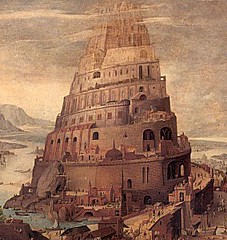
About 5 miles S.W. of Hillah, the most remarkable of all the ruins of Babylon, the Birs Nimroud of the Arabs, rises to a height of 153 feet above the plains from the base covering a square of 400 feet, or almost four acres. It was constructed of kiln-dried bricks in 7 stages to correspond with the planets to which they were dedicated: the lowermost black, the color of Saturn: the next orang for Jupiter; the third red, for Mars; and so on. These stages were surmounted by a lofty tower, on the summit of which we are told were the signs of the zodiac and other astronomical figures; thus having ( as it should have been translated) a representation of the heavens, instead of ‘ a top which reached unto heaven’. I would not go so far as to claim that these are the remains of the original tower; but they do illustrate its nature and dimensions.
The Babel crisis probabbly occurred some 300 years after the Flood. In Chapter 10:25 And unto Eber were born two sons; the name of the one was *Peleg; for in his days was the earth divided; and his brother's name was Joktan. (Gen 10:25) Where Peleg was named (From פלג palag, to divide, because in his days, which is supposed to be about one hundred years after the flood, the earth was divided among the sons of Noah. Though some are of opinion that a physical division, and not a political one, is what is intended here, viz., a separation of continents and islands from the main land; the earthy parts having been united into one great continent previously to the days of Peleg. This opinion appears to me the most likely, for what is said, Gen10:5, is spoken by way of anticipation).
Peleg died 340 years after the Flood, as can be easily be reconed in Chapter 11:10-19. The Babel tower was designed to hand down antediluvian traditions. Its wrongness lay in the fact that its builders were defying the Divine command to spread abroad and multiply and replunish the earth.
let us make us a name; lest we be scattered abroad upon the face of the whole earth.' Such defiance of God was the spirit of Babylon their meaning "let us rebel", their motive even today was pride and ambition.
Next time we will consider type teachings in Genesis
Denis
Monday, March 22, 2010
Gleanings from Genesis Lesson 2 Part 7 the Babel Dispersion
Doc Notes Gleanings from Genesis Lesson 2 Part 7 the Babel Dispersion
Gentle Reader,
We might add just another word about the Noachian Flood before we continue to look at the Babel Dispersion. And that is the Noachian Flood should not be confused with the prehistoric flood of which our geologist speak. All around the crust of this planet there are the marks of a vast flood; but these are not that in Noah’s day was such as could have been left by the inudation of such short duration as that in Noah’s day, even if that in Noah’s day was universal. The flood to which geology bears witness is that of Genesis 1:2. It is to this, also that 2 Peter 3:5 refers.
And we also note, finally that when the whole Adamic race was destroyed there was one man and his family who "found grace" in the sight of God. But Noah found grace in the eyes of the LORD. These are the generations of Noah: Noah was a just man and perfect in his generations, and Noah walked with God. (Gen 6:8-9) This man and his family were spared: it was vital for he was the tenth man from Adam in the Messianic line, from which the Saviour was to come in "the fullness of the time."
Satan may do his worst, and man may sink to his lowest and judgement may fall to the utermost; but the ultimate purpose of Jehovah cannot be thwarted. It moves on, and will yet triumph in a "new heavens and a new earth" wherein shall be righteousness and undimmed glory.
The Tower Of Babel
We must not think of the pre-flood age as one of primitive crudity. The indications are that it was the most remarkable civilization that our race has ever known. {Note; It is my belief that Adam and his progeny were as close to "perfect and intellectually superior as possible. We are told that today’s human being uses only less than 1/10 of his brain can you imagine what we would have been like using 100% of our brains? We could continue to learn for an 1000 years and never fill up our understanding.}
Human longevity in that era, uniformity of language, nearness to the Divine revelation and the freer communication between God and men-think what these must have meant. We get significant hints as to the arts and industries of that time in Genesis 4:20-24. But that first civilization, with its accumulation of knowledge and experience, its treasures of art and literature, its agriculture and industries, is now gone, and the Adamic race is to havea new start in Noah and his three sons with their families.
The record of the tower of Babel is one of the most well known but most misunderstood passages of the Bible. People remember in general terms the great tower, man’s challenge to God, and the confusion of language, but they usually remember the specific details imperfectly.
It’s a short record, so let’s read it now so we know what it actually says:
Genesis 11:
1 The whole earth had a common language and a common vocabulary.
2 When the people moved eastward, they found a plain in Shinar and settled there.
3 Then they said to one another, "Come, let’s make bricks and bake them thoroughly." (They had brick instead of stone and tar instead of mortar.)
4 Then they said, "Come, let’s build ourselves a city and a tower with its top in the heavens so that we may make a name for ourselves. Otherwise we will be scattered across the face of the entire earth."
5 But the Lord came down to see the city and the tower that the people had started building.
6 And the Lord said, "If as one people all sharing a common language they have begun to do this, then nothing they plan to do will be beyond them.
7 Come, let’s go down and confuse their language so they won’t be able to understand each other."
8 So the Lord scattered them from there across the face of the entire earth, and they stopped building the city.
9 That is why its name was called Babel—because there the Lord confused the language of the entire world, and from there the Lord scattered them across the face of the entire earth.
It is a surprise to most people to realise that the Bible does not present the narrative of the tower of Babel as an explanation of how all the languages of the world came about, though many people wrongly believe it says this.
From the previous chapter of Genesis, we find that many nations with their own languages already existed outside the Middle East at this time:
Genesis 10:
4 The sons of Javan were Elishah, Tarshish, the Kittim, and the Dodanim.
5 From these the coastlands of the nations were separated into their lands, every one according to its language, according to their families, by their nations.
From this record we can see that the descendants of Japheth already had their own languages at the time that the descendants of Ham had moved to Shinar. The Bible does not connect these two events, and although the history of Genesis 11 certainly steps back in time to the events of Genesis 10:9-10 (just after 2,900 BC), whereas the historical record of Genesis 10 contains events least as late as the building of Calah in verse 11 (about 1,200 BC), it does not make any reference to the descendants of Shem, Ham, or Japheth, or explain their diversity of language as a result of the events at Shinar (a diversity already referred to in Genesis 11:5-6, 20, 31).
The most decisive proof that this incident is not related in order to explain the origin of the world’s languages, is that the record says no such thing, and actually uses this event to explain something else entirely:
Genesis 11:
8 So the Lord scattered them from there across the face of the entire earth, and they stopped building the city.
9 That is why its name was called Babel—because there the Lord confused the language of the entire world, and from there the Lord scattered them across the face of the entire earth.
The record explicitly uses this event to explain why the Hebrew name ‘Babel’ was given to this city. The record tells us exactly what it intends to use this event to explain, and it is certainly not to explain the origin of the world’s languages.
It is also important to understand that the Babel narrative is confined to a local area within Mesopotamia, in the Middle East. The record is not speaking of the entire globe. The ‘earth’ in verse 1 is to be understood in its local sense. We saw that this is the same language as was used to describe the flood.
The proof of this is found in the first two verses of Genesis 11:
* Verse 1: the ‘whole earth’ shared a common language, but Genesis 10:5 tells that many nations with their own languages already existed outside the Middle East at ths time, so the word ‘earth’ in chapter 11 cannot be speaking globally
* Verse 2: ‘the people moved eastward’, a statement which cannot refer to all the people on the planet (did all the people on the planet really move eastward?), and must therefore refer to a group of people belonging to a local area
* Verse 2: the people moved from the west and arrived in a plain in the land of Shinar, a statement which only makes sense if referring to a group of people moving eastward from a local area west of Shinar, and makes no sense if applied globally (people in India or Russia could not be said to be travelling ‘eastward’ to Babylon)
* Verse 2: the group of people was small enough to consider a plain in nearby Shinar to be an area sufficient to accommodate their new urban development, indicating that this refers to a local group of people, and not the entire planet
What then is the record intending to teach us? What lessons are we to learn from this?
Some have seen the narrative as condemning urbanization, connecting the tower of Babel with God’s calling of Abraham out of Ur (an event which takes place in the very next chapter). It is suggested that the urban dwellers at Babel were deliberately scattered by God in order to teach them that the nomadic lifestyle was acceptable to God, whereas the urban lifestyle was not.
Since the city of Ur belonged to the same civilization to which the tower of Babel belonged, and since God called Abraham out of the urban lifestyle to a nomadic lifestyle, this seems at first to be a legitimate conclusion. However, whilst there are certainly important connections between the tower of Babel and the call of Abraham (and the two narratives do appear to have been placed next to each other in deliberate contrast), God’s punishment of the people at Babel is clearly declared to be the Divine judgment on a certain attitude, not simply a way of life.
The urbanization at Babel is a symptom of that attitude, but it is the attitude rather than the symptom which is punished:
Genesis 11:
4 Then they said, "Come, let’s build ourselves a city and a tower with its top in the heavens so that11 we may make a name for ourselves. Otherwise we will be scattered13 across the face of the entire earth."
6 And the Lord said, "If as one people all sharing a common language they have begun to do this, then nothing they plan to do will be beyond them. [18]
[18] tn Heb "all that they purpose to do will not be withheld from them."
It is this attitude of challenging the Divine, the assumption that man can dominate not only the natural realm of his own environment, but also the Divine realm of heaven, which is the attitude God condemns. This challenge to Divine authority, and the remaking of God in the image of man, is the sin which the tower of Babel represents, an attitude which is displayed today whenever Babel is used as a sign of man’s achievements or aims.
In fact, the lessons of the tower of Babel are so well understood that for centuries the tower of Babel has been used as a symbol of the very attitudes God condemned there.
Now lets consider the Bable Dispersion fron external evidence
The Tower of Babel: Outside The Bible
Archaeological evidence proves that the Bible’s description of the tower of Babel is historically accurate on the following points:
* The description of the building
* The time at which it was built
* The specific materials from which it was constructed
* The order of the construction process
* The motives involved in its construction
The Bible describes the tower of Babel using a term which is historically appropriate:
‘Gen 11:4 tells us that the settlers in Sumer decided to build "a city and a tower." The word used for tower is ldgm (migdal). Since this word is often used in the OT for a watchtower or a defensive tower (e.g., Judg 9:45, 51; 2 Kgs 9:17; 17:9; Isa 5:2) and nowhere else refers to a ziggurat, what reason is there to believe that in Gen 11:4 it refers to a ziggurat?
The first reason is that the setting is in Babylonia where the ziggurat was the most prominent structure in a city – both visually and ideologically. [18]
Secondly, the tower in our text was designed to bring fame and glory to the builders ("so that we may make a name for ourselves"). Mesopotamian kings often took pride in building ziggurats, but no such pride was taken in defensive towers which were simply parts of the city wall. [19]‘
‘As for the use of the word migdal, one wonders what other choice the Hebrews had for a word to refer to a ziggurat? Since they had no ziggurats in their culture, they would either have to borrow a word or use the closest word they could find in their own language. As Walton has pointed out, the word migdal is not inaccurate and has a similar etymology to ziggurat, being derived from gedal (to be large), while ziggurat is derived from the Akkadian word zaqaru (to be high). [22]‘
‘There is very good reason then to believe that the tower in our text refers to a ziggurat and not just to a defensive tower. The vast majority of scholars agree that a ziggurat is intended.
[18] Elizabeth C. Stone, "The Development of Cities in Ancient Mesopotamia," CANE 1:236, 238.
[19] Singer, A History of Technology, 1:254-55; Forbes, Studies, 1:68.
[22] John Walton, "The Mesopotamian Background of the Tower of Babel Account and Its Implications," BBR 5 (1995), 156’
Paul H Seely, ‘The Date Of The Tower Of Babel And Some Theological Implications’, pages 18-19, originally published in Westminster Theological Journal 63 (2001) 15-38
The Biblical account of the tower of Babel comes just after the record of the flood, and since it has been demonstrated that the flood occurred around 3,000 BC, we know that the events surrounding the tower of Babel must have taken place not long after this date.
The available archaeological evidence proves that the Bible is accurate in describing a building such as the tower of Babel as having been constructed at this time. In fact, this was precisely the era during which constructions made of baked bricks, with bitumen mortar, were being built in the Mesopotamian region:
‘Indeed, Jacquetta Hawkes indicates in her archaeological survey that baked brick was not used for architecture anywhere in the entire world until c. 3000B.C. [15]
The use of baked brick in the tower of Babel indicates very clearly, therefore, that it was not built before c. 3500 to 3000 B.C. The use of bitumen (asphalt) for mortar also gives clear evidence of the earliest date to which we can ascribe the events of Gen 11:1-9. Since there are extensive remains of brick buildings in the sites of the ancient Near East and bituminous mortar is nearly as indestructible as baked brick, [16] it is easy to ascertain when bitumen began to be used as mortar for bricks.
The evidence from thousands of bricks shows that bitumen was not used as a mortar for brick until baked brick appeared. Until c. 3500 to 3000 B.C., if mortar was used, it was gypsum or just mud.
[15] Jacquetta Hawkes, The Atlas of Early Man (New York: St. Martin’s, 1976), 50, 76.
[16] Forbes, Studies, 1:69.
Paul H Seely, ‘The Date Of The Tower Of Babel And Some Theological Implications’, pages 17-18, originally published in Westminster Theological Journal 63 (2001) 15-38
This tower could not have been built prior to 3,000 BC. The Biblical record is therefore correct in describing the building of this tower as being shortly after the Mesopotamian flood of 2,900 BC.
The specific materials which the Bible describes as having been used to build the tower are also historically accurate, indicating that it was indeed a ziggurat, as the Hebrew word suggests:
‘The use of baked brick and bitumen also tells us that the migdal in our text was a ziggurat rather than a defensive tower, for baked brick and bitumen were very expensive in Mesopotamia and hence were saved for luxurious architecture like palaces, temples, and ziggurats.’
Paul H Seely, ‘The Date Of The Tower Of Babel And Some Theological Implications’, page 18, originally published in Westminster Theological Journal 63 (2001) 15-38
Likewise, the order of construction described in the Biblical record is also accurate:
‘It is also telling that in our text the making of the baked bricks is specifically mentioned first (v. 3) and after that the building of the city and tower (v. 4). This is exactly the way the building of the temple and ziggurat of Babylon are described in Enuma Elish (6.50-70) as well as in the account of Nabopolassar in Neo-Babylonian times. [20]
[20] So strong is the parallel with Enuma Elish that E. A. Speiser thought Gen 11:1-9 was a response to Enuma Elish. Andre Parrot, The Tower of Babel (London: SCM, 1955), 19.’
Paul H Seely, ‘The Date Of The Tower Of Babel And Some Theological Implications’, pages 18-19, originally published in Westminster Theological Journal 63 (2001) 15-38
One of the motives the Bible ascribes to the builders of the tower, is the desire to reach heaven. This aim is commonly found in the records of the ziggurats of this era:
‘In addition, Nabopolassar is told to make the foundation of Babylon’s ziggurat "secure in the bosom of the nether world, and make its summit like the heavens" just as our text describes the tower as having "its head in the heavens." Indeed it is typical of the descriptions of Mesopotamian ziggurats that they have their heads in the heavens. Thus King Samsuiluna is said to have made "the head of his ziggurat … as high as the heavens." The top of Hammurabi’s ziggurat was said to be "lofty in the heavens." And Esarhaddon, speaking of the ziggurat he built, says, "to the heavens I raised its head."
[21] John H. Walton, The Tower of Babel (Ph.D, diss., Hebrew Union College, 1981), 44-45.’
Paul H Seely, ‘The Date Of The Tower Of Babel And Some Theological Implications’, page 18, originally published in Westminster Theological Journal 63 (2001) 15-38
Archaeological also evidence shows that the theological attitude on Mesopotamia changed significantly at this time, with the development of the urban state. The gods were no longer seen as simply the impersonal manifestations of natural forces, but were redefined in more human terms:
‘From every angle, then, the narrative, taken against its historical and cultural background, continually points us to the early period of urbanization in southern Mesopotamia.
As the urbanized state began to function, the universe came to be considered a state ruled by the gods. [45]‘
‘Jacobsen has presented the view that the earlier picture of the gods was one in which each god, or numinous power, was seen as bound up by a particular natural phenomenon through which he was made manifest. The god was seen to be the power behind the phenomenon, and the phenomenon circumscribed the power of the god and was the god’s only form. [46]
As the situation developed, however, a change took place. Rather than continuing to emphasize the powerful uncontrolled manifestation of deity in natural phenomena, the view of the cosmos as a state emerged, with the now humanized gods as citizens and rulers.
[45] Jacobsen, Before Philosophy, 142.
[46] Jacobsen, "Formative Tendencies In Sumerian Religion," Toward the Image of Tammuz, 2.’
John H. Walton, ‘The Mesopotamian Background of the Tower of Babel Account and Its Implications’, Bulletin for Biblical Research 5, pages 167-168, 1995
This new religious attitude was a direct product of the new urbanization process which took place after the flood:
‘Mesopotamian theology that is reflected in most of the mythology of Babylon and Assyria has an urbanized society as its foundation. This theological perspective arose sometime early in the urbanization process, for even the Early Dynastic literature reflects that point of view. One indicator of this shift is the sudden popularity of the practice of setting up statues in temples that were intended to pray for the life of the benefactor. Nissen observes,
We can assume that it is highly probable that the custom of setting up statues in temples with this intention began in the Early Dynastic Period.’
‘The ziggurat and the temple complex provide the link between urbanization, of which they are the central organ, and Mesopotamian religion which they typify.’
‘Jacobsen further comments:
Particularly powerful and concrete in the new anthropomorphic view was the symbol of the temple, the god’s house. Towering over the flat roofs of the surrounding town, it gave the townsmen visible assurance that the god was present among them. [49]
The development in Mesopotamian religion that took place with the development of urbanization, was that men began to envision their gods in conformity with the image of man.
[50] J. J. Finkelstein, "Bible and Babel," Commentary 26 (1958) 440.’
John H. Walton, ‘The Mesopotamian Background of the Tower of Babel Account and Its Implications’, Bulletin for Biblical Research 5, pages 167-168, 1995
It must be noted that the entire purpose of the ziggurat was to provide a physical connection between the human and the Divine, But although the ziggurat builders often speak of reaching the heavens with their towers, their aim was not to personally ascend to the gods, but to cause the gods to descend to earth. The ziggurat was not so much a stairway to heaven, as a stairway to earth. The gods would come down to earth at the request of men:
‘Man was no longer attempting to be like God, but more insidiously, was trying to bring deity down to the level of man. The gods of the Babylonians were not only understood to interact with each other and operate their affairs as humans do, but they also behaved like humans, or worse. Finkelstein observes,
The Babylonian gods … although not themselves BOUND by moral or ethical principles, nevertheless appreciated them and expected man to live by them. The Babylonians, it would seem, fashioned their gods in their own image more faithfully than the Israelites did theirs. [50]
This is what is represented by the ziggurat. The function of the ziggurat that was suggested earlier as a result of our study of the names further supports this. The needs and nature of the deities who would make use of such a stairway reflect the weakness of deity brought about by the Babylonian anthropomorphization of the gods. It is this system of religion that was an outgrowth of the urbanization process as it unfolded in Mesopotamia, and it was this system that had as its chief symbol the towering ziggurat.
[50] J. J. Finkelstein, "Bible and Babel," Commentary 26 (1958) 440.’
John H. Walton, ‘The Mesopotamian Background of the Tower of Babel Account and Its Implications’, Bulletin for Biblical Research 5, pages 167-168, 1995
The Biblical description thus displays evidence of being an excellent historical account, demonstrating a considerable knowledge of many details of these ziggurats, including:
* The era during which they were built
* The specific materials from which they were made
* The specific order of their construction
* The motivation behind them
In addition, there is a specific time duration in which this tower must have been built. Archaeological evidence proves that such a ziggurat must have been built no later than 2,400 BC:
‘We see then that the archaeological facts coalesce around the dates 3500 to 3000 B.C. The building of a city not just a settlement, the use of baked brick, the use of bitumen for mortar and the fact that a ziggurat is being built all dovetail in date. This remarkable agreement makes it highly probable that the earliest date to which we can ascribe the tower of Babel as described in Gen 11:1-9 is c. 3500 to 3000 B.C.
But, what is the latest date to which we can ascribe its building? There is a text saying that Sharkalisharri restored the temple-tower at Babylon c. 2250 B.C., and another text indicates that Sargon I destroyed Babylon c. 2350 B.C. [24]
This suggests that there was a city established at Babylon efore 2350 B.C.; so, allowing a modest 50 years of city history, we can set 2400 B.C. as the terminus ante quem for the first ziggurat built in Babylon. [25]
We can thus date the building of the tower of Babel sometime between 3500 and 2400 BC.
[24] CAH3 1:1:219; Evelyn Klengel-Brandt, "Babylon," OEANE 1:254.
[25] Ziggurats began as elevated temples and did not become "true ziggurats" until c. 2100 B.c., after which they continued to be built or at least rebuilt until the fall of Babylon in the sixth century B.C.’
Paul H Seely, ‘The Date Of The Tower Of Babel And Some Theological Implications’, page 19, originally published in Westminster Theological Journal 63 (2001) 15-38
This detail provides evidence that the Biblical record of the tower of Babel must itself be very old. Many modern scholars (especially secular academics), wish to argue that the Pentateuch was written at a very late date, supposedly during the Babylonian captivity (6th century BC), though incorporating some earlier material from no earlier than the 10th century BC.
It must be asked how even a 10th century writer living in Israel could possibly have such a precise knowledge of these specific details of religious buildings constructed over 1,400 years before he lived, during a kingdom long since ended, in a geographical area he had never visited.
Aside from the specific details of the tower itself, there is evidence for the key historical events described in Genesis 11, specifically:
* A time when the people had a common language and culture (Genesis 11:1)
* A new era of urbanisation subsequent to the flood (Genesis 11:3-4)
* The confusion of language (Genesis 11:5-7)
In agreement with the Biblical record, the Sumerian King List (copies of which date from at least 2170 BC), records that a new dynastic era commenced after the flood:
‘After the flood had swept over, and the kingship had descended from heaven, the kingship was in Kiš.
In Kiš, Gišur became king; he ruled for 1,200 years.’
The city of Kish was the first of the Sumerian Early Dynastic I era. This era is known as the ‘Golden Age’, and dates from 2,900-2,700 BC. It was the construction of monumental buildings which had previously not been made (such as the ziggurat), and large scale urbanization in the form of new city states:
‘The bloom and further development of the city states is called the Early Dynastic period (2900-2400 BCE) or Old Sumerian period. It is divided into three periods in which different cities dominate. The Old Sumerian period is characterized by strong rivalry between city states and an increasing division between state and religion. Monumental buildings that should be called palaces as opposed to temples are attested for the first time.’
John Heise, ‘Akkadian Language’, chapter 3, 1996
The fact that Early Dynastic I commences shortly after 2,900 BC, proves that both the Sumerian King List and the Genesis 11 record are correct to describe a new era of urbanization and monumental architecture subsequent to the Mesopotamian flood of 2,900 BC.
Significant for the Biblical narrative of the tower of Babel, this was an era during which the region shared a common culture, religion, and language:
‘Despite the rivalry there are strong similarities in architecture, building materials, motives of ornaments etc., The people shared a common religion and spoke the same language. So in general one could speak of a Sumerian art and culture.’
John Heise, ‘Akkadian Language’, chapter 3, 1996
The Sumerian King List informs us that Enmekar ruled subsequent to the kingship of Kis, meaning some time after 2,900 BC:
‘Then Kiš was defeated and the kingship was taken to Eanna.
In Eanna, Meš-ki’ag-gašer, son of Utu, became lord and king; he ruled for 324 years. Meš-ki’ag-gašer entered the sea and disappeared.
Enmekar, son of Meš-ki’ag-gašer, the king of Uruk, who built Uruk, became king; he ruled for 420 years.’
The list of kings of the Early Dynastic I era continues to the first dynasty of Ur, which took place some time after the reign of Enmekar. The sequence given in the Sumerian King List is clearly inaccurate, since archaeological evidence demonstrates that the kings during this time actually reigned between 2,900 and 2,600 BC, many of them being contemporary with each other. The reign of Enmekar therefore took place between 2,900 and 2,700 BC.
A legendary account of the reign of Enmekar, written some time after, includes a significant reference to the division of men’s languages by one of the gods. The exact details of the translation are uncertain, but it is undisputed that the text refers specifically to the languages of men having been divided by the god Enlil, some time prior to the reign of Enmekar.
Here are two translations of the text:
‘Once upon a time there was no snake, there was no scorpion,
There was no hyena, there was no lion,
There was no wild dog, no wolf,
There was no fear, no terror,
Man had no rival.
In those days, the lands of Subur (and) Hamazi,
Harmony-tongued (?) Sumer, the great land of the decrees of princeship,
Un, the land having all that is appropriate (?), The land Martu, resting in security, The whole
universe, the people in unison (?)
To Enlil in one tongue [spoke].
[...]
(Then) Enki, the lord of abundance (whose) commands are trustworthy,
The lord of wisdom, who understands the land,
The leader of the gods,
Endowed with wisdom, the lord of Eridu
Changed the speech in their mouths, [brought (?)] contention into it,
Into the speech of man that (until then) had been one.’
‘Chant to him the holy song, the incantation sung in its chambers — the incantation of Nudimmud: "On that day when there is no snake, when there is no scorpion, when there is no hyena, when there is no lion, when there is neither dog nor wolf, when there is thus neither fear nor trembling, man has no rival!
At such a time, may the lands of Cubur and Hamazi, the many-tongued, and Sumer, the great mountain of the me of magnificence, and Akkad, the land possessing all that is befitting, and the Martu land, resting in security — the whole universe, the well-guarded people — may they all address Enlil together in a single language! For at that time, for the ambitious lords, for the ambitious princes, for the ambitious kings, Enki, for the ambitious lords, for the ambitious princes, for the ambitious kings, for the ambitious lords, for the ambitious princes, for the ambitious kings
– Enki, the lord of abundance and of steadfast decisions, the wise and knowing lord of the Land, the expert of the gods, chosen for wisdom, the lord of Eridug, shall change the speech in their mouths, as many as he had placed there, and so the speech of mankind is truly one.’
Regardless of which translation is preferred, in both it is clear that this passage contains a reference to an earlier time, before the reign of Enmekar, when unity of language was ended by a Divine act resulting in a diversity of languages. The second translation sees this invocation as an appeal to the gods to reverse this process.
The Modern Babel
The modern manifestation of Babel was foretold in Scripture, just as the ancient Babel is recorded there. The spirit which drives men to form vast organisations aimed at uniting nations in political empires is as alive and well today as it was thousands is years ago on the plain on Shinar. Neither the attitudes, nor the aims have changes, and even the catchcry is the same:
‘For the first time since the fall of the Roman Empire we have the opportunity to unite Europe, not by force of arms, but on the basis of shared ideals and agreed common rules.’
Romano Prodi, EU Commission President, EU Parliament, 13 October 1999
‘The last step will then be the completion of integration in a European Federation, such a group of States could conclude a new European framework treaty, the nucleus of a constitution of the Federation.
On the basis of this treaty, the Federation would develop its own institutions, establish a government which, within the EU, should speak with one voice… a strong parliament and a directly elected president.’
Joschka Fischer, Geman Foreign Minister, Berlin, 12 May, 2000
As if this were not enough, these modern builders of Babel explicitly identify themselves with the ancient tower and its architects, even to the point of building their own tower. Many of us would be familiar with the poster printed by the European Council depicting the tower of Babel depicted in Pieter Bruegel the Elder’s painting of 1563, and the words ‘Europe: Many Tongues, One Voice’, an explicit challenge to the Divine judgment on the men of Shinar. We may also be familiar with the European Parliament building in Strasbourg, also designed deliberately to look like the same depiction of the tower of Babel.
These modern expressions of the spirit of Shinar show that the lesson is well understood and is being consciously rejected. But such schemes, though oft repeated over the centuries, are doomed to failure:
Daniel 2:
42 In that the toes of the feet were partly of iron and partly of clay, the latter stages of this kingdom will be partly strong and partly fragile.
43 And in that you saw iron mixed with wet clay, so people will be mixed with one another without adhering to one another, just as iron does not mix with clay.
‘Time and again men have dreamed of rearing on these dominions one mighty kingdom. Charlemagne tried it. Charles V tried it. Louis XIV tried it. Napoleon tried it. But neither succeeded.
A single verse of prophecy was stronger than all their host.
…’Partly strong, and partly broken,’ was the prophetic description. And such, too, has been the historic fact concerning them.
…It is ‘partly strong’–i.e., it retains, even in its broken state, enough of its iron strength to resist all attempts to mold its part together.
‘This shall not be,’ says the word of God.
‘This has not been,’ replies the book of history.’
William Newton, ‘Lectures on the First Two Visions of the Book of Daniel’, pages 34-35, 1859
Daniel 2:
44 In the days of those kings the God of heaven will raise up an everlasting kingdom that will not be destroyed and a kingdom that will not be left to another people. It will break in pieces and bring about the demise of all these kingdoms. But it will stand forever.
45 You saw that a stone was cut from a mountain, but not by human hands; it smashed the iron, bronze, clay, silver, and gold into pieces. The great God has made known to the king what will occur in the future. The dream is certain, and its interpretation is reliable."
We will continue this study and draw some conclusions next time.
Denis
Friday, March 12, 2010
"Doc Notes" Lesson 2 Part 6 "Sons of God"
Gentle Reader,
There are good men on either side of a discussion, here we find another enignia wrapped in a mystery the "sons of God" in Genesis I certainly have an opinion, but as my mither used to say "opinions are like noses everyone has one." So I will try to be as objective as I am able and allow you to decide on which side to come down on (if you wish to take sides)!
Satan's object therefore was to frustrate this counsel of God.
Having as yet no clue as to the line by which "the seed of the woman" should come into the world, his first effort was to corrupt and destroy the whole human race. This he carried out as described in Genesis 6 and Jude 6. "The sons of God" were angels; "the angels who sinned." All beings who are the direct creation of God are called his "sons." Adam was "a son of God" (Gen 5:1; Luke 3:38). We are not. By nature we are sons of Adam begotten in his likeness (Gen 5:3). The New nature in us makes us "sons of God," because that is God's own new-creation work (Eph 2:10; 2 Cor 5:17; Rom 8:14-17). For the same reason also, angels are called "sons of God," because they are the direct creation of God. In the Old Testament the expression always has this meaning. Before Adam was created "the morning stars sang together, and all the sons of God shouted for joy" (Job 38:7). An angel was sent to the lions' den to shut the lions' mouths (Dan 6:22), as another was sent to the fiery furnace to deliver Jehovah's servants; this angel is called "a son of God" (for there is no article).
They cannot (in Gen 6) be the seed of Seth, as is generally taught, because they are contrasted with "the daughters of MEN"; which shows they must be of a different nature.
We know from Genesis 6 how nearly that great plot succeeded; how the whole earth was corrupted* (Gen 6:11,12).
* (shachath), to ruin, lay in ruins, to make good for nothing. Hence (shackath), a sepulcher, corruption.
All, except Noah's family, were tainted with this uncanny and unholy breed called **"Nephilim." [ Longer Note at the end] Noah was tamim, i.e., "without blemish," as the word for "perfect" here is generally rendered elsewhere. All had to be destroyed by the Flood; but the angels who sinned are "reserved," in "chains" and "in prison" (1 Peter 3:19; 2 Peter 2:4; Jude 6), for their judgment at a yet future day.
The aim of Satan was to corrupt, and so secure the destruction of the whole human race. And his plot would have succeeded but for the direct interposition of Divine judgment.
"The seed of the woman" ultimately came into the world. The Word of God was fulfilled; and now, though His heel had been bruised, and He suffered and died, yet God raised Him from the dead, the token that Satan's head shall in due time be crushed.
This glorious triumph had to be heralded forth. Those who had taken part in that awful plot had to learn that the designs of Satan, their lord and master, had failed. This was the reason why Christ, having risen from the dead, went and proclaimed His glorious triumph.
This is why it is "better to suffer for well-doing than for evil-doing. FOR Christ also suffered" [for well doing], "the just for the unjust." And, it was "better" for Him; for He has triumphed gloriously: and it is "better" for us also; for we are thereby saved eternally.
Not merely saved through* the judgment (as the digression shows); not saved by means of material water; but by the "suffering" of that perfect sacrifice, which has made the comers thereunto "perfect as pertaining to the conscience" (Heb 9:9, 10:1), and given them "the answer of a good conscience toward God" (1 Peter 3:21).
* This is the force of (diasozo). See its only occurrences: Matthew 14:36; Luke 7:3; Acts 23:24, 27:43,44, 28:1,4; and here 1 Peter 3:20.
**The Nephilim were an antediluvian race (pre-flood) race which are referred to in the Bible as giants. They were reportedly the children born from the "daughters of men'', and the "Sons of God''. It is most important to note that they are mentioned almost simultaneous to God's statement that He would destroy the earth by flood, and it seems from this association that their affect upon mankind was one of the primary justifications that brought the destruction.
Genesis 6:1-7
1 When men began to increase in number on the earth and daughters were born to them, 2 the sons of God saw that the daughters of men were beautiful, and they married any of them they chose. 3 Then the LORD said, "My Spirit will not contend with man forever, for he is mortal ; his days will be a hundred and twenty years." 4 The Nephilim were on the earth in those days—and also afterward—when the sons of God went to the daughters of men and had children by them. They were the heroes of old, men of renown. 5 The LORD saw how great man's wickedness on the earth had become, and that every inclination of the thoughts of his heart was only evil all the time. 6 The LORD was grieved that he had made man on the earth, and his heart was filled with pain. 7 So the LORD said, "I will wipe mankind, whom I have created, from the face of the earth—men and animals, and creatures that move along the ground, and birds of the air—for I am grieved that I have made them." NIV
The Sons of God
Nobody knows what the ''Sons of God'' were, but the most obvious interpretation is that the Nephilim were a hybrid race between two distinct but sexually compatible beings. Many believe the ''Sons of God'' were fallen angels who corrupted mankind. The ''Sons of God''' are clearly distinguished from the daughters of men. This suggests the ''Sons of God'' were either not born on earth or simply righteous men as opposed to earthly. We can only speculate, but as angels are not biological organisms, they are not likely to be reproductively compatible with humans.
Another logical interpretation for the ''Sons of God'' is they were other created men. It is largely assumed that Adam and Eve were the only humans created in the beginning, but the Bible does not describe every person on earth, nor even everyone that was important to God. Only key individuals or situations are included within the text, and we can not say with certainty that God only created one pair of humans.
The phrase "sons of God" used in Genesis 6 is "bene elohim", which used apparently only three other times in Scripture and in each of the other cases it is found in the book of Job which is accepted as one of the most ancient books written. Job 1:6; 2:1; 38:7.
Job 1:6 Now there was a day when the sons of God came to present themselves before the LORD, and Satan came also among them.
Job 2:1 Again there was a day when the sons of God came to present themselves before the LORD, and Satan came also among them to present himself before the LORD.
Job 38:7 When the morning stars sang together, and all the sons of God shouted for joy?
And Also Afterward
In Genesis 6:4 it is said the Nephilim were on the Earth in those days - and also afterward. This seems to clearly imply that the Nephilim were also on the Earth after the flood of Noah. Although the Nephilim are only mentioned one other time in scripture after Genesis 6, during a false report brought back to Moses by the explorers of Canaan, this reference would suggest that the Israelites were familiar with the Nephilim.
Numbers 13:30-33
30 Then Caleb silenced the people before Moses and said, "We should go up and take possession of the land, for we can certainly do it." 31 But the men who had gone up with him said, "We can't attack those people; they are stronger than we are." 32 And they spread among the Israelites a bad report about the land they had explored. They said, "The land we explored devours those living in it. All the people we saw there are of great size. 33 We saw the Nephilim there (the descendants of Anak come from the Nephilim). We seemed like grasshoppers in our own eyes, and we looked the same to them." NIV
And now Gentle reader from another point of view:
The increasingly popular interpretation of the following passage is that it relates a story of angels interbreeding with the human race, and that this was a primary reason for God destroying most of humanity with the great flood.
First of all, it should be pointed out that angels are not humans, they are quite different creations of God. Satan and the other angels are spirit beings, and simply cannot have physical offspring (children). They do not marry (Matt. 22:28, Mark 12:25), they are incapable of procreation, and so are genderless creatures.
Let's look at this passage in an attempt to shed some light:
Gen 6:1 And it came to pass, when men began to multiply on the face of the earth, and daughters were born unto them,
Gen 6:2 That the sons of God saw the daughters of men that they were fair; and they took them wives of all which they chose.
Gen 6:3 And the LORD said, My spirit shall not always strive with man, for that he also is flesh: yet his days shall be an hundred and twenty years.
Gen 6:4 There were giants in the earth in those days; and also after that, when the sons of God came in unto the daughters of men, and they bare children to them, the same became mighty men which were of old, men of renown.
Gen 6:5 And God saw that the wickedness of man was great in the earth, and that every imagination of the thoughts of his heart was only evil continually.
Gen 6:6 And it repented the LORD that he had made man on the earth, and it grieved him at his heart.
Gen 6:7 And the LORD said, I will destroy man whom I have created from the face of the earth; both man, and beast, and the creeping thing, and the fowls of the air; for it repenteth me that I have made them.
Gen 6:8 But Noah found grace in the eyes of the LORD.
So now let's evaluate each verse, and what it is saying-
Gen 6:1 And it came to pass, when men began to multiply on the face of the earth, and daughters were born unto them,
This verse is straightforward. The human population on earth began to increase in numbers.
Gen 6:2 That the sons of God saw the daughters of men that they were fair; and they took them wives of all which they chose.
Now this verse is full of meaning. Some will point to Job 1:6, 2:1 and 38:7 where the same phrase "sons of God" is translated sometimes as angels, and conclude that this also refers to angels as well. The Hebrew words used are - ben: H1121 and 'elohiym: H430:
1121. ben, bane; from (Strong's Concordence H1129; a son (as a builder of the family name), in the widest sense (of lit. and fig. relationship, including grandson, subject, nation, quality or condition, etc., [like H1, H251, etc.]) ...
So the phrase "Sons of God" is a generic term that can mean the subjects or nation of God. It is not a phrase limited to just the angelic host, it has a wider meaning.
The sons of God in Gen 6:2, in context, speaks of those men who were (or claimed to be) obedient to the will of God, they were the people of God, from the lineage of Seth (Gen. 5). In opposition to this are the daughters of men (not obedient to God), from the lineage of Cain (Gen. 4). These woman were quite attractive and alluring, and had little trouble enticing the sons of God into intimate relations and marriage. In doing so, the sons of God quickly abandoned God for these women and their ways.
This is basically a retelling of the fall of Adam and Eve. Eve listened to the lies of Satan and doubted God. She ate from the forbidden tree and fell from the spiritual nature she previously enjoyed. That tree was the tree of knowledge of good and evil (Gen 2:9, 17). Upon eating from the tree, Eve was aware of what she had done. She now had the knowledge of evil and she was aware that she had sinned against God. In that knowledge, and having fallen, she then offered the fruit from the tree to Adam.
Adam was not deceived (1 Tim 2:14). He knew when he saw Eve that she had sinned, because she had lost the spiritual glow that results from being in close spiritual harmony with God. Moses had this same glow when he came down from Sinai (Exo 34:29, 30). Adam elected to eat the fruit, knowing what he was doing. His love for Eve (whom he knew had sinned) was greater than his love of God.
This is a tactic used time and again by Satan. The downfall of God's people is frequently through the temptations of godless women (See Numbers 25:1-9). Other examples that come to mind are Samson and Delilah, and David and Bathsheba.
So, now back to Gen 6:2. The same basic scenario is being repeated after the garden of Eden, only on a larger scale. There is a wholesale abandonment of God and his righteous ways by the descendants of Seth for women of the lineage of Cain, known to be in rebellion and sin. This is what God calls fornication, not referring only to a sexual sin, but the sin of mixing the righteous with the wicked, truth with evil. (One example of this is the word fornication as attributed to the harlot church in Rev 17:4 and 18:3) This sin was so prevalent, and so blatant a rejection of God that it could not be allowed to continue indefinitely.
Gen 6:3 And the LORD said, My spirit shall not always strive with man, for that he also is flesh: yet his days shall be an hundred and twenty years.
God in this verse has just set a period of probation of 120 years on the human race to repent of their wicked ways. It could not be allowed to continue.
Gen 6:4 There were giants in the earth in those days; and also after that, when the sons of God came in unto the daughters of men, and they bare children to them, the same became mighty men which were of old, men of renown.
The word "giants" here in the Hebrew is listed in Strong's as follows-
5303. nephiyl, nef-eel'; or nephil, nef-eel'; from H5307; prop., a feller[*], i.e. a bully or tyrant:--giant.
*Main Entry: 4fell
Function: adjective
Etymology: Middle English fel, from Middle French, from Old French -- more at FELON
1 a : FIERCE, CRUEL, TERRIBLE b : SINISTER, MALEVOLENT <a fell purpose> c : very destructive : DEADLY <a fell disease> –Webster’s Onelinehttp://www.m-w.com/cgi-bin/dictionary
So rather than being perhaps physical giants, in contrast to the meek people of god, these people were rebellious bullies and tyrants, forceful in character and great in their sins. This same phrase of "giants" is also used to describe the Canaanites following the exodus (Num 13:33). Again, this probably referred to their godless and lawless character, as much as their physical stature.
Gen 6:5 And God saw that the wickedness of man was great in the earth, and that every imagination of the thoughts of his heart was only evil continually.
The fault here is laid squarely on the wickedness of the people themselves. The first part of this verse is a restatement of the first part of verse 4. As a result of choosing godless women, men were turned away from God as well, and sin and wickedness flourished. God was rejected, and forgotten.
Gen 6:6 And it repented the LORD that he had made man on the earth, and it grieved him at his heart.
Gen 6:7 And the LORD said, I will destroy man whom I have created from the face of the earth; both man, and beast, and the creeping thing, and the fowls of the air; for it repenteth me that I have made them.
Sin became so great, that God had to bring the flood on them, to cleanse the earth of such great wickedness.
Gen 6:8 But Noah found grace in the eyes of the LORD.
Gen 6:9 These are the generations of Noah: Noah was a just man and perfect in his generations, and Noah walked with God.
Noah was the exception, and he was given the task to build the ark, that would be the refuge from the flood for those obedient to God.
So, now back to the popular story about this passage. Based on a very narrow interpretation of the phrase "sons of God" as found here in Genesis, and bolstered by Job 1:6; 2:1; 38:7; and Psalms 29:1; 82:6, the case is made that this is referring to heavenly beings/angels that interbred with women, causing a ghastly mixed breed of creatures that God had to destroy.
John 1:12 But as many as received him, to them gave he power to become the sons of God, even to them that believe on his name:
Rom 8:14 For as many as are led by the Spirit of God, they are the sons of God.
The above verses make clear that phrase "sons of God" applies to anyone with faith. Note how the righteous 144,000 are described
Rev 14:4 These are they which were not defiled with women; for they are virgins. These are they which follow the Lamb whithersoever he goeth. These were redeemed from among men, being the firstfruits unto God and to the Lamb.
"Not defiled with women" alludes back to Genesis 6 and the sons of God and the daughters of men. The 144,000 walk with God just like Noah, and are not defiled by the great whore of Revelation 17, or her harlot daughters, which are symbolic of apostasy.
So the angelic interbreeding story appears to be nothing more than an attempt to put the blame on angels rather than man. The passage in Genesis 6 speaks only to the wickedness of humanity, and places no blame at all on angels. Humanity had turned their back on God, and did it on such a scale that God was moved to destroy them. Yet, God in His mercy, amid all the wickedness, still did not act hastily to exact his judgment. He gave humanity a period of probation. A time of 120 years, during which Noah could preach the message of God, of repentance and faith. Through that period of probation, people heard the word of God, that they might be saved. Eventually Noah and 7 members of his family were saved in the ark.
Luke 17:26 And as it was in the days of Noe, so shall it be also in the days of the Son of man.
Luke 17:27 They did eat, they drank, they married wives, they were given in marriage, until the day that Noe entered into the ark, and the flood came, and destroyed them all.
It should be clear, to even a casual reader, that we have entered into the days of the Son of Man. History is repeating itself. There are "giants" on the Earth again. The Nephilim, those who follow the way of Cain, and are bold in their rebellion against God, again are filling the earth with sin and violence. Man's cup of iniquity is again reaching the brim, and God will not let it continue much longer. We have no angels to place blame on, and neither did those people in the time of Noah. Mankind is willfully abandoning God for the sake of the sins of iniquity. Yes, Satan and the other fallen angels can tempt mankind, just as Eve was tempted, but the choice to sin was Eve's and Adam's, and is also ours to make. The door of probation is soon to close again on this wicked world, just as it did for the people of Noah's generation, but this will be for the final time.
here were giants in the earth - נפלים nephilim, from נפל naphal, "he fell." Those who had apostatized or fallen from the true religion. The Septuagint translate the original word by γιγαντες, which literally signifies earth-born, and which we, following them, term giants, without having any reference to the meaning of the word, which we generally conceive to signify persons of enormous stature. But the word when properly understood makes a very just distinction between the sons of men and the sons of God; those were the nephilim, the fallen earth-born men, with the animal and devilish mind. These were the sons of God, who were born from above; children of the kingdom, because children of God. Hence we may suppose originated the different appellatives given to sinners and saints; the former were termed γιγαντες, earth-born, and the latter, ἁιοι, i.e. saints, persons not of the earth, or separated from the earth
So gentle reader we have two perspectives one that the "giants" were Nephilim or "monsters" and the second was that these Nephilim were in contrast to the children of the Seth line. The Line of Cain vs the line of Seth the wicked disobedent vs the obedient. The "sons’ of God those who were not fallen angels but wicked men contrasted by those who followed after righteous.
There you have it Gentle Reader, two perspectives who were the sons of God? Men or monsters?
Next time we’ll consider the Babel Dispersion.
Love,
Denis
Subscribe to:
Posts (Atom)

