Showing posts with label Christianity. Show all posts

Wednesday, September 17, 2008

Are you Anti-intellectual?

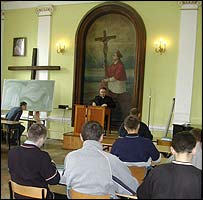
1seminaryclass

Beloved of my Father,

The central motivating factor in my ministry over the last twenty years has been the need for Christians to engage the intellectual side of the faith with more confidence, hope, and joy. I began Scripture Institute in 2001 which now is in read in hundreds of churches and has effected tens of thousands of people. I can barely keep up with the demands of this ministry as its need and potential becomes more evident each and every day.

The intellectual side of Christianity.

With all of these success, one inevitably finds those who continue to place much needed anchors in my mission. While I believe what I am doing has been given to me by God, I also understand that the intellect is not all there is. In fact, while I want to produce more confidence, hope, and joy in the lives of believers, I also want to instill a deep sense of humility. Theology done right should always produce a confident humility. Theology done wrong produces an ironically insecure emotional confidence that is made up of what I call “cut-and-paste” theology and apologetics (”just give me the answers, I don’t care how we get them”).

Anchored as I am in the reality that the intellectual side of our faith is not necessarily the end, but a foundation to all that is being built, I am more confident than ever that the church today continues to face a major crisis in its philosophy of faith and education. The majority of churches simply do not stimulate serious discussion concerning matters of theology. Most people do not find the church as a safe place to ask serious questions. In fact, most people are trained to fear any doubt, reserve questions, or to put away any sinful antagonistic feeling concerning any challenge that comes to the table.The church, unfortunately, more often than not, is in the obscuring business. No, not intentionally, but it is true. We protect ourselves and those we love from any “false doctrine” that leads away from Christ by hiding the issue or give a quick sound-bite apologetic which obscures and belittles the arguments of any opposition.But here is the problem (and don’t miss this): one day the opponent will find an audience. Someway, somehow, whether it be in college or through a New York Times best seller, the opposition that we have dedicated ourselves so much to hide will be found. When this happens, a different tale is told, and this tale is much more convincing coming from an educated adherent than it was coming from us.

Those who trusted us then feel betrayed. They begin to feel that their intellect was being molested for many years without their realization. Then they move into recovery without us. This recovery often finds a line of many other people on a trail called “apostasy.” It is not a happy trail, but more of a trail of tears, evidencing the emotions of those who feel they have been betrayed by those who were supposed to love them most.

This describes the intellectual epidemic that Christianity is facing today. Of course, it does not have to be such. The future of theological education need not repeat the sins of the fathers. But we need to change.

This change involves risk. We don’t like risk. That is why we lock our doors every night and set the alarm. That is why we purchase cars with anti-lock brakes and airbags. We are trained to prevent any problems. But in this case, we cannot take the chance that intellectual isolation will birth true commitment. Its track record is simply not very good.

We need to turn the air-bag off for a while. This risk has to do with opening the curtain that hides the wizard. People need to be educated, not indoctrinated. Most certainly there is a time when indoctrination is necessary since early in our lives we don’t have the capability to think critically. But some time between the ages of 5-10 we need to transition to a point of critical engagement. This includes critical engagement of what we already believe. The church should be facilitating this. This is simply discipleship 101. But the problem is, most of us don’t know how to critically engage issues ourselves. We have been trained to be scared.

The church needs to begin to expose those in the church to alternative explanations, showing that we don’t live in fear of “those of whom we do not speak.” We need to welcome doubt and questions even at the deepest level. The church should be a safe place that people feel welcome when they are going through intellectual trials, not a place they run from. Recently, a lady wrote this about de-conversion on Scot McKnight’s excellent blog:
“A common feature of deconversion for many is the overarching role played by a search for intellectual coherence. Reason alone brings few if any into the faith - but reason alone drives many away despite significant social and personal cost. Those who walk away find not faith and fellowship but freedom and intellectual coherence. I cannot overemphasize this point. The intellectual questions and struggles are painfully real. In many of the cases - especially for those with clearly developed commitment to the faith before being swamped by doubt - the issue is not sin, rebellion and self. . . .

The shame is that the church - rather than dealing with the problem at its core, rather than providing a forum for Christians to question and grow - has often responded in a reactionary and destructive fashion. It is easy (incredibly easy in fact) to find an advocate to lead one to reject the church and join the freedom of the secular world; it is hard, often well nigh impossible, to find an advocate to help one explore the hard questions of the faith.”
We would do well to listen to this women. Sadly, I believe her statements are to the point and insightful.

Folks, this is not an advertisement for The Theology Program, but it does communicate the need for discipleship in the church that moves beyond a simple teaching of right doctrine, rather it walks people through the issues, teaching them how to think without an absolute predetermined end. God ultimately provides true and lasting faith. But from the human perspective, we must be responsible not only in the discharge of the Gospel, but how we discharge it.

In the end, wouldn’t it be better to have someone reject the faith under your informed and intellectually honest education process, than to accept an obscured version of the faith that is predisposed to collapse?

I believe that Christianity is ultimately persuasive. Christ has risen indeed! In fact, the more I am challenged, the more convinced I become.

Folks, it is worth the risk. The future of the church, from a human perspective, is not in how many converts we make, but in how many true disciples we lead. Things have to change now. Join with me.

When someone has issues it no longer becomes a "pig wearing lipstick" or a hockey mom self styled "Pit bull" God speaks not only to my heart but with my voice! As the expression goes “truth to power.”
Love,
Denis

Friday, September 07, 2007

Christianity

the_sign_closeup
What is Christianity all about in 25 words or less (just kidding about the 25 words) If you were to ask the average person what Jesus' preached - even the average Christian - you'd no doubt hear something about love: "Jesus taught about love. He said we should all love each other." This perception of Jesus' teaching isn't wrong, let me hasten to add. Jesus did talk quite a bit about love. In fact he said that loving God is the greatest commandment and loving our neighbors is the runner up (Mark 12:29-31). So, to be sure, love figured prominently in the message of Jesus.
But love was not the core of his proclamation. And, to be sure, his preaching about love didn't get Jesus crucified. Neither the Romans nor the Jewish authorities would have been particularly bothered by a Jewish prophet who ran around telling people to love God and people. Quite a few Jews would have been distressed over the thought of having to love their enemies, however. But the Romans - the obvious enemies -- wouldn't have crucified someone whose main crime was telling Jews to love them and turn the other cheek! The core of Jesus' message must have been more contentious, indeed, more scandalous, than a call to love.

It's common for people to reduce the message of Jesus to something all too simple and, I might add, all too similar to the biases of whoever is doing the reducing. You'll see this in many of the contemporary "scholarly" attempts to summarize the message of Jesus. The infamous Jesus Seminar, by the time it stones Jesus to death with its red, pink, gray, and black beads, ends up with a sage who speaks in esoteric riddles, hardly someone who would be put to death as a threat to Roman order in Judea.

Whatever Jesus preached, it got people excited. Even the demons were riled up. And Jesus' message angered most of the religious leaders he encountered. In the end, it got him killed on a Roman cross. So what exactly was this inspiring, challenging, goading, and apparently subversive message of Jesus all about?

What Jesus actually proclaimed, first and foremost, was not that we should love, but something else. We find a succinct summary of this "something else" in the first description of Jesus' ministry in the Gospel of Mark: "Now after John was arrested, Jesus came to Galilee, proclaiming the good news of God, and saying, 'The time is fulfilled, and the kingdom of God has come near; repent, and believe in the good news'" (Mark 1:14-15). Here, in a nutshell, is the message of Jesus: the kingdom of God has come near.

I cannot tell you how many times in the last thirty years I've heard people locate the kingdom of God in human hearts. Christians do it, and so do many New Agers. Their credo is "The kingdom of God is within you" (Luke 17:21). But they missed Jesus' own meaning by a mile.

Yes, to be sure, God's reign will touch human hearts. But it is not limited to some kind of internal, subjective experience. Yes, I know Jesus is quoted as saying that "the kingdom of God is within you," but this verse is usually wrenched way out of context. Let's return to the passage from which this line comes:
Once Jesus was asked by the Pharisees when the kingdom of God was coming, and he answered, "The kingdom of God is not coming with things that can be observed; nor will they say, 'Look, here it is!' or 'There it is!' For, in fact, the kingdom of God is entos hymon" (Luke 17:20-21).

I've left the original Greek untranslated for a moment so we can see the context of this phrase without prejudging its meaning. Jesus is speaking, not to his faithful disciples, but to a group of Pharisees. They expected the kingdom of God to come with great signs, most obviously the beginnings of a successful revolt against Rome. But Jesus says their expectations are misguided. In fact, the kingdom of God is entos hymon. Given what Jesus says about the hearts of the Pharisees elsewhere - that are "full of greed and self-indulgence" and "all kinds of filth" (Matt 23:25, 27) - it's unlikely that Jesus is telling the Pharisees to look within their hearts to find the kingdom. Rather, he is saying to them: The kingdom of God is right here, in your midst. The Greek phrase entos hymon can mean "among you," as it does in this instance. If the Pharisees want to find the kingdom, Jesus says, they should look, not into their own sinful hearts, but right in front of their eyes, at Jesus himself, at his words and works.

So, though God's reign embraces and transforms human hearts, it is not limited to some sort of interior experience. The kingdom of God impacts actions, thoughts, relationships, families, institutions, and governments. In the end, it will touch everything on earth, when God's will is done on earth "as it is in heaven." Yet this expansive kingdom has begun on earth in a most unexpected and unnoticed way - rather like a mustard seed -- in the ministry of Jesus.

If the kingdom of God is neither up in heaven nor limited to human hearts, but is something we ought to experience in all aspects of our earthly life, this points to another question: When is it coming? Did Jesus envision the kingdom of God as present reality? Or was it rather something that was coming in the future?

What Was the Core of Jesus’ Message?

1. The core of Jesus’ message was the proclamation of the coming of the kingdom of God: “The time is fulfilled, and the kingdom of God has come near; repent, and believe in the good news” (Mark 1:14-15).
What is the Kingdom of God?

The English phrase “kingdom of God” translates a Greek phrase from the gospels that refers not so much to the place where God rules as to the presence and power of God’s actual rule. The kingdom or reign of God is here when God is exercising his authority on earth.

How Did Jesus Proclaim the Kingdom of God?
Jesus proclaimed the kingdom of God in words (basic statements of fact, explanations, parables) and in works (healings, exorcisms, nature miracles, other symbolic gestures). What Jesus said, he did. This not only illustrated the truth of his proclamation, but it also drew the people to him.
Where is the Kingdom of God?
Contrary to popular perceptions, the kingdom of God is not primarily in heaven or our hearts, but in all dimensions of reality. God’s reign impacts actions, thoughts, relationships, families, institutions, and governments.

When is the Kingdom of God Coming?Jesus proclaimed the kingdom of God as something present in his ministry, and also as something that was still to come in glory. Thus the kingdom is not either present or future, but both present and future. It is the “already and not yet kingdom.” It’s is already here, and not yet fully here. Thus it is rather like an engaged couple, a pregnant mother, or a finished but not quite yet graduated doctoral student.

How is the Kingdom of God Coming?

According to Jesus, the reign of God will not come through a Jewish revolt against Rome. Though he agreed with his Jewish contemporaries who looked forward to the coming of an anointed deliverer, Jesus conceived of the work of the Messiah in radically unexpected terms. Rather than conquering the Romans through force, Jesus, as Messiah or Son of Man, would die on a Roman cross. Through this sacrificial action he would take God’s judgment upon himself, offering his life as a ransom for many. The new exodus, God’s new act of salvation, was taking place in Jesus, and would be culminated in his passion and resurrection.

How Does the Message of Jesus Lead to Crucifixion?

Throughout his ministry, Jesus consistently upset many of the religious and political leaders of the day. His proclamation of the kingdom through words and works made him a marked man, both because he contradicted many of the core values of his opponents, and because he undermined their popular impact. But when Jesus “cleansed” the Temple in Jerusalem, this was the last straw. He became a clear and present danger, not only to the Pharisees in Galilee, but to the priestly hierarchy in Jerusalem, and to the Temple, the core institution of Judaism, and to the fragile peace of Judea. Thus he threatened the social order so essential to Roman domination. The leaders in Jerusalem, both Jewish and Roman, sought to crucify Jesus, both to get him out of their way and to warn others not to follow in his footsteps.

Closing Thoughts: How Do We Follow Jesus?

If Jesus came to inaugurate the reign of God on earth, if he proclaimed this message in words and works, and if, in the end, this message led him to the cross, then how do we who believe in Jesus follow him today? Let me offer a few brief suggestions:

1. We should seek to live each moment in the reality of the kingdom of God. Jesus said, “The kingdom of God has come hear; repent and believe in the good news” (Mark 1:15). This call is still valid today. When we accept God’s rule over our lives, we adopt values and priorities that are radically different than those of the world. Thus we make a U-turn; we repent and live our lives in a brand new direction, pointing toward God’s kingdom.

2. We live in the world as salt and light. Like Jesus, both our words and our works should proclaim the reality of the kingdom. We talk about the good news of what God has done in Christ, inviting others to accept this gospel and live under God’s reign. And we live out this reign each day by loving our enemies, healing the sick, confronting evil, feeding the hungry, forgiving those who wrong us, and living as a active member of the community of Jesus.

3. We take up our cross and follow Jesus each day. We who live in the community of Jesus must seek, not to dominate others, but to serve them. We live, not for our own glory, but for God, to whom belongs the kingdom, and the glory, and the power.

4. We live in the present power and the future hope of the resurrection. Although I have not spoken of the resurrection in this series on the message of Jesus, were it not for the fact that Jesus was raised from the dead on Easter, none of what I’ve said would have any value whatsoever. The message of Jesus would have been long forgotten as wishful thinking by one more failed Jewish messianic pretender. The resurrection of Jesus persuaded his confused and bereaved disciples that he was who he said he was, and that his paradoxical “program” for the coming of the kingdom had in fact been the right one. We who put our trust in Jesus today have access to same power that raised Jesus from dead – the Holy Spirit who dwells in and among us (Ephesians 1:17-23). Moreover, we believe that Jesus’ resurrection prefigures our own, and that one day we will live with him in the fullness of the kingdom of God (1 Corinthians 15). This hope sustains us as we live today in the ambiguity of the “already and not yet” kingdom. Someday the kingdom of God will come in full power; the mustard seed will be fully grown, and the victory of God will be complete. In that day, God will wipe away every tear and his dwelling will be here among us (Revelation 21). Then we will join the heavenly chorus in singing,
The kingdom of this world has become the kingdom of our Lord and of his Christ, and he shall reign forever and ever.
Hallelujah! Amen!