Wednesday, July 01, 2009

The Time of Your Life (Part 5 of Time, Eternity, and jelly donuts)

my favorite scene and line "I got's to know"

Part 5

Gentle Reader,

We are looking at "TIME" and the various aspects that make up our understanding. You might think that as a Doctor of History in Early Christianity and Linguistics that I am not qualified to discuss scientific matters. If you are one of those few that hold that science has no place in the matters of the religious "heart" than perhaps you are reading the wrong blog and need not apply for the rhetorical wedgie that is coming your way.

On the other hand if you’re a Clint Eastwood "Dirty Harry" fan who as was said in the first movie " I gots to know" than nothing is off limits to the increase in your "religious studies" For as I understand if God created everything then nothing is off limits and I believe that in learning we get step by step a wee bit closer to understanding God and what He has provided. It is only those with closed minds who never advance beyond the door of ignorance. So with that in mind who’s with me as I study "time" and its various aspects? Let’s move on and leave bread crumbs for the rest....


TIME: THE CULTURAL ACCOUNT

Western man is progressively putting more and more emphasis on the material things of life. This is a sad repudiation of our Christian heritage which is pre-eminently spiritual in its ethos.

We have sent missionaries to other people with the intent of converting them to a more spiritual way of life: but it often became apparent that these same people to whom we sent our missionaries actually took a more spiritual view of life than we do ourselves.

We assumed that the basis of this spiritual emphasis was in their case mere superstition, and undoubtedly this assessment has frequently been correct. Nevertheless, while we found them poor in this world's goods, they often turned out to be oddly well-to-do in the non-material aspects of their culture: and in spite of their poverty they usually found meaning in life where we seem to have lost it.

World views contrasted


Now, anthropologists have observed that many cultures of non-Western tradition do not bifurcate their world into two kingdoms: the material and the spiritual, the natural and the supernatural, the secular and the sacred. Western man tends to make a clear distinction in which the material world is taken to be the real world and the spiritual world is taken to be a fantasy, a creation of our ignorance. Primitive cultures, and many of the high cultures of ancient times, on the whole took a very different view of things. They saw the spirit world as everywhere interpenetrating the material world and, in fact, regulating it. It was for this reason that, in the case of an accident, they customarily asked not "How did it happen?" but "Who did it?"


Events were not analyzed intellectually: they were experienced as personal confrontations. They felt themselves to be citizens of what to them was a kind of 'commonwealth' of animated beings. Many of them still feel this way. If what one reads is true, the Hopi pre-eminently view their relationship to the world as such. What we call the unanimated forces of nature (with a small n ), to them are the animated wills of Nature (with a capital N ). Such people have always been humbler in the presence of elemental forces, less brash in their attitude towards the world around them, more aware of the comparative impotence of man when his behaviour is contrasted with that of animals. The relationship between man and his world was not, or is not, a me/it relationship (as it is with us) but a me/thou relationship.


As an illustration: in Egypt where annual records of the levels of the Nile river were kept from earliest times, the Pharaoh made gifts to the Nile every year at about the time it was due to rise. When they cast their sacrifices into the river, they also threw in a document stating, in the form of a contract, the Nile's obligations. The important thing was always to be in tune with Nature rather than on top of it.


The individual felt part and parcel of the universe, in sympathy with it, able and willing to deal with it on a person-to-person basis. In this personal relatedness he had no difficulty in seeing himself as surviving beyond the grave. Nature survives the apparent death of winter by spring, why should man not survive burial by resurrection?

It was only when the animate Wills of Nature were turned into inanimate forces, and when the characters of these wills were reduced to mere characteristics of things, that man followed suit and found himself reduced to a mere thing among things. The responding soul was turned into a reacting thing, nothing but physics and chemistry.


Whereas native people animate Nature and so relate to it on a personal basis, our de-animation of nature destroyed this sense of relationship and left man feeling orphaned in a hostile universe.

This sense of alienation has led Western man to seek the recovery of relatedness by reducing himself to the same inanimate status, thereby becoming a mere cog in an impersonal machine, but at least part and parcel of it all once again.


We have, in short, robbed ourselves of any spiritual significance.
We have become bundles of electrochemical reactions instead of vital, conscious, animated souls capable of active communion with God and his world. Where other cultures have maintained their sense of fraternity with their living world of trees, stones, rivers, mountains, sun and moon and stars, and mother earth, we have come to treat these things as material objects and then sought relatedness with them by reducing ourselves to the status of objects. It may be that either way is unrealistic, but man in these other cultures has probably done less harm to the dignity of his own being.


Time-conscious vs event-conscious


Now, these two rather different philosophies of life have produced what might be called an unexpected spin-off which has not been given sufficient thought. The more deeply embedded we become in the world of things, the more profoundly conscious we tend to become of time. One cannot have a pervasive concern with the three dimensions of space without being equally locked into the fourth dimension of time.

It is not an accident that Western man has expended so much energy perfecting clocks that parcel out time in smaller and smaller fragments upon which he places a more and more precise economic value.

We have thus come to quantify almost the whole of life. Never in human history was man so conscious of the importance of material possessions and of the necessity of preserving physical life, while paying less and less attention to its spiritual values. And never in human history was man so concerned to keep a precise record of the passing of time.


Other cultures had clocks and, like the Chinese, they gave much attention to improving their accuracy in any ingenious ways. But they were not intended to be read as marking fragments of time (seconds or minutes) for the individual but only for the co-ordination of events involving groups of people. And ninety-nine percent of the people felt no need to possess such devices nor sought to regulate their lives by them except on occasions of community effort. The ordinary man had a highly flexible sense of the flow of time, this flexibility depending entirely on the importance of the task engaged in. When there was no task that had to be done, there was no counting of time, and no sense of wasting it either. Time lost did not mean for them things lost, money lost, progress lost — in short, some of life lost as though life was parceled out and ended with death when time ran out.


There is a real bond between things and time, because things occupy space, and space and time are inextricably bound together. And those whose philosophy is materialistic are accordingly far more time conscious. This applies not merely to certain individuals within a culture, but to the whole culture itself.


When the ethos of a culture is materialistic, that culture is also likely to be strongly time-conscious. Many cultures throughout history which, unlike ourselves, have attached far less importance to things, have also attached far less importance to time.

This is true of all primitive cultures. Such cultures do not even think of themselves as living in time at all: they actually live in eternity.


People who are absorbed in the material world are absorbed in a temporal world: those who hold things lightly hold time lightly. Those who are unwilling to share their things find it difficult to share their time.


Time is money: which is another way of saying time is things.


Societies which bury all the treasures and material possessions of the dead with the deceased are in fact much closer in spirit to the child of God whose citizenship is in heaven and who lives in eternity, for such cultures are far less bound to the things of this world and do not find it difficult to relinquish them. During the early settling of the New World, many White men discovered that the graves of native people frequently contained valuables such as gold and silver, and they became chronic grave robbers. American Indians were often reluctant to move to new territories (sometimes even to better ones) because they could not bear the thought of the desecration of their burial grounds which they quickly found out was likely to happen as soon as the White man moved in.


It might be supposed that such people buried precious metals with their dead simply because they were not so "precious" in their sight. There was a reasonable abundance of gold and silver and it cost them little or nothing to collect it. But we know now that later on when such precious metals became more scarce, they still buried items which were not as accessible — for instance, perfectly good sewing machines were buried with dead women. Such items were of considerable practical importance once they formed part of their culture and they could not be easily replaced. Yet they did not hang on to them. They buried them, as they had buried precious metals. Sometimes a perfectly good hunting knife of hardened steel obtained from a White man would be buried with the dead owner, and one must conclude that the economics of such "waste" were overridden even when they were irreplaceable.

There is much evidence from studies made by anthropologists during the last century that primitive people do not hold the physical world to have the same paramount importance in their lives as we do. As a consequence they do not mark time as we do either, and perhaps even more significantly they have not treasured physical survival as we have.

Man straddles both worlds — the physical and the spiritual — even in his fallen state. The physical world is not merely a world of three dimensional space occupied by things, but a world also marked by a sense of time. The spiritual world is inevitably, from this side of the grave, a projection of our space-time world --
only we somehow conceive of its space as being qualitatively different rather than quantitatively different, and its time as being something which might appropriately be called eternal rather than merely extensive.


The Old Testament strongly reflects an awareness of the spiritual nature of this world. The Hebrew poets did this in the Psalms, calling upon all nature to worship the Creator in a spiritual way, inviting the mountains to skip like little children with sudden joy (The mountains skipped like rams, and the little hills like lambs. Psalm 114:4) and the floods to clap their hands (Psalm 98:8 ) . We think of this as fantasy.


Primitive people would not. They see a constant interaction between the visible and the invisible, betweennature and supernature, between time and eternity, between the animate and the inanimate. These two worlds do not form two kingdoms but one, and the more important world in certain respects is the supernatural -- more important because it is more difficult to control and therefore less predictable, and more important because it is constant while this world is always changing.


Living, as such people do, in daily awareness of this non-material world, they normally have a different time sense. The idea of cutting up time into segments of equal length and with more and more precise and diminutive divisions seems to them pointless. To get a native to use a watch in order to keep an appointment more accurately, or to report for work on a regular time basis, seems to him unreasonable. He is not clock conscious but event conscious: and for him 'event' usually means 'community event', shared event, and therefore corporate experience. To own a watch is fine as a prestige symbol, but to be in bondage to it is a form of slavery no sensible man should allow. The idea of an alarm clock that wakes a man while his soul is still wandering abroad in his dreams is the height of folly. The rudely awakened individual will be in danger of walking around for the rest of the day without any soul until sleep overtakes him again and his soul can finally catch up. All day he is a kind of half-there person.

That’s enough for now for you to think about. See you next time.....

Love,

Denis Bread Crumbs

Friday, June 26, 2009

All the TIME in the world (part 4)

time2time

Part 4 Time is NOW!

[From God’s point of view]

... we get to think of life as an inexhaustible well. Yet everything happens only a certain number of times, and a very small number, really. How many more times will you remember a certain afternoon of your childhood, some afternoon that's so deeply a part of your being that you can't even conceive of your life without it? Perhaps four or five times more. perhaps not even that. How many more times will you watch the full moon rise? Perhaps twenty. And yet it all seems limitless.

 Gentle Readers,

I hold along with many that all the time we have is NOW! If we are going to make a difference in the world, change our lives for the better, improve those around us, witness the truth about God, Creation, heaven and life in general. Then when will we start making an observable difference? Time is all we have, talents won’t if not used. Money may buy many things but will that wear out. It is only what you leave behind that will count for something, a word, a thought, a goal, a roan to follow. Time:

Events in our lives happen in a sequence in time, but in their significance to ourselves they find their own order the continuous thread of revelation.

 Time sense in children, men, women


These time sense distortions are, of course, distortions and nothing else, since the rest of the world continues to experience contemporary events within a "normal" time frame. They have nothing to do with Einstein's theory of the relativity of time. They are psychological and subjective. But in spite of their subjectivity they are real, and there is some evidence that they can be linked to such unlikely factors as the age and/or sex of the individual.

For example, LeComte du Nouy undertook a number of studies of the differences in time sense between children, men, and women, and concluded that they were real. He wrote about them at some length subsequently in a book entitled Biological Time. Here he observed:

Time does not have the same value in childhood as in later years. A year is much longer, physiologically and psychologically, for a child than for a man. One year for a child of ten corresponds to two years for a man of twenty. . . . The time lapsed between the third and seventh years probably represents a duration equivalent to fifteen or twenty years for a grown man.

Du Nouy believed that the capacity to absorb knowledge in a very young child was correspondingly far greater than in the adult, including the comparatively effortless learning of several languages concurrently. Children have more time, more psychological time, but not more chronological time. He also concluded that there is a real difference in the time sense of the adult man and the adult woman.


A man's time sense is particulate, fractional, an hours-minutes-seconds kind of time sense. A man very consciously counts time, saves it, loses it, wastes it, does many other such things with it as though it were being parcelled out to him in bits and pieces of a size convenient to the task which occupies it. Du Nouy believed that the male had a kind of inner clock, the ticking of whose mechanism he was somehow aware of. In England when the Gregorian calendar was adopted in 1752 and September 3rd suddenly became September 14th, general rioting resulted on account of the fact that workmen felt they had been robbed of eleven days of their lives, eleven whole days of life that personally belonged to them. A man tends to be more conscious of delay because of this inner clock. Western man makes clocks with smaller and smaller divisions until he can now measure a millionth of a second. He assumes that the measurement of a fraction of a second represents an absolute measure of some strictly objective reality: a sixteenth of an inch, let us say, of the tape that has been wound on the spool to the right.


According to du Nouy, a woman's sense of time is somewhat different from a man's, and the two divergent senses are cause of not a little confusion and sometimes friction. Her sense of time is not fractional or length oriented, but event oriented. He reasoned that this results from the various cycles which regulate a woman's experience throughout life, most of which are not experienced by the male. These cycles are essentially related to child-bearing, puberty, monthly periods, gestation periods, menopause, and so forth.

The result is that a woman is timing life, not by the even spacing of the minutes or the hours in the way that a man times his, but in cycles which are much longer and not nearly so precise. The intervening time spaces are not attended to in the same way.


When a Marti responds to her impatient husband (name withheld to protect myself if she reads this - although she would agree with me) as he waits to take the family to the movie, by saying "Coming, dear, right away," she does not mean this literally. She means only that at that moment this is the next event she has in mind: to join her husband.

Meanwhile, I make a mental note of her reply and allows her forty-five seconds to make the trip from her bedroom to the front door! Consequently, I am is frustrated when, ten minutes later, I am still pacing up and down the hall. . . .
Neither party seems able to accept the other's sense of time. And children have the same problem with grownups.

Flow rate of time: absolute or relative?
It is clear, therefore, that time does not have a fixed spending&value in experience. It does not flow at a uniform rate through the consciousness of each individual. If we were all drugged alike, the passage of time might be universally accelerated or decelerated: and no one would detect it. Our mechanical clocks would be part and parcel of the conspiracy and their observed rate would simply reflect our drugged perception and share in the same acceleration or deceleration. Just as, if we were to double the size of the Universe and everything in it, we would also have doubled the size of our yardstick, so that the Universe would measure exactly what it did before! The same is true with time. If time passed for all of us at twice the speed or dragged for all of us at half the rate that it presently does, we would not be aware of any change.
This variability is entirely subjective of course -- or at least we assume it is. Actually, we have no way of knowing whether there really is — somewhere — an objective flow rate of time or an actual yardstick for size. We build our clocks by our consciousness of the time it takes the earth to complete one revolution about its axis, and our calendar around the time it takes the earth to circle the sun. We observe the rate of the revolution of the earth and try to make sure that the rate of the revolution of the clock hands is in agreement: but in either case it is, after all, by our consciousness of this rate that we are guided. Some other smaller people on some other larger planet might be surprised at our assessment of how fast time flies, especially if what we call a drugged state is the normal state for them, or if their body temperature is running much higher or much lower than ours.


Thus the rate of time's flow lies in our consciousness. It is relative, to us. There is no way in which we can say how fast it is flowing by until we specify whose time we are talking about. Whose time is right? Moreover, there is no absolute ground for assuming (as we commonly do) that the flow rate of time is the same everywhere in the Universe. And God's time and our time may be very different things, not perhaps in the direction in which it flows but in the rate at which it flows.


One might argue that the sun determines the rate, not we. So it does. But it is important to realize that if our inner clocks all ran at one tenth of their present rate we would simply see the sun moving correspondingly more slowly across the sky, and we would still see our clocks keeping time with that movement. It would not be necessary to re-set our clocks. Our reading of the sun as moving at a slower rate across the sky would be exactly matched by a similar reading of the movement of the minute and hour hands of our clocks, even if they were one of these new types which are claimed to have such tremendous accuracy. Pendulum clocks are highly dependable, but they too would be seen to slow up or to accelerate. The swing of the pendulum back and forth would be matched to our perception of the speed of the sun in its circuit, because we would make sure that it did. On the basis of this swinging pendulum we might make our calculations of the value of gravity and though they would be adjusted to our time sense, they would still be correct. In short, nothing would change. Only some super-natural being who was not locked in as part of our space/time frame of reference, who could look on without becoming entangled with our metabolic acceleration or deceleration, would be able to observe what was happening to us. We ourselves would not be aware of it if we were all involved.


Nevertheless, we still feel confident that somewhere there is indeed a real time rate, and that it is only our sense of time that is upset -- not the time rate itself. We recognize that we are all alike immersed in a psychological time frame from which we cannot escape. But we all agree, or did agree until Einstein came along, that the flow rate of time itself had an absolute quality about it.

What, then, did Einstein really mean when he said that time is relative? Did he only mean that the sense of time is relative, while the flow of its current moves on at a speed that is invariable? Did he mean only that we experience time at different rates but that this variability is only in the consciousness of the observer? The answer is, No! This is not what he meant. He meant that time does not have a fixed flow rate, that its flow rate really is variable, that this variability is not dependent on the observer!


Before we turn to examine the implications of what Einstein proposed, implications which have since been very widely confirmed by experiment and observation, it will be well to see that Western man has often lagged behind people of other cultures in their understanding of the "real" nature of time. We shall then be in a better position to use this new understanding as a means of explaining a number of important passages of Scripture — some of which have hitherto appeared to be in contradiction with each other in disconcerting ways.

Think about these things and we’ll get together to consider these and others as we begin to see time as God "sees"

Love,

Denis

Tuesday, June 23, 2009

Time and a peanut butter sandwich

Peanut butter and jelly

Part #3

Of Time, infinity, & Eternity and a peanut butter sandwich

Gentle readers,

I brought a peanut butter sandwich this time as a jelly donut won’t be enough as we delve into the mysteries of God , what He has provided us and where we (you and me) fit into the scheme of things. If you need to refresh your memory you can find the previous 2 studies on this site and if you need a basic understanding then refer to our study (where this all began) on "Time and Space".

Now I might point out that you don’t need to be a member in good standing of MENSA (Mensa's only requirement for membership is that one score at or above the 98th percentile on certain standardized IQ tests, such as the Standford-Bient).However these studies are rather like the time we lived in Florida and Marti and I went to the ocean. Now Marti is five feet nothing and she dipped her toes in the water (I should tell you that it was January came back to our apartment and called her mother to tell her we had been swimming in the waters of the gulf)! That wasn’t swimming . But I never could convince her that she had to actually get in the water before she could call it swimming Just like Peter had to step out of the boat to walk on the water. These studies are designed to get you out of the boat ( or in most cases out of the box [the narrow thinking which prevails in many today].

So with that as a lead up lets consider munching our peanut butter sandwich as we consider time from God’s point of view.


The Theory of Relativity has forever changed our concept of Time. everyone 'knows' that time, viewed objectively, began "in the beginning" and flows by with a past, a present, and a future until it ends "when time is no more". Time began, said Augustine, with creation. Time has no meaning or existence, said Einstein, apart from the physical universe.


So one asks, How much "time" was taken for creation? Did God work "slowly" or did He create it all in a moment of time? Would He create something and give it an appearance of age it didn't have? Is eternity an extension of time? Can time and eternity even be compared? And what will heaven be like without time?


Everyone 'knows' that time, viewed subjectively, is relative: it slows almost to a halt in suffering but speeds by in joy. This has a bearing on what happened on the Cross during those three hours of darkness.

"Actual time," whatever that is, may be much faster or much slower than we apprehend it to be. Our time may depend upon the mean temperature at which our minds operate. If all life on some other planet operated at a temperature of, say, 70 F. or 110 F., the time frame would be very different. Presumably the order of events would remain the same but the time intervals between these events, and therefore the speed at which things happen, would be experienced very differently. The problem is that we could only discover it if we, unlike that other planet's inhabitants, wore some kind of insulated clothing to keep our body temperature precisely where it now is, while we visited with them.
Such, then, is one of the factors which conceals from us the "real" rate at which time flows by

Size: Now it is also possible that the size of our bodies relative to the Universe has a bearing on how we experience the passage of time. To a tiny insect with a life span of only a few hours, a geological age would be an eternity. The size of an organism obviously has a bearing simply because a highly complex creature of large proportions needs more time just to reach adult size, and thus has to "take longer at meals" in order to get enough food to sustain itself and to grow up. Cell division and multiplications at a certain "normal" rate, and obviously the larger the number of cells that have to multiply to generate the adult organism the longer the time it will take. Within certain very loose limits a larger animal will have a longer life. The insect that lives for a few hours presumably passes through all the phases of maturing and the experiences which accompany them from birth to death in those few hours. Though it is difficult to conceive of it, it seems likely that such a creature would pass through its carefree childhood, anxious adolescence, bored middle life, and disappointed old age: and who knows but that it looks forward in its childhood to a lifetime as stretching out before it, or thinks back in the retrospect of old age upon what is past, in a way which is somewhat analogous to the human situation. This may not be true of insects, of course. But it seems likely that it is partially true of such a creature as a dog whose life span is nevertheless only about one fifth of ours. So size obviously has a bearing on experienced time. One Victorian writer, Ambrose Bierce, wrote:ld

‘Now it is also possible that the size of our bodies relative to the Universe has a bearing on how we experience the passage of time. To a tiny insect with a life span of only a few hours, a geological age would be an eternity. The size of an organism obviously has a bearing simply because a highly complex creature of large proportions needs more time just to reach adult size, and thus has to "take longer at meals" in order to get enough food to sustain itself and to grow up. Cell division and multiplications at a certain "normal" rate, and obviously the larger the number of cells that have to multiply to generate the adult organism the longer the time it will take. Within certain very loose limits a larger animal will have a longer life. The insect that lives for a few hours presumably passes through all the phases of maturing and the experiences which accompany them from birth to death in those few hours. Though it is difficult to conceive of it, it seems likely that such a creature would pass through its carefree childhood, anxious adolescence, bored middle life, and disappointed old age: and who knows but that it looks forward in its childhood to a lifetime as stretching out before it, or thinks back in the retrospect of old age upon what is past, in a way which is somewhat analogous to the human situation. This may not be true of insects, of course. But it seems likely that it is partially true of such a creature as a dog whose life span is nevertheless only about one fifth of ours. So size obviously has a bearing on experienced time.

4. Bierce, Ambrose: quoted by E. L. Hawke in a written

communication for the discussion of a Paper presented by F. T. Farmer, "The Atmosphere: Its Design and Significance in Creation", Transactions of the Victoria Institute (England), vol. 71, 1939, p.54, 55.


Life span
Man lives three score years and ten. The period is long enough relative to the life of an insect to make our estimate of time very different. Did we live as long as the pre-Flood patriarchs who survived for almost a thousand years, a geological age might strike us as not quite such a long period, and an historical epoch might seem very brief.
There are among us a small number of unfortunate individuals suffering from a disease called progeria which brings about a frighteningly accelerated rate of aging of the body. Within a period of ten to fifteen years these people pass through infancy and childhood, adolescence, middle age, senility, and death. Each stage is marked by all the symptoms more or less characteristic of a normally spanned life. By the age of twelve or so, the sufferer is already an old man, decrepit in physique, hard of hearing, dim of eye, bald and toothless, shrunken in appearance. All the tell-tale marks associated with old age are evident, even sometimes to the hardening of the arteries. One foot is already in the grave.
To such individuals, we who survive to the presently allotted span of life must appear as the pre-Flood patriarchs do to us. A corollary of this would naturally be that, to the pre-Flood patriarchs, we who think we are in health would actually appear as pitiful progeriacs. And possibly this is the truth of the matter: but because we have come to accept our present life span as normal, we discount the records of antiquity as

unbelievable.(6)
While they are reported to have lived to almost a thousand years, we may live to almost a hundred: and while we live to almost a hundred years, the progeriac lives to about ten. The proportions are curiously much the same -- ten to one. Who can say what a normal life span really is, or ought to be? But now, if our life time passes at a normal rate for us, did the pre-Flood patriarchs live at a much slower rate? Did time therefore seem to pass much more slowly in each of their days? Who knows whose biological clocks are actually telling the right time? We don't know what a short time is or a long time: and it seems virtually impossible for us ever to find out how long, long is. Their one thousand years may have seemed to them, experientially, no longer than our mere three score years and ten. The progeriac, in his "younger" days, perhaps watches those around him growing slowly into potential Methuselahs, while he himself experiences the flow of time at a "normal" pace.

(6) Progeria: for the implications of this disease upon the Genesis record of longevity, see Arthur C. Custance, The Seed of the Woman, Hamilton, Ontario, Can., Doorway Publications, 1980, p.26-28.

Drugs
Some drugs have the effect of so slowing up the time at which things happen that the subject appears to have been provided with 'more time' to examine events that normally occur too rapidly for comprehension of what is happening. One has to put the words "more time" in quote marks because we do not really know whether this is the way to describe the situation or whether it is the mental processes that are enormously speeded up instead. Constance Holden speaks of a pianist who under the influence of drugs worked out an interpretation of a Bach toccata, condensing what she considered to be eight hours of practice time in ten minutes of trance time. She also refers to a song writer who during a drug-induced trance imagined that she walked down a street into a cabaret, ordered a sandwich and a beer, and then listened to a singer rendering three songs. All of this took place in a clocked time interval of only two minutes. Afterwards she was able to sing the songs, each one of which was new to her. This was done entirely by normal speed recollection of events which had been imagined under drugs at a vastly accelerated rate.

Who knows but what we ourselves may wake up some day and find that our whole life has in effect passed in a moment or two of real time -- as Psalm 103:15 and 16 almost seem to suggest "As for man, his days are as grass: as a flower of the field, so he flourisheth. For the wind passeth over it, and it is gone; and the place thereof shall know it no more." (Psa 103:15-16)

Think about these things, Gentle reader, and get back with me next time.

Love, Denis

mugsmall


Thursday, June 18, 2009

Time, Infinity and a Jelly donut (Part 2)

The BeginningEternity

When time begins . . . and ends ((part 2)

"If we assume that all matter were to disappear
from the world . . . there would no longer be any
space or time."
Albert Einstein
(1979—1955)

"Here you must put time out of your mind and
know that in that world there is neither time nor a
measure of time, but everything is an eternal moment".
Martin Luther
(1483—1546)

"Creation was with time, not in time."
Augustine of Hippo
(354—420)

"Time shall be no more." (Revelation10:6)
John the Apostle
(0—100? A.D.)

"Time began with the world — or after it."
Philo Judaeus
(B.C. 20—40 A.D.)


Gentle Readers,

We can “kill time”, we can waste time, we can try to make up time, or slow time down, have a good time, tea time, make time, we can work full time, or play time or find extra time, time to sleep or wake up! As the wisest man who ever lived summed it up To every thing there is a season, and a time to every purpose under the heaven: A time to be born, and a time to die; a time to plant, and a time to pluck up that which is planted; A time to kill, and a time to heal; a time to break down, and a time to build up; A time to weep, and a time to laugh; a time to mourn, and a time to dance; A time to cast away stones, and a time to gather stones together; a time to embrace, and a time to refrain from embracing; A time to get, and a time to lose; a time to keep, and a time to cast away; A time to rend, and a time to sew; a time to keep silence, and a time to speak; A time to love, and a time to hate; a time of war, and a time of peace (Ecc 3:1-8 )


If time is of no interest to you them consider eternity. Time someone said is like a river and eternity is like standing on the river bank.

;Time, like an ever-rolling stream,
Bears all its sons away
So go the opening lines of one stanza of Isaac Watt's well-known hymn.
It expresses the common sense view of the flow of time, a steady stream of something in which we live, carrying us along in its current, flowing always at the same speed and in the same direction, and passing across the stage of our experience like a tape upon which events are being indelibly impressed. It comes out of eternity and passes on into eternity, allowing us an opportunity to act out our little part in the allotted span.
Nothing happens outside of it because it is inconceivable that it could. There has always been time, and all events are embedded in it, even creation itself. Before the universe existed, time must have been passing even in eternity, while God was making his plans. When the world comes to an end, we have to ask how there can possibly be "no more time" (as Revelation10:6 (1) seems to say) since God and the angels surely continue, and so will we as God's children. At any rate, such is the common sense view of things.
"And [the angel] sware by him who lives for ever and ever, who created heaven, and the things that are therein, and the sea, and the things which are therein, that there should be time no longer " (Revelation 10:6).

The common sense view tells us that time is constant in its flow, unvarying and unending. But experience challenges this, now and then.(2) Let us explore the circumstances under which such challenges may arise. They seem to depend on some factors that are external to ourselves and some factors that are within ourselves.

Some of the external factors are such things as the time of day, environmental temperature, darkness, extended periods of absolute silence, total deprivation of sense stimulation, and involvement in a threatening situation or an actual accident.

Some of the external factors are such things as the time of day, environmental temperature, darkness, extended periods of absolute silence, total deprivation of sense stimulation, and involvement in a threatening situation or an actual accident.

Some of the internal factors are age (childhood, maturity, or senility), body temperature (whether due to fever or to environmental conditions), hypnosis, the action of drugs or poisons, potential starvation, and sex (whether male or female).

Other internal factors are extremes of pain or fear, pleasure or excitement. These, too, effectively distort our awareness of the passage of time, the former enormously slowing it up and the latter substantially accelerating it. It has been observed that, in retrospect, we retain only vague memories of what was happening when time was dragging, but vivid memories when time was flying. It is as though our estimate of time is somehow adjusted to the intensity of our awareness.

We measure time by change. But change has to be perceived and perceiving involves some kind of activity of the mind that is almost certainly linked to the electrochemical processes of the brain. So we now suspect that altered temperatures upset the normal operating speed of these processes. The higher the temperature, the more rapidly the "frames" are recorded and the greater the number of them per time unit: the lower the temperature, the more slowly they are recorded and the fewer of them per unit of time.

The hibernating animal whose temperature steadily falls until he finally goes to sleep, probably skips straight from the picture of the last day of autumn to the first day of spring. There is no experienced interval in this "skip." The eye of its mind therefore takes only two photographs in that interval -- the first falling snowflake and the last melting icicle. The intervening winter is by-passed entirely (and so is our “step out of time” via “death into what we call timelessness or eternity ). As a sun dial counts only the sunny hours, so the animal's consciousness perceives only the warm days. On its last wakeful day in the fall, the sun declines more and more slowly as its own temperature falls and it loses consciousness even before the sun has actually set. It is months later that one day in the spring as the warming sun rises higher in the morning and the environmental temperature allows the animal to return to a waking state, it opens its eyes to see the sun already risen. In the interval it has not known that the sun was daily continuing its circuit across the sky. Kaleidoscoping its last moments of wakefulness in the fall with its first day of wakefulness in the spring, it had not actually seen the sun go down at all. The winter months have simply been eclipsed. There have, in fact, been no intervening winter sunsets.

What if the only creatures alive were creatures like this? Their picture of the world would be the only reality they could know and they might very well assume that it was the reality. We are in much the same position, except that we depend on mechanical clocks rather than biological ones, and these mechanical clocks continue to run even when we are unconscious. Nevertheless, it is we who have set the speed at which they go, according to the speed at which we have sensed the sun in its journeyings

It is true that this is all subjective. Yet the question arises whether the flow rate of time that is normal to human experience may not actually be determined by the mean temperature at which our bodies operate. This temperature is remarkably constant for all men all over the world -- at the equator, in the tropics, in temperate zones, and even in the Arctic. Thus if body temperature does regulate time sense in any way, we all agree pretty well on the speed at which time is passing, i.e., at what speed the sun is making its daily round. . . . and therefore at what speed to set our mechanical clocks.

But what if we lived on a planet where the normal body temperature happened to be 104 F. (as it is in birds) instead of 98 F.? Of course, the sun would go across the sky at its own fixed rate, whatever that happens to be, but if we with our new time sense perceived it to be going more slowly than it now is and accordingly set our clocks to match its slower time, how could we ever discover it? How then can we know what the objective flow rate of time really is? We naturally assume that there is some such objective flow rate for the Universe but we cannot tell what it is for sure because it is locked into our stream of consciousness, and this is determined by our temperature.

We ourselves as part of the system cannot know whether our time sense reflects the actual passage of time. Perhaps God observes the movements of the Universe at twice the speed we do, or only at half the speed we do. To Him who stands outside of it, uninfluenced by temperature or any other such factor, time may pass at an entirely different rate, the "actual" rate one might say. Thus there could be a general conspiracy to which all objective time markers within the system are party, and we assess the flow rate of all these markers in the context of our own consciousness. We set our clocks to keep our time as determined by the speed at which we observe the passage of the sun across the sky of our experience. We filter these signals through our minds and every kind of marker is forced through the same filtering process, both the clocks we make and the length of the day by which we set them. Of this filtering process we are unaware.


To be continued....


Love, Denis


2. On some research done in this area, see Alton J. DeLong, "Phenomenological Space-Time: Towards an Experiential Relativity", Science, vol. 217, 7 August, 1981, p. 681.


Saturday, June 13, 2009

IN REMEMBRANCE OF YOU

"I thank my GOD upon every remembrance of you, always in every prayer of mine making request for you all with joy." [Philippians 1. 4]

"Grace to you and peace from GOD our FATHER and the LORD JESUS CHRIST." [Philemon 1. 3]
We humbly and graciously thank the MOST HIGH GOD for allowing us to have such wonderful, personal CHRIST-like friends all over the world. Our special, faithful, dedicated friends, family -- who have held us up in prayer, encouraged us, laughed with us and at us, lightened burdens, cheered us, refreshed and supported us and our ministry in MESSIAH JESUS' service. . We are truly richly blessed and owe such a debt to the ALMIGHTY ONE for the treasured gifts HE has given us in each of you.

This is devoted to our beloved family of friends in the great Lord, King Messiah of Israel: "To the saints and faithful brethren in Christ...Grace to you and peace from GOD our Father and the LORD JESUS CHRIST. We give thanks to the GOD and FATHER of our Lord Jesus Christ, praying always for you…for your faith in JESUS CHRIST and of your love for all the saints; because of the hope which is laid up for you in heaven, of which you heard before in the word of the truth of the gospel, which has come to you, as it has also in all the world, and is bringing forth fruit, as it is also among you since the day you heard and knew the grace of GOD in truth." [Colossians 1. 2-6]

And this we pray, "that your love may abound still more and more in knowledge and all discernment, that you may approve the things that are excellent, that you may be sincere and without offense till the day of CHRIST, being filled with the fruits of righteousness which are by JESUS CHRIST, to the glory and praise of GOD." [Philippians 1. 9-11]

"Brethren, your faith grows exceedingly, and the love of every one of you all abounds toward each other." [2 Thessalonians 1. 3] We personally know "of your love and faith which you have toward the Lord Jesus and toward all the saints…and every good thing which is in you in MESSIAH JESUS." [Philemon 1. 4-6] "For this reason we also thank GOD without ceasing, because when you received the WORD OF GOD which you heard from us, you welcomed it not as the word of men, but as it is in truth, the WORD OF GOD, which also effectively works in you who believe." [1 Thessalonians 2. 13]

May the MIGHTY CREATOR, the GOD OF HOSTS keep each of you "steadfast, immovable, always abounding in the work of the LORD, knowing that your labour is not in vain in the LORD." [1 Corinthians 15. 58] "Watch, stand fast in the faith, be brave, be strong. Let all that you do be done with love." [1 Corinthians 16. 13-14]

Precious one, know always that you are cherished, appreciated and loved . . . Thanks for being you! We thank YOU LORD, our Great GOD and praise YOUR GLORIOUS NAME, for each treasured individual YOU have blessed us to share in their lives. We prayerfully ask YOU, OMNIPRESENT LOVING MASTER, to bless, enrich and strengthen each one as only YOU can. Amen, Amen!

Sunday, June 07, 2009

Chaos theory

21 centuries of hate, war and horrific treatment of others; Humans created in the image of God... How is that working? Shouldn't we try something else?
Chaos Theory
Gentle Readers,
We have seen more hatred, killing, murders, violence and generally calamity than anyone should expect and while some scream out loud and shake their wee fist a a seeming uncaring God who does not hear. Others try to explain what is going on and why way Jesus the Christ called the “prince of peace”? No one is immune to this havoc that is visited on the human race, from the pundits who claim to be journalists and advocate hate and retribution on those who disagree with their position, to those who make no claims except to line their pockets and scream at our newest president “I hope he fails” To those leaders, so-called who desire to incite people to riot and kill in the name of a cause that they do not even understand! Hatred, destruction and evilness are all about us and what we here from God is a “silent heaven”
Not so gentle reader, What God is trying to teach us is that we are, regardless of race, color creed - Family and family ought to stand together under all types of circumstances . We should stand against evil, come to the aid of brothers and sister, children and the elderly for this reason alone we are all in this together. And this was the final word received by humanity from God.
TO COMPLETE THE WORD OF GOD { Colossians 1:25} There is a post-Acts dispensational ministry given through the Apostle Paul that completes and fills full The Word of God. This final ministry completes the whole canon of Scripture. This was done by an inspired apostle, not by an uninspired church council meeting centuries later. This many-faceted ministry of Paul (contained in Eph./Col.) brings forth and makes operational those hitherto secret purposes of God -- those that awaited the right and opportune time for their revelation.
The purpose of the ages past as well as the substance of the on-coming ages was now made known. It is the cap-stone-of the revealed will of God, and the most sublime of all God's revelations in respect to Himself, The Lord Jesus Christ, and of all that is related to and in Christ.
The secret of The Father's heart's desire is to head-up, sum-up, comprehend under one Head, and gather together in the perfect Christ all things in the heavens, and upon the earth, in Him (Eph. 1:9,10). An adjunct to the Dispensation of Grace to all people, Eph. 3:2, is The Mystery of Christ, a setting forth of the perfections of Christ's person in relationship to His Body, and that as a projection of what is in store for all. Christ's various modes of being are developed in the Colossian Letter with Christ filling full the Body of Christ with Himself, Col. 1:27; cf.Eph.1:23.
There is a revealing and a releasing of the untrackable riches of Christ, this having been heretofore hidden away from all ages of time, and from all generations, Col.1:26.
This unprophecied and non-Jewish uncovenanted program is without temple, priestcraft, ritual, or ordinances. It exists within the frame-work of The Spirit's Unity in Eph.4, a oneness made by God -- and in which there is no excommunication, and in which all are made "complete in Christ," Col. 2:10. All are made "prepared" Col. 1:12, and are jointly-seated with Christ, Eph. 2:6.
The Mystery was God's original purpose, antedating Israel, Abraham, or the Old and New Covenants … it reaches back before the dawn of time and stretches forth into all the on-coming ages and their generations. No hint is given of its interruption, termination, or any other program taking priority over it as to time, place or rank. There is no intimation anywhere in The Word of God that this Mystery ministry of Paul's is, was, or ever will be a parenthesis within the frame-work of Israel's hope.
This grace, fullness, and Christ orientated dispensational program is not a substitute until something better is revealed. This is the very best that God has ever revealed. Can you understand God’s silence? Gentle reader, God is waiting for humanity to catch up! ,
 You are accepted, you are valued your are loved by God and by me!
Denis
chaos theory

Friday, May 29, 2009

Time, Infinity and jelly donuts

The BeginningEternity


Gentle reader,

 It's no easy task to write about such a vast topic. Please be patient. I 'll have it right soon (maybe) Have a jelly donut while you wait...

Gentle readers,

Many have ask if I wouldn’t expand on my understanding of Time and how infinity is involved. Is time travel possible? What is time, do we recognize what time it is or how much time we have left?

time waits on no man

We are all travelers these days. Every one is "going somewhere else" — to England, to Europe, to South America, to the Caribbean. So exciting to most people is the prospect of travel that the destination
itself is scarcely important! The great thing is to be on the move and to be going "first class" if possible.
Probably Americans are the most mobile people in the world — with the exception of nomads!


But there is one journey we are reluctant to think about — at least, we want to postpone it as long as possible. It is the journey out of time into eternity. Yet we know we shall all, or nearly all, have to make it in the end, and at a time not altogether of our choosing. . . .

FromEternityToEternity


What can it mean to pass out of this world of space and time and find ourselves in a timeless, spaceless (?) world in which to move from one "place" to another will neither occupy time nor require passing through the intervening space between? How "long" will it take? How does one "go" there?


A propos of the matter of the "time" taken for this journey, I presented a paper in London somewhere around 1998-9 as the crows flies.

After the lecture, a man came up to me and said: "This is all nonsense! How can you say that where there is no space there is no time either? Existence without time is inconceivable!" But then he added, "I'd still like to have a copy of your paper."


So I gave him one. But I hardly felt encouraged by his response to a truth I had only a little while before
perceived as having a profound relevance to what happens when we pass out of this world and go to be forever with the Lord.

What if heaven is just an instant? What if time does not exist as we it does? What if we live our whole lives in only the now?


Some weeks later, I had a phone call from him. "What did you mean," he asked, "by the statement. . . ." and he read to me a couple of sentences that were really the crux of the matter. And I could see that he had been mulling over the subject and was in fact on the verge of seeing the whole point. Indeed, about three months later he was explaining it all to his wife and invited me to come over and help him along! He had gotten the point. And you may imagine how rewarded I felt.


Anyway, you may very well find yourself wondering, as he did. I only hope you will stay with it. I believe it provides an answer to a very profound problem that has been unresolved for centuries but is now within sight of resolution and the prospect is indeed an exciting one.

Someone said that it takes two to tell a truth, one to speak it and one to hear it spoken. 

There are truths that we only grasp after we have given them verbal expression for the benefit of someone else. We may think we understand a truth, but when we try to share it with another person we often discover that we only half understand it ourselves. Then the attempt to communicate it clarifies our thoughts and the would-be teacher becomes his own pupil and learns from himself by the effort of telling.


I believe that each gentle reader will profit most from this study if he will try to share it with a friend with whom rapport has already been established, and will then discuss it so as to clarify its implications.

These implications are profound and far reaching. There is much to comfort those who have fears about the journey that is to be taken from time into eternity when we come to crossing over Jordan. Moreover, some centuries-old questions regarding the nature of man.

The nature of the intermediate state between death and resurrection ( if you are one who believes that we never die but pass on to another plain of existence) are answered in a new way.


Although it seemed necessary to begin with certain aspects of time upon which recent research has shed an entirely new light, the perceptive reader will soon begin to recognize the relevance of this research to a number of more puzzling passages of Scripture, the meaning of which has hitherto
remained somewhat obscure.


New light may also be shed on the phenomenon of expectancy of the Lord's return, an expectancy that seems so clearly indicated in the New Testament and has always been dear to the Lord's people in spite of centuries of "delay." Indeed, so long has this delay continued that many believe such expectancy is both unreasonable and improper. This study, however, will help to show that such a negative conclusion is entirely unwarranted. The Coming of the Lord in glory can indeed be looked for, expectantly, by every believer.

If you find the going difficult here and there, don't give up. You will be amply rewarded in the end. Keep going as I write about the various aspects of time and how infinity enters in to our understanding. Gradually the picture will become clearer until suddenly the light will shine and you will say, "Oh, I see!" and you will rejoice in the Lord. Who will have deepened your understanding and faith as this for many of you will be a foray into territory that is not usually explored by the Christian reader, and it stretches the mind in new directions. It is an adventure in ideas that may at first seem to be foreign to the things that matter most to people. But eventually you will find that the Word of God has been marvelously illuminated in an entirely new way as the old Faith becomes doubly reassuring about one of the greatest mysteries of life, the journey out of your time into infinity and eternity.tunnel

 So for now gentle reader.... have a jelly donut!

 To be continued. . .

 Love,

Denis

jelly donuts

Monday, May 25, 2009

Lest we forget 2009

Gentle Reader,

vet3 

It is the 
VETERAN

 not the preacher,
 
 who has given us freedom of religion


It is 
the
 VETERAN
 
not the reporter, 
  who has given us freedom of the press.


It is 
the
 VETERAN
 
not the poet, 
who has given us freedom of speech.


It is 
the
 VETERAN
not the campus organizer, 
who has given us freedom to assemble. 


It is 
the
 VETERAN
 
not the lawyer, 
who has given us the right to a fair trial. 


It is 
the
 VETERAN
 
not the politician, 
Who has given us the right to vote.


It is the
 
VETERAN
 who 
salutes the Flag,
 

vet 2

Proud to be an American!

Tuesday, May 19, 2009

The Pub, to some, is Church

Irish pub


Gentle readers,

Should we try making our church more like a Pub? Bruce Larson describes how the neighborhood bar becomes the substitute for the church in meeting the needs of unchurched individuals who are longing for friends: “It’s an imitation, dispensing liquor instead of grace, escape rather than reality, but it is a permissive, accepting, and inclusive fellowship. It is unshockable. It is democratic. You can tell people secrets and they usually don’t tell others or even want to. The pub flourishes, not because most people are alcoholics, but because God has put into the human heart the desire to know and be known, to love and be loved, and so many seek a counterfeit at the price of a few Guiness.”

If this need for friendship is essential in getting decisions, it is equally vital in keeping new converts attached to the body, both in emotional as well as physical proximity. Jerry Cook says there are three guarantees from the church that people must have before they will risk becoming open enough to receive the healing that brings spiritual maturity and wholeness. First, the guarantee that they will always be loved—under every circumstance— with no exception.

Second, that they will be totally accepted, without reservation. Third, that no matter how miserably they fail or how blatantly they sin, unreserved forgiveness is theirs for the asking.


The first and second of these guarantees are crucial in the impact of friendship for new members. A friend will love a friend and accept that person for who they are—warts and all! A friend will seldom do this for a stranger. Strangers will find little acceptance, little love, and virtually no forgiveness from a group of people who do not know them.


Furthermore, no matter how theologically persuaded new members are of the doctrinal positions of their new church, without friendship it is nearly impossible to remain in fellowship. When new members are recruited on the basis of doctrine alone, without fellowship as a strong and accompanying reality, we set both ourselves and the new members up for failure.

Rather than assuring that new believers either already have friends or gain new friends within the congregation, members often adopt a “holier than thou” attitude that excludes people at the very moment they most need inclusion. As Christians we are rightfully concerned for our unsaved loved ones. Perhaps we should show equal concern for our unloved saved ones.


Applying Cook’s first step to this issue of “having friends within the church,” notice what he says: “Love means accepting people the way they are for Jesus’ sake. Jesus hung around with sinners and if we’re too holy to allow people to blow smoke in our faces, then we’re holier than Jesus was. He didn’t isolate Himself in the synagogue. In fact, He mixed with sinners so much that the self-righteous got upset about it. ‘He’s friendly with some very questionable people,’ they said. And Jesus replied, ‘Yes, because I didn’t come to minister to you religious leaders. I came to call sinners to repentance.’ Isn’t that fantastic? Jesus spent His time with dirty, filthy, stinking sinners. And when those kind of people find someone who will love and accept them, you won’t be able to keep them away!”

This is the very essence of discipling! This is the very process of nurturing new members to the point of fruit-bearing maturity, and the best “first fruit” they can bear will be extending love, acceptance, forgiveness, and friendship with another new believer. “Pastors are not obligated to get people to heaven. That’s the work of Jesus. A pastor’s obligation to people is first to love and accept and forgive them, and second, to bring them to ministry readiness by teaching them to do the same.”


And even this emphasis on extending forgiveness and acceptance relates directly back to articulating the doctrines—the most essential one being salvation by grace through faith in Christ Jesus. The Church needs continually to relearn that Jesus accepts us—although our lives have much that offends His holiness. Righteousness by faith in His merits says that His acceptance of us does not imply approval of our misbehavior, but rather it shows love that will transcend our shortcomings and transform our behavior into His likeness if we will only allow sufficient time to interact with Him as “a friend who sticks closer than a brother” (Prov. 18:24, NIV)!

If we, then, are acceptable to Jesus despite our lack, how could we dare reject others?

If I may just use a thought that has stood me in good stead "You are what you are - because you choose to be that way"  What do you choose?

 Love,

Denis

Irish church 2

Sunday, May 10, 2009

A song to our mothers

Gentle Readers,

 This is the story behind the song,  While not my story  it is a true story told by many and sung by one. 

 In 1999 I worked for nine months at a Christian group home for boys with ADD/ADHD related issues. Shortly after I started working there, I was asked to teach the boys a song they could sing for their mothers on Mother's Day. I knew one Mother's Day song, but it didn't seem to fit the situation, so I looked on the internet for a Mother's Day poem that I thought might work for these boys. I looked for hours but couldn't find anything that I thought would work. Then one of the boys, who knew I was searching for a poem I could make a song out of, handed me a poem he had just finished writing. It didn't take me long to realize that this was exactly what I was looking for. All sixteen boys sang this song to their mothers that Mother's Day, and there wasn't a dry eye in the house! I only wish I had a recording of that event!

One more thing about this song, the words were written by a boy who had been terribly abused (in every sense of the word) and had to be removed from the home of his birth parents. It was written to the mother who adopted him, and also in a sort of a hopeful way to the mother who had allowed him to be abused.

I know a lot of us come from broken homes, and I certainly am no exception to that rule. My mother divorced my dad when I was two, and my sister and I ended up in foster homes for what seemed like an eternity at the time, but probably was only a few mnths. I have some terrible memories from that time in my life, but I was so young, at least they're distant memories. I don't think my mom meant to abandon us, it just sort of happened. Anyway, my dad finally got custody of us, and at the time he was married to a wonderful woman named Maryanne who was very much like the woman in Tom's poem. So if it sounds like I'm singing this from my heart, you kind of know why.

I LOVE YOU MOTHER
words by Tom D.
music by Jack Marti

Love is on my mind.
Sometimes it's hard to find.
But there is someone out there
Who takes the time to show she cares.

She keeps an eye on me
When Satan tries to tempt me.
She cares when I am ill
Even when I go against her will.

She blessed me when I cursed her
Though deep inside it hurt her.
God made mothers from the start
With an understanding heart.

If you're smart you'll love her too
Just the same way she loves you.
I know that in my heart
We will never ever be apart.

She is a wonderful caring woman.
And I'm her greatest fan, that's certain.
She is so full of love,
She is a gift from God above.

I like it when she laughs with me
Because it shows our love will always be.
Mom, you're the kindest person ever made
And our love will never fade.

So don't give up on me
You have a heart that sees through me,
I love you like no other.
I thank God you are my mother.

 Some stories need to be told!

 Love, Denis

Friday, May 08, 2009

Grandmothers Hands


GRANDMA'S HANDS A must read to the end please!!!!!!!!!!!!!

Grandma, some ninety plus years, sat feebly on the patio bench. She didn't move, just sat with her head down staring at her hands.

When I sat down beside her she didn't acknowledge my presence and the longer I sat I wondered if she was OK

Finally, not really wanting to disturb her but wanting to check on her at the same time, I asked her if she was OK. She raised her head and looked at me and smiled. 'Yes, I'm fine, thank you for asking,' she said in a clear voice strong.

'I didn't mean to disturb you, grandma, but you were just sitting here staring at your hands and I wanted to make sure you were OK,' I explained to her.

'Have you ever looked at your hands,' she asked. 'I mean really looked at your hands?'

I slowly opened my hands and stared down at them. I turned them over, palms up and then palms down. No, I guess I had never really looked at my hands as I tried to figure out the point she was making.

Grandma smiled and related this story:

'Stop and think for a moment about the hands you have, how they have served you well throughout your years. These hands, though wrinkled shriveled and weak have been the tools I have used all my life to reach out and grab and embrace life.

'They braced and caught my fall when as a toddler I crashed upon the floor.

They put food in my mouth and clothes on my back. As a child, my mother taught me to fold them in prayer. They tied my shoes and pulled on my boots. They held my husband and wiped my tears when he went off to war.

'They have been dirty, scraped and raw , swollen and bent. They were uneasy and clumsy when I tried to hold my newborn daughter. Decorated with my wedding band they showed the world that I was married and loved someone special.

They wrote my letters to him and trembled and shook when I buried my parents.

'They have held my children and grandchildren, consoled neighbors, and shook in fists of anger when I didn't understand.

They have covered my face, combed my hair, and washed and cleansed the rest of my body. They have been sticky and wet, bent and broken, dried and raw. And to this day when not much of anything else of me works real well these hands hold me up, lay me down, and again continue to fold in prayer.

'These hands are the mark of where I've been and the ruggedness of life.

But more importantly it will be these hands that God will reach out and take when he leads me home. And with my hands He will lift me to His side and there I will use these hands to touch the face of Christ.'

I will never look at my hands the same again. But I remember God reached out and took my grandma's hands and led her home.

When my hands are hurt or sore or when I stroke the face of my children and husband I think of grandma. I know she has been stroked and caressed and held by the hands of God.

I, too, want to touch the face of God and feel His hands upon my face.

When you receive this, say a prayer for the person who sent it to you, and watch God's answer to prayer work in your life. Let's continue praying for one another.

Passing this on to anyone you consider a friend will bless you both.

Passing this on to one not yet considered a friend is something Christ would do.

Wednesday, May 06, 2009

The Pub in my Church

Irish pub


Gentle readers,

Should we try making our church more like a Pub? Bruce Larson describes how the neighborhood bar becomes the substitute for the church in meeting the needs of unchurched individuals who are longing for friends: “It’s an imitation, dispensing liquor instead of grace, escape rather than reality, but it is a permissive, accepting, and inclusive fellowship. It is unshockable. It is democratic. You can tell people secrets and they usually don’t tell others or even want to. The pub flourishes, not because most people are alcoholics, but because God has put into the human heart the desire to know and be known, to love and be loved, and so many seek a counterfeit at the price of a few Guinness.”

If this need for friendship is essential in getting decisions, it is equally vital in keeping new converts attached to the body, both in emotional as well as physical proximity. Jerry Cook says there are three guarantees from the church that people must have before they will risk becoming open enough to receive the healing that brings spiritual maturity and wholeness. First, the guarantee that they will always be loved—under every circumstance— with no exception. Second, that they will be totally accepted, without reservation. Third, that no matter how miserably they fail or how blatantly they sin, unreserved forgiveness is theirs for the asking.


The first and second of these guarantees are crucial in the impact of friendship for new members. A friend will love a friend and accept that person for who they are—warts and all! A friend will seldom do this for a stranger. Strangers will find little acceptance, little love, and virtually no forgiveness from a group of people who do not know them.

Furthermore, no matter how theologically persuaded new members are of the doctrinal positions of their new church, without friendship it is nearly impossible to remain in fellowship. When new members are recruited on the basis of doctrine alone, without fellowship as a strong and accompanying reality, we set both ourselves and the new members up for failure.

Rather than assuring that new believers either already have friends or gain new friends within the congregation, members often adopt a “holier than thou” attitude that excludes people at the very moment they most need inclusion. As Christians we are rightfully concerned for our unsaved loved ones. Perhaps we should show equal concern for our unloved saved ones.

Applying Cook’s first step to this issue of “having friends within the church,” notice what he says: “Love means accepting people the way they are for Jesus’ sake. Jesus hung around with sinners and if we’re too holy to allow people to blow smoke in our faces, then we’re holier than Jesus was. He didn’t isolate Himself in the synagogue. In fact, He mixed with sinners so much that the self-righteous got upset about it. ‘He’s friendly with some very questionable people,’ they said. And Jesus replied, ‘Yes, because I didn’t come to minister to you religious leaders. I came to call sinners to repentance.’ Isn’t that fantastic? Jesus spent His time with dirty, filthy, stinking sinners. And when those kind of people find someone who will love and accept them, you won’t be able to keep them away!”

This is the very essence of discipling! This is the very process of nurturing new members to the point of fruit-bearing maturity, and the best “first fruit” they can bear will be extending love, acceptance, forgiveness, and friendship with another new believer. “Pastors are not obligated to get people to heaven. That’s the work of Jesus. A pastor’s obligation to people is first to love and accept and forgive them, and second, to bring them to ministry readiness by teaching them to do the same.”

And even this emphasis on extending forgiveness and acceptance relates directly back to articulating the doctrines—the most essential one being salvation by grace through faith in Christ Jesus. The Church needs continually to relearn that Jesus accepts us—although our lives have much that offends His holiness. Righteousness by faith in His merits says that His acceptance of us does not imply approval of our misbehavior, but rather it shows love that will transcend our shortcomings and transform our behavior into His likeness if we will only allow sufficient time to interact with Him as “a friend who sticks closer than a brother” (Prov. 18:24, NIV)! If we, then, are acceptable to Jesus despite our lack, how could we dare reject others?

If I may just use a thought that has stood me in good stead "You are what you are - because you choose to be that way"  What do you choose?

 Love,

Denis

Irish church 2

Friday, May 01, 2009

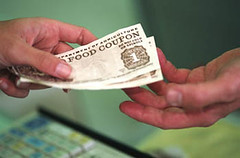
Poverty in America

Is this the land of milk and honey or a land of Greed?

poverty_foodstamps

Gentle Reader,

Let me take a break from telling you the truth about Christianity to tell you the truth about where I live . I am in the State of Indiana and while it's flat and smells like car exhaust it's as good a place to be from as where you live. Why? Because we have a common problem! Let me be specific . There is a new bill floating around our government called the "Farm Bill" part of it deals with the food stamp issue. Well let me rant about what is really going on in this country. (Like you didn't know already) 

It takes a hurricane. It takes a catastrophe like Katrina to strip away the old evasions, hypocrisies and not-so-benign neglect. It takes the sight of the United States with a big black eye—visible around the world—to help the rest of us begin to see again. For the moment, at least, are Americans are ready to fix their restless gaze on enduring problems of poverty, race and class that have escaped their attention? Does this mean a new war on poverty? No, especially with Katrina's gargantuan price tag. But this disaster may offer a chance to start a skirmish, or at least make Washington think harder about why part of the richest country on earth looks like the Third World.

"I hope we realize that the people of New Orleans weren't just abandoned during the hurricane," Sen.(now President) Barack Obama said two years ago on the floor of the Senate. "They were abandoned long ago—to murder and mayhem in the streets, to substandard schools, to dilapidated housing, to inadequate health care, to a pervasive sense of hopelessness."

The question now is whether the flood waters can create a sea change in public perceptions. "Americans tend to think of poor people as being responsible for their own economic woes," says sociologist Andrew Cherlin of Johns Hopkins University. "But this was a case where the poor were clearly not at fault. It was a reminder that we have a moral obligation to provide every American with a decent life."

In the last four decades, none of of that obligation has been met. Social Security and Medicare have not made or eliminated poverty among the elderly [not any longer they don't even try witness the inflated salaries of your elected officials and compair that with the fact that they don't even hide their disregard for your needs ] . Food stamps  (See the food stamp challenge a way to make you think that these politicians care) we don't need another election where its politics as usual we need Statesmen NOT politicians have made severe hunger in the United States mostly a thing of the past [that’s way we go to bed hungry each night]. A little-known program with bipartisan support and a boring name—the Earned Income Tax Credit—supplements doesn’t help the puny wages of the working poor, help to lift millions into the lower middle class.

But after a decade of improvement in the 1990s, poverty in America is actually getting worse. A rising tide of economic growth is no longer lifting all boats. For the first time in half a century, the third year of a recovery (2004) also saw an increase in poverty. In a nation of nearly 300 million people, the number living below the poverty line ($14,680 for a family of three) recently hit 37 million, up more than a million in a year.

The food stamp challenge is another example to the rich trying to identify with the poor. Gentle reader, let’s face it America has lost it’s moral fiber and has totally disregarded the poor in America. It’s time to take back what was stolen from us, our rights

 Just my opinion,

Denis

Beggar

When "Junk" DNA" isn't "Junk"

darwin_jesus

In the Darwinist repertoire, a standard response to evidence of design in the genome is to point to the existence of “junk DNA.” What is it doing there, if purposeful design really is detectable in the history of life’s development? Of course this assumes that the “junk” really is junk. That assumption has been cast increasingly into doubt. New research just out in the journal Nature Genetics finds evidence that genetic elements previously thought of as rubbish are anything but that. The research describes tiny strands of RNA, previously thought to be junk, that now turn out to play a role in gene expression. Another finding by Dr. Geoff Faulkner shows that “retrotransposons,” a further variety of “junk” as the dogma previously taught, play a similar role.

Nearly half of the mammalian genome (less than 45 percent) is comprised of DNA sequences thought for decades to be but evolutionary flotsam and jetsam or junk: retrotransposons. Found along every one of our chromosomes, retrotransposons mobilize within our cells via RNA copies, copies that are then converted into DNA and afterward pasted into different DNA sites. To be sure, the vast majority of these “jumping gene” duplicates, well over a million elements, appear to be little more than pseudogenes, defective images of master templates that merely drift by mutations into a phylogenetic oblivion.

Retrotransposons appear to fit the neo-Darwinian story perfectly. First, the master templates of these elements seem to serve no other purpose than to promote their own replication at the expense of the cell, and so, by the criteria of Richard Dawkins’s 1976 book The Selfish Gene, retrotransposons are selfish genes par excellence. Second, the DNA progeny of such “endogenous viruses” are without a doubt marred in various ways, as just mentioned. Relative to the original, in other words, they are junk. Third, a retrotransposon inserted into a chromosome can disrupt normal gene functions, and mutations due to these sequences have long been detected. Fourth, only a comparative few retrotransposons are conserved across different groups of mammals, with most of the DNA families being restricted to certain families, genera, or even species. Humans and mice as well as mice and rats can readily be separated solely on the basis of their retrotransposon profiles. So the bulk of these sequences do not merit being retained by natural selection.

With such facts at hand, it is no wonder that retrotransposons and other “non-coding” DNAs are part of Exhibit A on the side of the neo-Darwinian prosecution, over and against the intelligent design defense.

But there have always been big holes in this tale of selfish, junk DNA. We have known since the late 1980s that retrotransposons are distributed non-randomly along chromosomes. Even though humans and mice and rats have different families of these sequences — ultimately a reflection, according to neo-Darwinists, of randomness — the linear pattern of placement of the elements is uncannily similar. Likewise, data accumulated throughout the ’80s and ’90s which indicated that normal gene regulation can be controlled by pieces of such mobile DNA. Evidence for other diverse regulatory roles of retrotransposons has also continued to mount till the present.

But it wasn’t until recently that we learned just how extensive is the informational impact of retrotransposons on the mammalian genome. The recent study by Geoffrey Faulkner et al. (2009) is only the latest. Using the RNA expression profiles of the human and mouse genomes as a backdrop, a number of key facts were uncovered. For one thing, tens to hundreds of thousands of transcription start sites — the beginning points of RNA transcripts — occur in retrotransposons. According to the data they gathered, anywhere from 6 to 30 percent of RNAs in the two species arise from repetitive (aka “junk”) DNA. For another, elements that reside in or near protein-coding genes provide alternative regions to initiate transcription, many previously unknown, and they allow for the production of various non-translated RNAs. The “start RNA production” signals conveyed by retrotransposons such as the mouse-specific VL30 retrovirus-like sequences are also markedly tissue-specific. Altogether, the results point to retrotransposons being “intrinsic components of the transcription forest regions of the genome” (Faulkner et al., 2009).

This is all rather awkward for the Darwinian side, obviously. Another standard weapon in their armory is to charge intelligent-design theorists with making a “God of the gaps” argument, where gaps in scientific knowledge are assumed to be evidence of design. The reality is that the case for Darwinian evolution is much more reasonably shown to depend on gaps — in our knowledge of what “junk DNA” does, for one thing. Hence a sobriquet for the view that evolutionists are saddled with defending: “Darwin of the gaps.”