skip to main |
skip to sidebar
 My Child,
You think that that I don't care about what goes on in your life. You think that I am just "The Man upstairs" or "The Big Guy" that I don't exist. How wrong you are! I do exist and I do care. You see I was planning your life long before you were born, long before time was begun. I knew you, I made you with all of your weakness so that you would need Me. I brought friends neighbors and yes, ever strangers into your life to help you along your journey called life. I am next to you even now wanting to help you. All you have to do is call out to me and before you finish calling I will answer. I am your heavenly Father and I love you.
To show your love for Me, love others,
God
How the world's most famous Christmas carol came to be writtenWhile we were serving as missionaries in Europe we visited a small little church in Austria. That church was the birthplace of "Silent Night." Here's the story how this most famous of Christmas carols came to be written:
In 1818, a roving band of actors was performing in towns throughout the Austrian Alps. On December 23 they arrived at Oberndorf, a village near Salzburg where they were scheduled to perform the story of Christ's birth in the Church of St. Nicholas.
Unfortunately, the St. Nicholas' church organ wasn't working and would not be repaired before Christmas. (Note: some versions of the story point to mice as the problem; others say rust was the culprit) Because the church organ was out of commission, the actors presented their Christmas drama in a private home. That Christmas presentation put assistant pastor Josef Mohr in a meditative mood. So, instead of walking straight to his house, Mohr took a longer way home. His path took him up over a hill overlooking the village.
From that hilltop, Mohr looked down on the peaceful snow-covered village. Reveling in the wintry night's majestic silence, he gazed down at the glowing scene. His thoughts about the Christmas play he had just seen reminded him of a poem he had written a couple of years earlier. The poem about the night when angels announced the birth of the long-awaited Messiah to shepherds on a hillside.
Mohr decided those words would make a good carol for his church to sing the following evening at their Christmas eve service. However, he didn't have any music to which that poem could be sung. So, the next day Mohr went to see the church organist, Franz Xaver Gruber. Although he only had a few hours to come up with something, by that evening, Gruber had composed a musical setting for Mohr's poem which could be sung with a guitar (since the organ was broken).
On Christmas Eve, the little Oberndorf congregation heard Gruber and Mohr sing their new composition to the accompaniment of Gruber's guitar.
Weeks later, well-known organ builder Karl Mauracher arrived to fix the St. Nicholas church organ. When he finished, Mauracher stepped back to let Gruber test the instrument. When Gruber sat down, he began playing the melody he had written for Mohr's Christmas poem. Deeply impressed, Mauracher took the music and words of "Silent Night" back to his own Alpine village, Kapfing. There, two well-known families of singers -- the Rainers and the Strassers -- heard it. Captivated by "Silent Night," both groups put the new song into their Christmas season repertoire.
Silent night! holy night!
All is calm, all is bright,
'Round yon virgin mother and Child!
Holy Infant, so tender and mild,
Sleep in heavenly peace,
Sleep in heavenly peace.
The Strasser sisters spread the carol throughout northern Europe. In 1834, after they had performed "Silent Night" for King Frederick William IV of Prussia, that king ordered his cathedral choir to sing it every Christmas eve.
The Rainers brought the song to the United States in 1839, singing it (in German) at the Alexander Hamilton Monument located outside New York City's Trinity Church.
In 1863, nearly fifty years after being written in German, "Silent Night" was translated into English (by either Jane Campbell or John Young). In 1871 the English version was published in an American hymnal: Charles Hutchins' Sunday School
There was a poor woodcutter who worked hard to make his ends meet and earn his earned his daily bread. He had a loving wife and two lovely children called Valentine and Marie. All of them helped him in his work, were obedient to him and pious in nature. They would daily read the Bible over the table, even if they had only a small loaf of bread to eat. Once, when they were going through this particular daily ritual, somebody knocked on the window. It was a little child suffering from cold and hunger. They pitied him and immediately took him inside their small home. Both the children offered him a place near the fire to keep him warm and a portion of their bread. Since, he seemed very tired too, they offered him their bed too while they slept on the bench in great discomfort all through the night.
The stranger child thanked them for their kindness and soon fell asleep while they prayed for the poor child who did not even have the nice warm room and the comfortable bed that they had. They could only fall asleep late at night but the little Marie was woken up in the wee hours of the morning by sweet musical sound of harps and singing that seemed almost divine. She gently woke up his brother Valentine and together they listened to the notes, which told them that it was the angels singing for the Christ Child, the child they had played host to a day before. Their hearts leapt with happiness and when they looked through te window to see the beautiful dawn and a number of little children holding golden harps and lutes dressed in sparkling silver robes.
They turned around to see the stranger Child standing behind them wearing golden robes and a golden crown. He told them that he was indeed the Christ Child and wandered about to give good things and joys to king and loving children. Since they had been so unselfish and helpful, he gave them his blessing and took a bough from a nearby fir tree and planted it in the ground. He then told them, that this branch would soon grow up in a tree and bear them Christmas fruits every year. The Christ Child then vanished leaving the children overwhelmed with what they had seen and heard. Soon the fir branch grew into a high and stately Christmas tree that bore golden apples, silver nuts and lovely toys on every Christmas Eve. It is in remembrance and anticipation of the Christ Child that the Christmas tree is decorated every year.
You think our kids are all fluff? Read on. While in middle school, students seem to have one goal: to be popular. More than anything, most of the students fervently hope to not be accused of going against the grain. These young teenagers would much rather conform and be accepted by the "in" crowd than focus on finding their own identity, style or path. Like most thirteen-year-olds, I succumbed to this need to fit in. One afternoon, however, I had a conversation with my father that made me think twice about following the rest of the lemmings over the proverbial cliff.
My dad and I were sitting in the dining area of the local Dairy Queen eating Blizzards on a dreary winter afternoon. We had run the gambit of usual conversation topics: school, orchestra, my plans for the weekend. Then, and I'm not quite sure how the discussion began, we started talking about popularity. I told him that I wanted to be popular, or at least accepted favorably by those who were. He looked at me and asked me why I felt that way. I shrugged my shoulders and looked back into my drink. I had never stopped to think about why I felt the need to fit in . . . I simply did. I had been told by my friends that I should want to be popular, and since I had always trusted them, I was inclined to believe them.
My father proceeded to tell me a story from his college days. His mother, my grandmother Lorraine, had made him several sweater vests to wear at school. These sweater vests were practical and comfortable, but hardly "in style." Nevertheless, they became a staple of my father's wardrobe. He didn't care that he wasn't sporting the latest fashion. In fact, he didn't care what everyone thought of him, either. I was shocked. What was even more surprising was that after a few weeks, other students at my dad's school began wearing sweater vests. By deviating from the norm, my father had started a trend. What he wore became fashionable because the other students saw the confidence with which he dressed.
This information was a lot for a thirteen-year-old girl to process, especially one who had been carefully taught about what was "cool" and what was most certainly not cool. I found it hard to believe that going against the grain could have benefits for me, so I continued to wear the same clothes, listen to the same music and go to the same places that my peers did. Surely my father was mistaken. This is also, of course, the stage in which children think they know infinitely more than their parents. I had not yet seen the light, and I continued on my quest for popularity. However, our conversation that bleak winter day replayed over and over in my mind.
As the days passed and I mulled it over, I realized that my father's words might have some validity after all. I began to evaluate my wardrobe to find which items I had bought because they were cool and which items I'd bought because I truly liked them. I also looked back at my actions, attempting to determine how many of them I performed to please the crowd and how many of them I performed because I actually enjoyed them. I found myself caring less and less what people thought about me. It was wonderfully liberating.
I have come a long way since middle school. It no longer bothers me that those who still feel compelled to follow the herd do not accept me as one of their own. I do not strive to dress in the latest fashions; if anything, I attempt to create my own. The conversation I had with my father about wearing sweater vests and feeling the need to fit in sparked in me the desire to deviate from the beaten path and form one of my own. I have learned a valuable lesson in the process: Swimming against the current can only make me stronger.By Ester Sooter, Age 16
 ONCE, BEFORE THE FOUNDATION OF THE
W O R L D,
Jesus and His Father had a conversation about the great plan of redemptiom. That conversation included you.
Jesus looked down the corridors of time and knew that you would be born.
He saw your needs for Him when He said to the Father "I will go" . At the Father's appointed time, Jesus came
He was The great plan of redemption, so that you would never need to be far from Him.
What an incredible journey He made; what an overwhelming expression of love He made; what an awesome purpose He had in mind.
Your were on His HEART When He left His home in heaven, He saw you
when He became a man on earth, He was seeking you; when He streched His hands upon the cross, He
was reaching out to you, when He returned to the Father.
He was preparing a place for you. You are His sheep He has come to shepherd, to guide, to feed, to
protect, to shelter, and to carry. You are the one He calls His own.
In this time of Birthday celebration may you also sense His celebration over you.
 "He gave His only-begotten Son."- John 3: 16.
We have reached December. Christmas draws near again, with all its tender associations and mighty meaning. Over against the saddening spectacle of our war-scarred, sinstrangled, twentieth-century world, let us reflect again, with simple-hearted gratitude, on the wonder of wonders, in the text of texts, John 3: 16.
"He gave His only-begotten Son." The measure of love is always its willingness to give; its capacity for sacrifice. If we would measure the
love of God, we must measure it by Calvary. Someone has thus written of love:
Love ever gives, forgives, outlives; And ever' stands with open hands;
And while it lives it gives;
For while it gives it lives;
And this is Love's prerogative
To give-and give-and give.
This is certainly true of the love of God. It is revealed in its giving, and is thus seen to be beyond all measure. We can never know the costliness of Calvary to God, nor can we ever measure the love that lay behind it. AIl we can do is to fall back on that elastic particle, "so":
God so loved. . . that He gave His only-begotten Son."
This we know: such is the oneness of the Father and the Son, that, in giving the Son, the Father gave Himself; for" God was in Christ, reconciling the world unto Himself" (2 Cor. 5: 19).
The Lord Jesus is not merely an agent through whom God sends the message that He loves us. He is God Himself actually come to earth loving us. He does not merely declare or expound the love of God: He is the love of God incarnate.
What adverbs we may unite with that particle "so"! God so loved" -so fully, so freely, so sublimely. But when we proceed to the counterpart of that particle" so", in the words, "that He gave His only-begotten Son ", and when we reflect on the mysterious fact that the Father gave up the eternal Son, not only to the fathomless woe of Calvary, but to the incorporating of our human nature itself into His divine being, by a real human birth, so that He is now the Son of Man for evermore, as well as God the Son, we can only exclaim, "God loved so unutterably. .." Language indeed breaks down. We are lost in wonder, love and praise.
Yes, Christmas draws near again. In our thinking of it, we must never isolate Bethehem from Golgotha. or the Cradle from the Cross. Apart from the Incarnation there never could have been the Atonement; and apart from the Atonement there never would have been the Incarnation; and apart from the infinite love of God there neither could nor would have been either. Orion and Pleiades may be wonderful to us, in their flaming magnificence and immensity; but the greatest thing we know about the Creator is just this: "God so loved. . . that He gave His only begotten Son."
 About a week before Christmas, Mom bought a new nativity scene. When
she unpacked it, she found two figures of the Baby Jesus. "Someone must
have packed this wrong," mother said, counting out the figures. "We have
one Joseph, one Mary, three wise men, three shepherds, two lambs, a
donkey, a cow, an angel, and two babies. Oh, dear! I suppose some set down at
the store is missing a Baby Jesus because we have two."
"You two run back down to the store and tell the manager that we
have an extra Jesus. Tell him to put a sign on the remaining boxes saying
that if a set is missing a Baby Jesus, call 7126. Put on your warm coats, it's
freezing cold out there." The manager of the store copied down
mother's message, and the next time we were in the store, we saw the
cardboard sign that read, "If you're missing Baby Jesus, call 7126." All week long
we waited for someone to call. Surely, we thought, someone was missing
that important figurine.
Each time the phone rang, mother would say, "I'll bet that's about
Jesus." But it never was. Father tried to explain there are thousands of
these scattered over the country, and the figurine could be missing from a
set in Florida or Texas or California. Those packing mistakes happen all
the time. He suggested that she just put the extra Jesus back in the box and
forget about it. "Put Baby Jesus back in the box?! What a terrible thing to
do," said mother. "Surely someone will call. We'll just keep the two of
them together in the manger until someone does."
When no call had come by 5:00 on Christmas Eve, mother insisted that
father "just run down to the store" to see if there were any sets left.
"You can see them right through the window, over on the counter," she said.
"If they are all gone, I'll know someone is bound to call tonight." "Run down
to the store?" father thundered. "It's 15 below zero out there!" "Oh,
Daddy, we'll go with you!"
We began to put on our coats. Father gave a long sigh and headed for
the front closet. "I can't believe I'm doing this," he muttered. We ran
ahead as father reluctantly walked out in the cold. Tommy got to the store
first and pressed his nose up to the store window. "They're all gone, Daddy,"
he shouted. "Every set must be sold. Hooray! The mystery will be solved
tonight!" Father heard the news still a half block away and
immediately turned on his heel and headed back home.
When we got back into the house, we noticed that mother was gone and
so was the extra Baby Jesus figurine. "Someone must have called, and she
went out to deliver the figurine," father reasoned, pulling off his boots.
"You kids get ready for bed while I wrap mother's present."
Then the phone rang. Father yelled "answer the phone and tell 'em we
found a home for Jesus." But it was mother calling with instructions for us
to come to 205 Chestnut Street immediately, and bring three blankets, a box
of cookies and some milk. "Now what has she gotten us into?" father
groaned as we bundled up again. "205 Chestnut. Why that's across town. Wrap
that milk up good in the blankets, or it will turn to ice before we get there.
Why can't we all just get on with Christmas? It's probably 20 below out
there now. And the wind is picking up. Of all the crazy things to do on a
night like this."
When we got to the house at 205 Chestnut Street, it was the darkest
one on the block. Only one tiny light burned in the living room, and the
moment we set foot on the porch steps, mother opened the door and shouted,
"They're here! Oh thank God you got here, Ray! You kids take those blankets
into the living room and wrap up the little ones on the couch. I'll take the
milk and cookies."
"Would you mind telling me what is going on, Ethel?" father asked.
"We have just walked through below zero weather with the wind in our faces
all the way."
"Never mind all that now," mother interrupted. "There is no heat in
this house, and this young mother is so upset, she doesn't know what to
do. Her husband walked out on her, and those poor little children will have
a very bleak Christmas, so don't you complain. I told her you could fix
that oil furnace in a jiffy. My mother strode off to the kitchen to warm the
milk while my brother and I wrapped up the five little children who were
huddled together on the couch.
The children's mother explained to my father that her husband had
run off, taking bedding, clothing, and almost every piece of furniture, but
she had been doing all right until the furnace broke down. "I been doin'
washin' an ironin' for people and cleanin' the five and dime," she said. "I saw
your number every day there, on those boxes on the counter. When the
furnace went out, that number kept goin' through my mind....7162, "Said on the
box that if a person was missin' Jesus, they should call you. That's how I
knew you were good Christian people, willin' to help folks. I figured that
maybe you would help me, too. So I stopped at the grocery store tonight, and I
called your missus. I'm not missin' Jesus, mister, because I sure love the
Lord. But I am missin' heat. I have no money to fix that furnace."
"Okay, okay," said father. "You've come to the right place. Now
let's see.You've got a little oil burner over there in the dining room.
Shouldn't be too hard to fix. Probably just a clogged flue. I'll look it over,
see what it needs."
Mother came into the living room carrying a plate of cookies and
warm milk. As she set the cups down on the coffee table, I noticed the figure
of Baby Jesus lying in the center of the table. It was the only sign of
Christmas in the house. The children stared wide-eyed with wonder at the plate of
cookies my mother set before them.
Father finally got the oil burner working but said, "You need more
oil. I'll make a few calls tonight and get some oil. Yes sir, you came to the
right place." Father grinned. On the way home, father did not complain
about the cold weather and had barely set foot inside the door when he was on
the phone. "Ed, hey, how are ya, Ed? Yes, Merry Christmas to you, too.
Say Ed, we have kind of an unusual situation here. I know you've got that
pick-up truck. Do you still have some oil in that barrel on your truck? You
do?" By this time the rest of the family was pulling clothes out of their
closets and toys off of their shelves. It was long after our bedtime when we
were wrapping gifts.
The pickup came. On it were chairs, three lamps, blankets and gifts.
Even though it was 30 below, father let us ride along in the back of the
truck. No one ever did call about the missing figure in the nativity set,
but as I grow older I realize that it wasn't a packing mistake at all. Jesus
saves, that's what He does.
 I said a Christmas prayer for you
Because the season's near
I didn't ask for riches
But for gifts so much more dear.
I asked for joyful gatherings
With your family all around
And for carols to inspire you
With their old familiar sound.
I asked for quiet moments
In your heart on Christmas morn
For a special time to celebrate
The Savior who was born.
I asked for friends to send their best
That you might know they care
I asked for peace and love and hope
And I know God heard my prayer.
 A wealthy man and his son loved to collect rare works of art. They had everything in their collection, from Picasso to Raphael. They would often sit together and admire the great works of art.
When the Viet Nam conflict broke out, the son went to war. He was very courageous and died in battle while rescuing another soldier. The father was notified and grieved deeply for his only son.
About a month later, just before Christmas, there was a knock at the door. A young man stood at the door with a large package in his hands. He said, "Sir, you don't know me, but I am the soldier for whom your son gave his life. He saved many lives that day, and he was carrying me to safety when a bullet struck him in the heart and he died instantly. He often talked about you, and your love for art. The young man held out his package. "I know this isn't much. I'm not really a great artist, but I think your son would have wanted you to have this." The father opened the package. It was a portrait of his son, painted by the young man. He stared in awe at the way the soldier had captured the personality of his son in the painting. The father was so drawn to the eyes that his own eyes welled up with tears. He thanked the young man and offered to pay him for the picture. "Oh, no sir, I could never repay what your son did for me. It's a gift." The father hung the portrait over his mantle. Every time visitors came to his home he took them to see the portrait of his son before he showed them any of the other great works he had collected.
The man died a few months later. There was to be a great auction of his paintings.
Many influential people gathered, excited over seeing the great paintings and having an opportunity to purchase one for their collection. On the platform sat the painting of the son. The auctioneer pounded his gavel.
"We will start the bidding with this picture of the son. Who will bid for this picture?" There was silence. Then a voice in the back of the room shouted. "We want to see the famous paintings. Skip this one." But the auctioneer persisted. "Will someone bid for this painting? Who will start the bidding? $100, $200?" Another voice shouted angrily. "We didn't come to see this painting. We came to see the Van Goghs, the Rembrandts. Get on with the real bids!"
But still the auctioneer continued. "The son! The son! Who'll take the son?" Finally, a voice came from the very back of the room. It was the longtime gardener of the man and his son. "I'll give $10 for the painting." Being a poor man, it was all he could afford. "We have $10, who will bid $20?" "Give it to him for $10. Let's see the masters." "$10 is the bid, won't someone bid $20?" The crowd was becoming angry. They didn't want the picture of the son. They wanted the more worthy investments for their collections. The auctioneer pounded the gavel. "Going once, twice, SOLD for $10!"
A man sitting on the second row shouted. "Now let's get on with the collection!"
The auctioneer laid down his gavel. "I'm sorry, the auction is over."
"What about the paintings?"
"I am sorry. When I was called to conduct this auction, I was told of a secret stipulation in the will. I was not allowed to reveal that stipulation until this time.
Only the painting of the son would be auctioned. Whoever bought that painting would inherit the entire estate, including the paintings. The man who took the son gets everything!"
God gave His son 2,000 years ago to die on a cruel cross. Much like the auctioneer, His message today is, "The son, the son, who'll take the son?"
Because, you see, whoever takes the Son gets everything.
--author unknown

It begins with the king as a boy, having to spend the night alone in the forest to prove his courage so he can become king.
Now while he is spending the night alone he's visited by a sacred vision. Out of the fire appears the holy grail, symbol of God's divine grace. And a voice said to the boy,
"You shall be keeper of the grail so that it may heal the hearts of men."
But the boy was blinded by greater visions of a life filled with power and glory and beauty.
And in this state of radical amazement he felt for a brief moment not like a boy, but invincible, like God,
... so he reached into the fire to take the grail,
... and the grail vanished,
... leaving him with his hand in the fire to be terribly wounded.
Now as this boy grew older, his wound grew deeper.
Until one day, life for him lost its reason. ... He had no faith in any man, not even himself.
... He couldn't love or feel loved.
... He was sick with experience.
He began to die.
One day a fool wandered into the castle and found the king alone. And being a fool, he was simple minded, he didn't see a king. He only saw a man alone and in pain. And he asked the king,
"What ails you friend?"
The king replied,
"I'm thirsty. I need some water to cool my throat".
So the fool took a cup from beside his bed, filled it with water and handed it to the king.
As the king began to drink, he realized his wound was healed. He looked in his hands and there was the holy grail, that which he sought all of his life. And he turned to the fool and said with amazement,
"How can you find that which my brightest and bravest could not?"
And the fool replied,
"I don't know. I only knew that you were thirsty."
 WISE MEN STILL SEEK HIM
The men slowly made their way toward Bethlehem under the clear Judean sky. Their clothing had an Eastern Oriental design and their camels were laden down with treasures they had brought from afar. Their eyes twinkled with excitement as they anxiously watched the skies for a sign. Then... there it was! A star--brighter than any other in the sky! The same star they had first seen in their home country in the Far East...the same star they had been following for weeks... and there it was again--hovering over the small town of Bethlehem. The men quickened their pace as their anticipation grew. They talked and wondered about the baby they would find in this small town--the one whose birth had caused a new star to shine in the night sky. As they drew nearer, the star suddenly stopped...right over a stable near a local inn. The wise men stopped also--wondering if there had been some mistake. As they stood watching the star, a baby's cry suddenly pierced the silence. The men looked at each other and then, with an expectant nod, the first one entered the stable. What had brought these wise men from their Far East home in search of -- a baby?!
The wise men had finally reached their destination...and they bowed down and worshipped Jesus because they knew who He was and why He came! Together with Mary and Joseph, they had the first baby shower...and they gave Jesus three gifts--each with its own special meaning:
Gold was the money of kings and was worth about $600 a pound.
Frankincense was found in Southern Arabia, Ethiopia, and Egypt. It is a sticky, white gum taken from the Bozwalia Carteri Tree. When the tree's bark is cut, it covers the tree in clear lumps the size of hens eggs that can be burned as incense. The word "frank" means clear or strong, hence the word "frankincense." It has a strong, sweet odor and was also used as an antiseptic to heal open cuts, to fight bacteria and infections. It was good for Bronchitis and lung infections, it could be chewed as a gum to fight bad breath and tooth decay...and it was worth about $500 a pound. The trees were so sacred that the farmers who grew them were told to keep themselves pure from sin...especially while harvesting the Frankincense. It is mentioned 15 times in the Old Testament and in Revelation 8:4 it says, "And the smoke of the incense, which came with the prayers of the saints, ascended up before God out of the angel's hand." Burning Frankincense was a reminder to the people of how their prayers reached God and how sweet they smell to Him. Now, that's enough to make you rethink your prayer life, isn't it?
Myrrh is a reddish-brown gum from the bark of the Cammaforah Myrrh Tree and is found in Somalia, Africa, and Yemen. It has a spicy, oriental scent. Kings owned all of the Myrrh trees and closely guarded them. It was also used in incense, to cure fevers, diarrhea, asthma, and could be put on open wounds as an antiseptic. Because it was so hard to obtain, Myrrh was worth about $4,000 a pound. It is mentioned 17 times in the Bible: In Exodus 3, God told Moses to take Myrrh, mix it with other spices, and anoint Aaron and his sons as high priests and anoint everything in the temple. And when kings were buried, they used 15 pounds of Myrrh to wrap them with to keep the body from stinking. John 19:39,40 tells us that after Jesus had died, Joseph of Arimathaea and "Nicodemus came...and brought a mixture of myrrh and aloes, about an hundred pound weight. Then took they the body of Jesus, and wound it in linen clothes with the spices, as the manner of the Jews is to bury." Remember that Myrrh was worth about $4,000 a pound and they brought 100 pounds to wrap Jesus with!
Someone asked me if Nicodemus ever believed that Jesus was the Messiah. Well, I believe he did... because I know I would never spend $400,000 of my hard earned money to bury someone if I thought he was a false prophet! And if it was customary to use 15 pounds of Myrrh to wrap a king's body, and Nicodemus used 100 pounds to wrap Jesus' body...that shows me that Nicodemus not only believed that Jesus was king of the Jews but also the King of Kings!
Jesus received three gifts for his birthday: Gold as a symbol of a king, Frankincense as a symbol of the prayers of the people being answered, and Myrrh as a symbol of our High Priest.
Gerntle Reader, if you are unsure about where you stand in God's eyes, then I want to invite you to pray this simple prayer right now: "Jesus, I'm afraid and unsure about my life. At times my life doesn't make any sense and I'm searching for answers. I believe that you have what I'm looking for. So I'm going to trust you with my life, my future, and my soul. I ask you to forgive me for the sins and mistakes that I've made. I believe that you died on the cross for me...that you took the shame and the blame for my mistakes and failures upon yourself so that I wouldn't have to pay the penalty for my sin. Thank you for giving me eternal life! Now, give me peace concerning my future and all that it holds. Amen."If in your hearts of hearts you ask Jesus the Christ Child to Change your life and save you from past then rest assured Dear One He did just that. Call and tell someone what you did. Find a Bible believing church and talk to the Minister about the truth that I just shared!
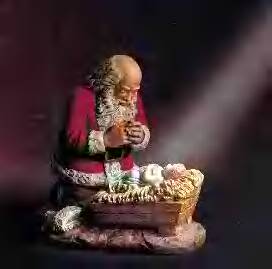 Late one Christmas Eve, I sank back, tired, but content, into my easy chair. The kids were in bed, the gifts were wrapped, the milk and cookies waited by the fireplace for Santa. As I sat back admiring the tree with its decorations, I couldn't help feeling that something important was missing. It wasn't long before the tiny twinkling tree lights lulled me to sleep. I don't know how long I slept, but all of a sudden I knew that I wasn't alone. I opened my eyes, and you can imagine my surprise when I saw Santa Claus, himself, standing next to my Christmas tree. He was dressed all in fur from his head to his foot just as the poem described him, but he was not the "jolly old elf" of Christmas legend. The man who stood before me looked sad and disappointed. And there were tears in his eyes.
"Santa, what's wrong?" I asked, "Why are you crying?"
"It's the children," Santa replied sadly.
"But Santa, the children love you," I said.
"Oh, I know they love me, and they love the gifts I bring them," Santa said, "but the children of today seem to have somehow missed out on the true spirit of Christmas. It's not their fault. It's just that the adults, many of them not having been taught themselves, have forgotten to teach the children."
"Teach them what?" I asked.
Santa's kind old face became soft, more gentle. His eyes began to shine with something more than tears. He spoke softly. "Teach the children the true meaning of Christmas. Teach them that the part of Christmas we can see, hear, and touch is much more than meets the eye. Teach them the symbolism behind the customs and traditions of Christmas which we now observe. Teach them what it is they truly represent."
Santa reached into his bag and pulled out a tiny Christmas tree and set it on my mantle."Teach them about the Christmas tree. Green is the second color of Christmas. The stately evergreen, with its unchanging color, represents the hope of eternal life in Jesus. Its needles point heavenward as a reminder that mankind's thoughts should turn heavenward as well.
"Santa reached into his bag again and pulled out a shiny star and placed it at the top of the small tree. "The star was the heavenly sign of promise. God promised a Savior for the world and the star was the sign of the fulfillment of that promise on the night that Jesus Christ was born. Teach the children that God always fulfills His promises, and that wise men still seek Him."
"Red," said Santa, "is the first color of Christmas." "He pulled forth a red ornament for the tiny tree. Red is deep, intense, vivid. It is the color of the life-giving blood that flows through our veins. It is the symbol of God's greatest gift. Teach the children that Christ gave his life and shed his blood for them that they might have eternal life. When they see the color red, it should remind them of that most wonderful gift.
"Santa found a silver bell in his pack and placed it on the tree. "Just as lost sheep are guided to safety by the sound of the bell, it continues to ring today for all to be guided to the fold. Teach the children to follow the true Shepherd, who gave His life for the sheep."
Santa placed a candle on the mantle and lit it. The soft glow from its one tiny flame brightened the room. "The glow of the candle represents how people can show their thanks for the gift of God's son that Christmas Eve long ago. Teach the children to follow in Christ's footsteps...to go about doing good.
Teach them to let their light shine before people that all may see it and glorify God. This is what's symbolized when the twinkle lights shine on the tree like hundreds of bright shining lights, each of them representing one of God's precious children's light shining for all to see."
Again Santa reached into his bag and this time he brought forth a tiny red and white striped cane. As he hung it on the tree he spoke softly. "The candy cane is a stick of hard white candy. White to symbolize the virgin birth and sinless nature of Jesus, and hard to symbolize the Solid Rock, the foundation of the church, and the firmness of God's promises. The candy cane form's a"J" to represent the precious name of Jesus, who came to earth. It also represents the Good Shepherd's crook, which He uses to reach down into all ditches of the world to lift out thefallen lambs who, like all sheep, have gone astray. The original candy cane had three small red stripes, which are the stripes of the scourging Jesus received by which we are healed, and a large red stripe that represents the shed blood of Jesus, so that we can have the promise of eternal life. Teach these things to the children.
"Santa brought out a beautiful wreath made of fresh, fragrant greenery tied with a bright red bow. "The bow reminds us of the bond of perfection, which is love. The wreath embodies all the good things about Christmas for those with eyes to see and hearts to understand. It contains the colors of red and green and the heaven-turned needles of the evergreen. The bow tells the story of good will towards all and its color reminds us of Christ's sacrifice. Even its very shape is symbolic, representing eternity and the eternal nature of Christ's love. It is a circle, without beginning and without end. These are the things you must teach the children."
I asked, "But where does that leave you Santa?" The tears gone now from his eyes, a smile broke over Santa's face. "Why bless you, my dear," he laughed, "I'm only a symbol myself. I represent the spirit of family fun and the joy of giving and receiving. If the children are taught these other things, there is no danger that I'll ever be forgotten." "I think I'm beginning to understand." "That's why I came," said Santa. "You're an adult. If you don't teach the children these things, then who will?"
---Author Unknown
 Here is another tale to think about this Christmas!December was especially bleak; the weather was cold and dark, reflecting my feelings. I usually welcomed this time of year, savoring every minute of the holiday season, but this year it was different. Financial worries weighed heavy on my spirits, and my husband David worked grueling hours to make ends meet. There was always too much to do and too little time. Too many needs and too little money. Moreover, I had struggled with post-partum depression since the birth of my fourth child a few months before, and it made Christmastime especially tough. It seemed every glad carol and glittering ornament mocked my despair.
Thankfully, my children seemed unfazed by my less-than-jolly attitude. They carefully penned their letters to Santa and made red and green paper decorations for our spindly Christmas tree. I didn't want to spoil the holidays for them, yet I felt entirely justified in feeling sorry for myself.
Day after dreary day blurred together until suddenly it was Sunday, December 24. I was alone with the children, as David worked yet another Christmas Eve at the hospital. An empty sadness filled my heart as I dressed and readied my family for church, attending more out of habit and obligation than desire.
If I had expected some renewal from the service, it wasn't to be, and I couldn't wait for it to be over. Being in the presence of so many happy people was almost more than I could bear.
After herding the kids into the car, I charged homeward, anxious to finish the day's preparations. In my haste, I accidentally passed our usual turn-off. As we detoured down the unfamiliar street, I noticed an old man up ahead. He walked with a pronounced limp, and he struggled to carry a heavy grocery sack. Suddenly, inspiration overcame discretion--and going against caution and my better judgment--I pulled over.
"Hello," I called through the open passenger's side window. "Can we give you a lift somewhere?"
The stranger hesitated before answering, taking a long look at my kid-packed station wagon. "Sure," he said carefully.
After he settled into the backseat, I asked him where he would like to go.
"I don't know," he replied quietly. Before I could reply, my children had invited the shabby stranger to our house for dinner.
"I suppose you could come over until you figure something else out..." I muttered.
As we drove, I introduced myself and my children. Our passenger introduced himself simply as "Richard."
As it turned out, Richard truly was a stranger--just passing through town on his way to nowhere in particular. He lived wherever nightfall found him. All that he owned he carried in an overstuffed shopping bag.
Once home, my children had no trouble warming up to our visitor, but getting Richard to open up was like cracking a vault rusted shut by years of disuse. Yet, they persevered. They gathered around, asking him question after question, prodding and prying until his history and its neglected cache were slowly revealed to us.
We discovered that Richard had served in two wars, worked on the railroad, and hitchhiked across North America. He had lost his sweetheart and young son many years ago in the same accident that left him crippled. Afterward, he bounced around from job to job, and ended up homeless and fighting an addiction to alcohol.
This Christmas found Richard a physically and mentally broken man. Richard's hard life and years on the streets were reflected in his careworn face. His appearance was haggard and dirty. He coughed frequently and smelled faintly of whiskey.
And yet...my children saw none of this. They gathered around him, asking question after question. They listened eagerly and treated him with the familiarity of a long-lost relation. Where I had seen a pitiful stranger, my children saw a kindly old man. They saw in Richard a fellow human being who could love and be loved. They saw a friend.
When dinner was ready, Richard ate like he hadn't had a meal in days. I pretended not to notice when he tucked an extra piece of bread in his coat pocket. Afterward, I invited him to rest in the big recliner; he was sound asleep before the dishes were cleared. While he slept, I undertook the business of finding Richard a place to stay for the night. But who could I reach on Christmas Eve? Who would be available at this hour? As I had feared, the calls to each charity and agency were met with an answering machine or a terse "We're full."
When there seemed nothing else to do--save turn him out on the street--Richard became our guest for the night. Richard accepted the invitation and thanked us with the graciousness of a refined gentleman. He thanked me for the home-cooked meal, the pleasant company, and for the best sleep he'd had in years. Then he said good-bye to each child. It was a tender scene as they parted with their newfound friend.
Later, as I lay in my warm, comfortable bed, I contemplated Richard and his misfortunes. I was humbled as I recalled how that very morning I had been so pessimistic and ungrateful for my own abundant life.
My introspection was interrupted by quiet footsteps as my 6-year-old son appeared at the foot of my bed. "Mom, are you awake?"
"Yes, Jeffrey," I whispered.
"What if we hadn't given Richard a ride?" He asked pensively.
As a single shaft of moonlight parted the darkness of the room, illuminating my son's guileless face, I was filled with emotion. Then a lonely old man would have spent Christmas Eve cold and hungry, I thought, my eyes brimming with tears. And I said, "I guess we might never have known what a wonderful person he is." As I pulled my dear son close, the two of us shared a moment of eloquent silence, and I offered a voiceless prayer, Thank you, God, for sending us Richard
 This story came across my desk and I thought you might enjoy it. Is there a message? You decide! My wife and I had just finished the 150-mile trip home from our daughter's college. It was the first time in our lives that she would be gone for any length of time. We wondered how other people had survived it.
Later in bed, I thought of the time I started college. My father had driven me too. We rode in the farm truck. In the back was the trunk I had bought with money earned by pitching hay that summer. My mother had to stay behind to keep the cattle from getting into the crops. I, the fourth in a line of brothers, was the first to go away to college. My mother cried, and I cried; after we were out of sight of the farm, I began to feel jellylike and scared.
The truck was slow, and I was glad. I didn't want to get to the city too soon. I remembered how my father and I stopped by a stream and ate the sandwiches my mother had prepared.
My daughter's day was different, of course. We stopped at a classy roadside place and ordered fried chicken. Then we went to the dormitory, and my wife talked with the housemother. When she came back, she was wiping her eyes. It wasn't until we were passing through the next town that she discovered our daughter had forgotten to take out the portable radio and record player. I told her she should have put it in the trunk with the other things, not in the back seat.
Now I heard a sob beside me. I knew that my wife was thinking about the new kind of loneliness before us.
My father didn't let me stay at the dormitory. A room in a private home was cheaper and better if a student wanted to work his way through. But I didn't have a room. My father told me that we'd leave my trunk at a filling station. I could come for it the next day after I had found a place to stay. We toured the town a bit, but the traffic confused him. I said maybe I'd better go on my own.
I shook hands with my father in the truck. For a long, haunting moment he looked straight ahead, not saying a word, but I knew he was going to make a little speech. "I can't tell you nothing," he finally said. "I never went to college, and none of your brothers went to college. I can't say don't do this and do that, because everything is different and I don't know what is going to come up. I can't help you much with money either, but I think things will work out."
He gave me a brand-new checkbook. "If things get pushing, write a small check. But when you write one, send me a letter and let me know how much. There are some things we can always sell." In four years, the total of all the checks I wrote was less than a thousand dollars. My jobs chauffeuring a rich lady, janitoring at the library, reading to a blind student and baby-sitting professors' kids filled in the financial gaps.
"You know what you want to be, and they'll tell you what to take," my father continued. "When you get a job, be sure it's honest and work hard." I knew that soon I would be alone in the big town, and I would be missing the furrowed ground, cool breezes and a life where your thinking was done for you.
Then my dad reached down beside his seat and brought out the old, dingy Bible that he had read so often, the one he used when he wanted to look something up in a friendly argument with one of the neighbors. I knew he would miss it. I also knew, though, that I must take it.
He didn't tell me to read it every morning. He just said, "This can help you if you will let it."
Did it help? I got through college without being a burden on my family. I have had a good earning capacity ever since.
When I finished school, I took the Bible back to my father, but he said he wanted me to keep it. "You will have a kid in school some day," he told me. "Let the first one take that Bible along."
Now, too late, I remember. It would have been so nice to have given it to my daughter when she got out of the car. But I didn't. Things were different. I was prosperous and my father wasn't. I had gone places. I could give her everything. My father could give me only a battered, old Bible. I'd been able to give my daughter what she needed.
Or had I? I don't really believe now that I gave her half as much as my father gave me. So the next morning I wrapped up the book and sent it to her. I wrote a note. "This can help you," I penned, "if you will let it."
 Here is what we talked about...."And God Said No"
I asked God to take away my pride,
And God Said, "No."
He said, "It is not for Me to take away,
But for you to give up."
I asked God to make my handicapped child whole,
And God said, "No."
He said, "Her spirit is whole,
Her body is only temporary."
I asked God to grant me patience,
And God said, "No."
He said, "Patience is a byproduct of tribulation,
It isn't granted, it's earned."
I asked God to give me happiness,
And God said, "No."
He said, "I give blessings,
Happiness is up to you."
I asked God to spare me pain,
And God said, "No."
He said. "Pain tells Me what to heal,
And brings You closer to Me."
I asked God to make my spirit grow.
And God said, "No."
He said, "You must learn how to grow,
And I will prune you to make you fruitful when you ask."
I asked God to help me love others,
As much as He loves me,
And God said,
"Ah finally,
You have the idea."
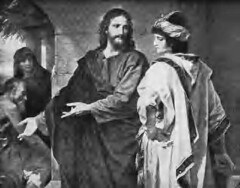 "How often would I . . . and ye would not!"-
Luke 13: 34
Look once again at the sad words of our text. The saddest of all refusals is a direct refusal of the divine love which came down to this earth in the person of the meek and lowly Jesus.
Love came down at Christmas,
Love all lovely ; Love divine.
Yes, "Love came down at Christmas." Love walked and talked with us, up and down the lanes of Galilee and Judaea. Love grieved and bled and broke its heart in agonising expiation for us, on Calvary! In Jesus, the incarnate Son of God, the divine love has clothed itself in visible sublimity. "The Word became flesh, and dwelt among us; and we beheld His glory . . . full of grace and truth."
In Jesus, God looks on us through human eyes, beckons' to us with human hands, calls to us through human lips, walks toward us with human feet over life's troubled sea, sympathises with us through human susceptibilities, and feels after us with a divine love which now beats through a human heart!
God's thoughts are love, and Jesus is
The loving voice they find.
His life lights up the vast abyss
Of the eternal Mind.
Who can sound the deeps of that fathomless sob, "Ob, Jerusalem, Jerusalem. . . how often would I have gathered thy children together as a hen gathers her brood under her wings, and ye mould not!" Yet even that sad refusal was not as ungrateful as the refusal of many a heart today; for when Jesus wept over Jerusalem He had not yet gone to the crowning expression of divine love on Calvary. As we have said before, to those. of us who live on this side of Calvary, the greatest sin is no longer that of transgressing the commanding law sent down through the venerable Moses, but the refusing of the redeeming love poured out through the crucified Saviour. Through the Cross, not only does salvation from eternal Gehenna come to believers, but there draws near to us in its sublimest, tenderest, most appealing way, the kingdom of heaven, the kingdom of love, the kingdom of Jesus.
How can men refuse? Yet they do! And then. what? They know they cannot be neutral, so they build false little kingdoms of their own-little kingdoms of intellectuality. personal superiority. religion, phllosophy, pleasure, angry resentment. Or they drive conscious refusal of Christ down into the vaults of the sub-conscious. thinking it Will die in the dark; and then, when they gradually become insensitive to Christ, they think it a sign of strength, when all the time it is the weakness of a mind cowering away from reality; a chronic mental state of cowardly refusal brought on by successive acts of refusal.
It is a morbid thickening of the mind's "outer skin", not protecting it, but cutting it off from the one true kingdom of light and health. Let us say a big. eager "YES" to Jesus, now and always!
Walking The Road of Uncertainty...
Who wants to travel down lonely roads,
Or encounter heartaches along the way?
Who wants to be brought to their knees,
Or reach the point of brokeness - and NEED to pray?
Who wants to reflect on past hurts
Or contemplate life's paths they have trod
Who wants to LEARN to walk in Faith,
Completely LEARNING to trust in God?
I do.
Who wants to taste the bitterness,
Or have peace compromised with tears?
Who wants to be part of a continual growth
And constantly have to face their most inner fears?
Who wants temptations to come their way,
And have trials refine them, even at risk of fall?
Who wants to be a broken alabaster jar,
Poured out at the feet of Jesus - SURRENDERING ALL?
I do.
I might walk a road of uncertainty,
When it comes to circumstances that I encounter along the way...
But in learning to walk in faith,
I have Christ' strength everyday!!!
So if you ask Who wants to experience all of this,
I say I do - Because in the road of faith, these things we must meet...
And I want to experience all of Christ teachings,
And pour all of myself out like OFFERING, at JESUS' feet!
Christ, and Christ alone knows my heart -
He knows my desire to earnestly seek his will and obey
He knows the obstacles that I must overcome,
And so He leads me everyday...
 THE GIFT OF LISTENING...
But you must REALLY listen.
No interrupting, no daydreaming,
no planning your response.
Just listening.
THE GIFT OF AFFECTION...
Be generous with appropriate hugs,
kisses, pats on the back, and handholds.
Let these small actions demonstrate the
love you have for family and friends.
THE GIFT OF LAUGHTER...
Clip cartoons.
Share articles and funny stories.
Your gift will say, "I love to laugh with you."
THE GIFT OF A WRITTEN NOTE...
It can be a simple
"Thanks for the help" note or a full sonnet.
A brief, handwritten note may be remembered
for a lifetime, and may even change a life.
THE GIFT OF A COMPLIMENT...
A simple and sincere,
You look great in red," "You did a super job,"
or "That was a wonderful meal"
can make someone's day.
THE GIFT OF A FAVOR...
Every day, go out of your way
to do something kind.
THE GIFT OF SOLITUDE...
There are times when we want nothing better
than to be left alone.
Be sensitive to those times and give
the gift of solitude to others.
THE GIFT OF A CHEERFUL DISPOSITION...
The easiest way to feel good is
to extend a kind word to someone.
Really, it's not that hard to say,
Hello or Thank You.
Ever wonder about the abbreviation A.S.A.P.?
Generally we think of it in terms of even more hurry and stress in our lives.
Maybe if we think of this abbreviation in a different manner, we will begin to find a new way to deal with those rough days along the way.
There's work to do, deadlines to meet;
You've got no time to spare,
But as you hurry and scurry--
A.S.A.P.--Always Say a Prayer.
In the midst of family chaos,
"Quality time" is rare.
Do your best; let God do the rest--
A.S.A.P.--Always Say a Prayer.
It may seem like your worries
Are more than you can bear.
Slow down and take a breather--
A.S.A.P.--Always Say a Prayer.
God knows how stressful life is;
He wants to ease our cares,
And He'll respond
A.S.A.P.--Always Say a Prayer.
Today I'm saying a little prayer that GOD will smile on you and send you all of the special blessings you deserve.

God Is Under The Bed
My brother Kevin thinks God lives under his bed. At least that's what I heard him say one night. He was praying out loud in his dark bedroom, and I stopped outside his closed door to listen.
Are you there, God?" he said. "Where are you? Oh, I see, under the bed."
I giggled softly and tiptoed off to my own room. Kevin's unique perspectives are often a Source of amusement. But that night something else lingered long after the humor.
I realized for the first time the very different world Kevin lives in. He was born 30 years ago, mentally disabled as a result of difficulties during labor. Apart from his size (he's 6-foot-2), there are few ways in which he is an adult. He reasons and communicates with the capabilities of a 7-year-old, and he always will. He will probably always believe that God lives under his bed, that Santa Claus is the one who fills the space under our tree every Christmas, and that airplanes stay up in the sky because angels carry them.
I remember wondering if Kevin realizes he is different. Is he ever dissatisfied with his monotonous life? Up before dawn each day, off to work at a workshop for the disabled, home to walk our cocker spaniel, returning to eat his favorite macaroni-and-cheese for dinner, and later to bed. The only variation in the entire scheme is laundry days, when he hovers excitedly over the washing machine like a mother with her newborn child. He does not seem dissatisfied. He lopes out to the bus every morning at 7:05, eager for a day of simple work.
He wrings his hands excitedly while the water boils on the stove before dinner, and he stays up late twice a week to gather our dirty laundry for his next day's laundry chores.
And Saturdays-oh, the bliss of Saturdays! That's the day my dads takes Kevin to the airport to have a soft drink, watch the planes land, and speculate loudly on the destination of each passenger inside. "That one's going to Chi-car-go!" Kevin shouts as he claps his hands. His anticipation is so great he can hardly sleep on Friday nights.
I don't think Kevin knows anything exists outside his world of daily rituals and weekend field trips. He doesn't know what it means to be discontent. His life is simple. He will never know the entanglements of wealth or power, and he does not care what brand of clothing he wears or what kind of food he eats. He recognizes no differences in people, treating each person as an equal and a friend.
His needs have always been met, and he never worries that one-day they may not be. His hands are diligent. Kevin is never so happy as when he is working. When he unloads the dishwasher or vacuums the carpet, his heart is completely in it. He does not shrink from a job when it is begun, and he does not leave a job until it is finished.
But, when his tasks are done, Kevin knows how to relax. He is not obsessed with his work or the work of others. His heart is pure. He still believes everyone tells the truth, promises must be kept, and when you are wrong, you apologize instead of argue. Free from pride and unconcerned with appearances, Kevin is not afraid to cry when he is hurt, angry or sorry. He is always transparent, always sincere. And he trusts God. Not confined by intellectual reasoning, when he comes to Christ, he comes as a child. Kevin seems to know God to really be friends with him in a way that is difficult for an "educated" person to grasp. God seems like his closest companion.
In my moments of doubt and frustrations with my Christianity, I envy the security Kevin has in his simple faith. It is then that I am most willing to admit that he has some divine knowledge that rises above my mortal questions. It is then I realize that perhaps he is not the one with the handicap, I am. My obligations, my fear, my pride, my circumstances they all become disabilities when I do not submit them to Christ. Who knows if Kevin comprehends things I can never learn? After all, he has spent his whole life in that kind of innocence, praying after dark and soaking up the goodness and love of the Lord. And one day, when the mysteries of heaven are opened, and we are all amazed at how close God really is to our hearts, I'll realize that God heard the simple prayers of a boy who believed that God lived under his bed. Kevin won't be surprised
I guess that I'll just give up thinking about someone watching me in the shadows when I have God under my bed!
Tomorrow is Saturday We need to get ready for our worship service. If you want to help you can drop off some thoughts you would like me to discuss
Tomorrow Then ?
It's a date!
Dennis
" For God has not given us a spirit of fear, but of power and of love and of a sound mind."