Thursday, February 12, 2009

Part 13 Jesus in Syria


Gentle reader,

We have been looking for some time at the 4 Gospels from the perspective of those 1st century believers. For it is my belief that one cannot truly understand what the authors were trying to impart until you try one their sandals.
We were discussing the early persecuted believers reading of Marks gospel and when they might have drawn from these words.

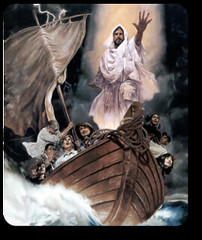
Jesus in the boat not only rebukes the sea and the winds but the disciples also using the harsh words (Greek deiloi) “cowards! Are you still without trust” We find that the disciples are constantly criticized by Jesus for their lack of trust (sound like someone you might know personally?). The kind of truse that He showed when He was sleeping without fear of the storm We need to understand this verse penned by the Apostle Paul to his spiritual son Timothy 2Ti 1:7 For God hath not given us the spirit of fear; but of power, and of love, and of a sound mind.

On another occasion they fear for the crowds would starve in the desert for the lack of food (as if Jesus could not provide). They ask themselves “What manner of man is this that the winds and the sea obey him?” The disciples are confronted with the frightening prospect that God Himself is their fellow traveler toward Syria.
On His arrival in syria Jesus is confronted by a demoniac who saw Him from afar off. And they came over unto the other side of the sea, into the country of the Gadarenes. And when he was come out of the ship, immediately there met him out of the tombs a man with an unclean spirit, Who had his dwelling among the tombs; and no man could bind him, no, not with chains: Because that he had been often bound with fetters and chains, and the chains had been plucked asunder by him, and the fetters broken in pieces: neither could any man tame him. And always, night and day, he was in the mountains, and in the tombs, crying, and cutting himself with stones. But when he saw Jesus afar off, he ran and worshipped him, (Mar 5:1-6)
This man was in an “unclean” land of Gentiles, suffers every kind of ritual pollution. He lives an a graveyard, he is uncontrollable, he burst all the chains and challenges Jesus the minute Christ puts His foot on Gentile territory. “And cried with a loud voice, and said, What have I to do with thee, Jesus, thou Son of the most high God? I adjure thee by God, that thou torment me not”.
The Devil tries to fence with Jesus in this impure land, having failed in the desert. “For he said unto him, Come out of the man, thou unclean spirit. And he asked him, What is thy name? And he answered, saying, My name is Legion: for we are many. And he besought him much that he would not send them away out of the country. Now there was there nigh unto the mountains a great herd of swine feeding. And all the devils besought him, saying, Send us into the swine, that we may enter into them. And forthwith Jesus gave them leave. And the unclean spirits went out, and entered into the swine: and the herd ran violently down a steep place into the sea, (they were about two thousand;) and were choked in the sea”. (Mar 5:8-13) The fact that this is a foreign land is emphasized by the name that the demons give themselves. They call themselves “Legion” the title of a Roman military unit of thousands, not only that but the wild boar was the emblem of the Roman soldiers stationed in Palestine. Jesus has gone beyond the realm of the Temple and what he tells the man he freed is strikingly different than what he tells others that He has healed. Normally He tells any cured person not to relate what has happened , but with man who wants to return with Jesus to Judea, Christ orders him to stay in the Gentile area. “Howbeit Jesus suffered him not, but saith unto him, Go home to thy friends, and tell them how great things the Lord hath done for thee, and hath had compassion on thee” (Mar 5:19). He calls Himself The Lord and makes a beachhead in this territory. Nonetheless the people in this area beg him to leave. They do not want to be caught in this cosmic struggle- they do not believe Christ is acting on His own but must be of the Devil as He could not be the Messiah. This is what confronts the Markean community as they enter Syria. To be continued...

Thursday, January 29, 2009

Part 12 The Gospels

jesus_calms_storm
Part 12 The Gospels

Gentle reader,
We are back in the study of “What your father never knew and your mother wouldn’t tell you” about the gospels. I remind you that as many ways as there are to study the 4 gospels and this is just another way that perhaps may put things in perspective a wee bit. We are looking at the gospels from the perspective as Paul wrote in Hebrews “ For the word of God is quick, [living] and powerful, and sharper than any twoedged sword, piercing even to the dividing asunder of soul and spirit, and of the joints and marrow, and is a discerner of the thoughts and intents of the heart”. (Heb 4:12) describes

Jesus first trip to Syria

The first trip into Gentile territory follows right after the parable the describes the gathering of the Gentiles (remember that it was to the Jew first and then to the Gentile according to Paul: “For I am not ashamed of the gospel of Christ: for it is the power of God unto salvation to every one that believeth; to the Jew first, and also to the Greek”. (Rom 1:16). In the parable of the mustard seed, small at first . That grows into a huge bush where “ But when it is sown, it groweth up, and becometh greater than all herbs, and shooteth out great branches; so that the fowls of the air may lodge under the shadow of it. (Mar 4:32)
This image of birds for gathering nations is familiar in the writings of the Hebrew Scriptures: In the mountain of the height of Israel will I plant it: and it shall bring forth boughs, and bear fruit, and be a goodly cedar: and under it shall dwell all fowl of every wing; in the shadow of the branches thereof shall they dwell. (Eze 17:23).
Ezekiel 31: 5-6 describes the Assyrian empire, before pride led to its downfall, as a great cedars in Lebanon Therefore his height was exalted above all the trees of the field, and his boughs were multiplied, and his branches became long because of the multitude of waters, when he shot forth. All the fowls of heaven made their nests in his boughs, and under his branches did all the beasts of the field bring forth their young, and under his shadow dwelt all great nations.
Daniel 4:21 describes Nebuchadnezzar before he was cursed , as a great tree ‘in whose branches the birds lodged’ The parable of Jesus thus says His reign will gather in the nations. [Note we might point out that this fact was not understood by the 12 nor perhaps those that followed, with the exception of the apostle Paul who received the further Revelation from Christ see Acts “But the Lord said unto him, Go thy way: for he is a chosen vessel unto me, to bear my name before the Gentiles, and kings, and the children of Israel:” (Act 9:15)

So Gentle Reader,
Those passages from the Hebrew Sacred writings would be the kind that Mark’s community would be meditating on as they recalled the parable of the mustard seed, and it’s connection with the Gentiles of Syria.

They would also reflect on other passages having to do with fear and depression when they heard how Jesus crossed to Syria over the Sea of Galilee. When the Storm tosses the little boat, yet Jesus slept peacefully in the tumult, the disciples are panic-stricken. And he was in the hinder part of the ship, asleep on a pillow: and they awake him, and say unto him, Master, carest thou not that we perish? (Mar 4:38). This plaintive cry would be familiar to the Markan community , since Levites were required to recite Psalm 44:23-24 every day (which is why they were called Wakers). Awake, why sleepest thou, O Lord? arise, cast us not off for ever. Wherefore hidest thou thy face, and forgettest our affliction and our oppression?
(Psa 44:23-24)

And he arose, and rebuked the wind, and said unto the sea,[‘be bridled’] [To the wind ‘Silence ]Peace, be still. And the wind ceased, and there was a great calm. (Mar 4:39). What Mark was depicting was the divine act of reining in the sea, what God does in Genesis (And God said, Let the waters under the heaven be gathered together unto one place, and let the dry land appear: and it was so. Gen 1:9 ). And also in Job He hath compassed the waters with bounds, until the day and night come to an end. The pillars of heaven tremble and are astonished at his reproof. (Job 26:10-11 ).
Look also at “Thou hast set a bound that they may not pass over; that they turn not again to cover the earth. “(Psa 104:9) And God speaks in Isaiah 50:2 Wherefore, when I came, was there no man? when I called, was there none to answer? Is my hand shortened at all, that it cannot redeem? or have I no power to deliver? behold, at my rebuke I dry up the sea, I make the rivers a wilderness: their fish stinketh, because there is no water, and dieth for thirst.
Also Psalm 106: 9 we read “He rebuked the Red sea also, and it was dried up: so he led them through the depths, as through the wilderness. “
Which we see that the last two citations are important since there is the EXODUS imagery that runs all through this gospel. Storms are often an image of persecution or of war, or temptation (Augustine, when he prayed for release from temptation, ask God to quell the frothy sea at its shore.[Confessions 2:3].
The disciples expressing fear at the sea are like Mark’s community terrified under persecution, and the rebuke at there lack of trust is like that of Moses when he broke the tablets because of the Israelites’ lose of faith while he was on the mountaintop.

So much for now gentle Reader, just remember to take away from this study that “Faith is what gets you started, Hope is what keeps you going. Love is what get you there’!
Next time,
Love,
Denis

Sunday, January 25, 2009

A Brief pause-by way of Explanation

Laptop and coffee

 Dear Gentle Reader,

 From time to time I take a wee break from writing. Not that anything is particularly wrong. Or that there is some emergency,  we are not dying of anything other that what kills us all. that is to say we wear out !  But those of you that read on a regular basis know that thinking is a difficult business, not only that but to be reflective in a world that spends its time on sound bites or being amused by "girls gone wild" or soap operas like "As the stomach turns" they won't miss my small attempt to get one to think as a intelligent person. Those who need to think, perhaps, need to consider this.  

 The Talmud tells that a gentile came to Shammai saying that he would convert to Judaism if Shammai could teach him the whole  Torah in the time that he could stand on one foot. Shammai drove him away with a builder's measuring stick! Hillel, on the other hand, converted the gentile by telling him, "That which is hateful to you, do not do to your neighbor. That is the whole Torah; the rest is commentary. Go and study it." So may I take that quote and change it a wee bit to this "

"Master, which is the great commandment in the law? Jesus said unto him, Thou shalt love the Lord thy God with all thy heart, and with all thy soul, and with all thy mind. This is the first and great commandment. And the second is like unto it, Thou shalt love thy neighbour as thyself." (Matt. 22:36-39) That is the whole of Christianity, the rest is commentary.

 So for a brief pause Gentle reader, if you need me read some of the 1500 + articles that I have left with you to reflect upon while I recharge my spiritual battery and if you hear of me advising the President on matters of state, it';s just a rumor started by the people who would like to start rumors.

 See you a a while Gentle reader, and remember you are accepted, you are valued, you are loved, by God and by me.

Denis  

Out to lunch at the Pub

Saturday, January 17, 2009

The Gospel of Mark (Part 11)

Abandon Church

What the 4 Gospels meant to early believers

(And what we can learn from them today)

Part 11

Gentle Reader,

We have been looking back at the 1st century believers understanding of the Gospels. We have begun with Mark as the shortest of the 4. You need to copy the study so that you can refer to the historical insights and my understanding of the issues. Now understand that as Paul said " For now we see through a glass, darkly; but then face to face: now I know in part; but then shall I know even as also I am known. (1Co 13:12) Those who claim to have everything worked out, all the answers, don’t! It’s rather like a jigsaw puzzle in which we worry over one piece of the puzzle when there are other pieces yet to be found (understood).

It’s only when we look closely and then take a step back, consider all the evidence at our disposal with one eye on the possibility that we might be wrong but ‘pressing toward the mark" of the high calling or better the calling upon high to as it were see over the next hill that we will begin to grasp in some small way the wisdom, knowledge and understanding of our heavenly father.

So with that in mind lets see if we can’t get a wee better grasp of what the early believers might have thought of Mark’s gospel.

Remember last time I told you to put your self in the sandals of those readers who were being persecuted and having to flee to the gentile country of Syria and then reading about Jesus two trips and why it would have special meaning for them!

Jesus first trip to Syria

The first trip into the Gentile territory follows immediately on Jesus’ use of a parable that describes the gathering-in of the Gentiles (into to Kingdom of heaven). It is the parable of the mustard seed, small at first, that grows into a huge bush where " But when it is sown, it groweth up, and becometh greater than all herbs, and shooteth out great branches; so that the fowls of the air may lodge under the shadow of it." (Mar 4:32) this image of birds for gathering nations is familiar in the Sacred Writings. At Ezekiel 17:23, the lord takes a tiny slip from a cedar tree which, planted, grows so large that "In the mountain of the height of Israel will I plant it: and it shall bring forth boughs, and bear fruit, and be a goodly cedar: and under it shall dwell all fowl of every wing [of every kind]; in the shadow of the branches thereof shall they dwell". (Eze 17:23)

While Ezekiel 31:5-6 describes the Assyrian empire before pride led to its downfall, as the great cedar of Lebanon:

"Behold, the Assyrian was a cedar in Lebanon with fair branches, and with a shadowing shroud, and of an high stature; and his top was among the thick boughs. The waters made him great, the deep set him up on high with her rivers running round about his plants, and sent out her little rivers unto all the trees of the field. Therefore his height was exalted above all the trees of the field, and his boughs were multiplied, and his branches became long because of the multitude of waters, when he shot forth. All the fowls of heaven made their nests in his boughs, and under his branches did all the beasts of the field bring forth their young, and under his shadow dwelt all great nations. " (Eze 31:3-6)

Daniel 4:21 describes Nebuchadnezzar, before he was cursed as a great tree "Whose leaves were fair, and the fruit thereof much, and in it was meat for all; under which the beasts of the field dwelt, and upon whose branches the fowls of the heaven had their habitation

The parable of Jesus thus says that his reign will gather in the nations. These passages from the Sacred (Hebrew) Writings are the kind Mark’s community would be meditating on as they recalled the parable of the mustard seed, and its connection with the Gentiles of Syria.

They would have also reflected on other passages having to do with fear and persecution when they heard how Jesus crossed to Syria over the Sea of Galilee. When the grart storm tossed the boat, yet Jesus sleeps peacefully through it all. The disciples are panic-stricken. Mar 4:38 And he was in the hinder part of the ship, asleep on a pillow: and they awake him, and say unto him, Master, carest thou not that we perish? That cry would be familiar to the Marken community, since the Levites were required to recite "Awake, why sleepest thou, O Lord? arise, cast us not off for ever. Wherefore hidest thou thy face, and forgettest our affliction and our oppression? "(Psa 44:23-24) every day (which they were called Wakers). And he arose, and rebuked the wind, and said unto the sea, Peace, be still. And the wind ceased, and there was a great calm. (Mar 4:39)

We find Jesus the wind "silence " and tells the sea "be bridled". Reining in the sea is a divine act, what God does at "And God said, Let the waters under the heaven be gathered together unto one place, and let the dry land appear: and it was so. "

(Gen 1:9), where He reings in the sea to make land appear. And in Job He hath compassed the waters with bounds, until the day and night come to an end. The pillars of heaven tremble and are astonished at his reproof. (Job 26:10-11).

In Psalm 104 "Thou hast set a bound that they may not pass over; that they turn not again to cover the earth." (Psa 104:9). While in Isaiah "Wherefore, when I came, was there no man? when I called, was there none to answer? Is my hand shortened at all, that it cannot redeem? or have I no power to deliver? behold, at my rebuke I dry up the sea, I make the rivers a wilderness: their fish stinketh, because there is no water, and dieth for thirst." (Isa 50:2). Psalm 106:9 "He rebuked the Red sea also, and it was dried up: so he led them through the depths, as through the wilderness. "

These last two citations are especially important as we shall see- the Exodus imagery runs all through this Gospel.

Tell next time,

Love,

Denis


Sunday, January 11, 2009

"Run Into the Hills"

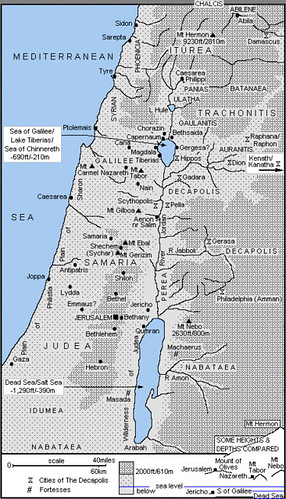
CNM37-Palestine

The Gospel of Mark (part 11)

Gentle Reader,

I do apologize for the time that it takes me to post our studies, if things were on a even keel I would be teaching a wee bit each day. However with Marti as sick as she has been and at times all I can do is sit sadly by and watch her suffer as this cursed disease takes its toll. And on the other hand our studies are not for those who are weak kneed, in their faith. As Paul our Apostle to the Gentiles once said Eph 4:13 Till we all come in the unity of the faith, and of the knowledge of the Son of God, unto a perfect man, unto the measure of the stature of the fulness of Christ:"

 And as I have pointed out several times we are looking at the 4 Gospels from the point of view of the 1st century Believer as if the ink was still wet on the parchments.

This is an new study for me as I wish to push your understanding and mine as far as we may go in this direction.

We might point out the Luke takes "the Defilement that desolates" (to bdelygma tes eremoseos) from Daniel 11:31, 12:11 "And arms shall stand on his part, and they shall pollute the sanctuary of strength, and shall take away the daily sacrifice, and they shall place the abomination that maketh desolate. (Dan 11:31) And from the time that the daily sacrifice shall be taken away, and the abomination that maketh desolate set up, there shall be a thousand two hundred and ninety days. (Dan 12:11) which describes the pollution of the Temple by Antiochus Epiphanes who in 168BCE placed a pagan altar above the altar of sacrifice, which "put a stop to sacrifice and offering (Dan 9:27). This is not parallel to the Romans’ total destruction of the Temple, but it does have a parallel in the Zealots’ seizure of the Temple in 67CE, which escalated the Jewish War. The Zealots maintained their military camp in the Temple until it was destroyed. Josephus, the Jewish historian, calls these Zealots "outlaws" lestai (Jewish War 4.13 ) . The same term Jesus uses in Mark 11:17 " And he taught, saying unto them, Is it not written, My house shall be called of all nations the house of prayer? but ye have made it a den of thieves". For those who abuse their roles in the Temple. Which convinces me that the action of the Zealots in 67 CE and the following years is what prompted the Markan community to "run away in the hills" in Syria, escaping the war that would soon destroy the Temple. The Zealots are the Jews who would have been persecuting the Markan community just as the next wave of Zealots would do under Bar Kakhba in 132 CE.

The nearest hills for the persecuted Christians in Judaea ro run toward were in the Syrian Decapolis, a Gentile area where Paul had been active in his preaching. Mark shows that Jesus visiting Syria twice, crossing the sea of Galilee to reach it. If that indeed was where Mark’s listeners had run from their persecutors, both of the times when Jesus entered that territory would be rich with personal meaning for them, and Mark’s emphasis on the two trips would become more understandable.

Now Gentle Reader, for next time re read the 2 times that Jesus crossed into Syria and think about if you were living in that 1st century what would you have thought and felt and how close would you have felt to the King of Kings, and Lord of Lords?

Till next time then,

Love,

Denis


Sunday, January 04, 2009

The Gospel of Mark

art_bible_codex Gospel of Mark

Part 10 The gospel of Mark

Dear Gentle reader,

It has been some time that I have started this study on the 4 gospels (excluding all the other "gospels" that were rejected. The last time we were considering the persecuted "church" as we now can read in the Gospel of Mark. If Mark was written in and for a community under persecution, does he supply any hints about where this persecution was occurring? It was held in past times that the older view was that it was written in Rome, and that Peter had dictated the Gospel to Mark, and that Peter as well as Paul died in the Neronian persecution in Rome (64CE). My own personal view (now under reconsideration) is that the Gospel was written if not published around 43 A.D.

If that older view were historically accurate or the view was sound then this Gospel would hardly show such a lack of sympathy with Peter. Besides, the persecution that killed Peter and Paul on the charge of burning Rome down was a brief spasm not the sort the Markan community undergoes. And while some may argue that Peter was being humble the writing in Mark shows more than humility directed towards Pater. In the light of that fact that it was the (Jewish brethren? ) Who betrayed the Gentiles Christians in Rome.

What does the Gospel itself about and to the plight of those 1st century believers?

"And ye shall be hated of all men for my name's sake: but he that shall endure unto the end, the same shall be saved. But when ye shall see the abomination of desolation, spoken of by Daniel the prophet, standing where it ought not, (let him that readeth understand,) then let them that be in Judaea flee to the mountains: And let him that is on the housetop not go down into the house, neither enter therein, to take any thing out of his house: And let him that is in the field not turn back again for to take up his garment. But woe to them that are with child, and to them that give suck in those days! And pray ye that your flight be not in the winter. For in those days shall be affliction, such as was not from the beginning of the creation which God created unto this time, neither shall be. And except that the Lord had shortened those days, no flesh should be saved: but for the elect's sake, whom he hath chosen, he hath shortened the days." (Mar 13:13-20)

Mark alerts those in his audience that he is talking about them "(let him that readeth understand,) "understand this, reader! And also gives them hope that the time of their ordeal has been aborted (literally "cut back")

What is this defilement that desolates (to bdelgma tes eremoseos)? It has often been taken to refer to the destruction of the temple by the Romans in 70 A.D.. But elsewhere Mart does appear to seem to know the circumstances of that destruction, and he does not refer to it directly . As does Luke in "And when ye shall see Jerusalem compassed with armies, then know that the desolation thereof is nigh. Then let them which are in Judaea flee to the mountains; and let them which are in the midst of it depart out; and let not them that are in the countries enter thereinto." (Luk 21:20-21). Luke was written around 58 A.D. and seems to have seen the final siege of Jerusalem. Which takes us to the Gospel of Matthew and the questions ask and answered by Christ to his disciples.

And Jesus went out, and departed from the temple: and his disciples came to him for to shew him the buildings of the temple. And Jesus said unto them, See ye not all these things? verily I say unto you, There shall not be left here one stone upon another, that shall not be thrown down. And as he sat upon the mount of Olives, the disciples came unto him privately, saying, Tell us, when shall these things be? and what shall be the sign of thy coming, and of the end of the world? And Jesus answered and said unto them, Take heed that no man deceive you. For many shall come in my name, saying, I am Christ; and shall deceive many. And ye shall hear of wars and rumours of wars: see that ye be not troubled: for all these things must come to pass, but the end is not yet. For nation shall rise against nation, and kingdom against kingdom: and there shall be famines, and pestilences, and earthquakes, in divers places. All these are the beginning of sorrows. Then shall they deliver you up to be afflicted, and shall kill you: and ye shall be hated of all nations for my name's sake. And then shall many be offended, and shall betray one another, and shall hate one another. And many false prophets shall rise, and shall deceive many. And because iniquity shall abound, the love of many shall wax cold. But he that shall endure unto the end, the same shall be saved. And this gospel of the kingdom shall be preached in all the world for a witness unto all nations; and then shall the end come. When ye therefore shall see the abomination of desolation, spoken of by Daniel the prophet, stand in the holy place, (whoso readeth, let him understand ) Then let them which be in Judaea flee into the mountains: Let him which is on the housetop not come down to take any thing out of his house: Neither let him which is in the field return back to take his clothes. And woe unto them that are with child, and to them that give suck in those days! But pray ye that your flight be not in the winter, neither on the sabbath day: For then shall be great tribulation, such as was not since the beginning of the world to this time, no, nor ever shall be. And except those days should be shortened, there should no flesh be saved: but for the elect's sake those days shall be shortened. Then if any man shall say unto you, Lo, here is Christ, or there; believe it not. For there shall arise false Christs, and false prophets, and shall shew great signs and wonders; insomuch that, if it were possible, they shall deceive the very elect. Behold, I have told you before. Wherefore if they shall say unto you, Behold, he is in the desert; go not forth: behold, he is in the secret chambers; believe it not. For as the lightning cometh out of the east, and shineth even unto the west; so shall also the coming of the Son of man be. For wheresoever the carcase is, there will the eagles be gathered together. Immediately after the tribulation of those days shall the sun be darkened, and the moon shall not give her light, and the stars shall fall from heaven, and the powers of the heavens shall be shaken: And then shall appear the sign of the Son of man in heaven: and then shall all the tribes of the earth mourn, and they shall see the Son of man coming in the clouds of heaven with power and great glory. And he shall send his angels with a great sound of a trumpet, and they shall gather together his elect from the four winds, from one end of heaven to the other. Now learn a parable of the fig tree; When his branch is yet tender, and putteth forth leaves, ye know that summer is nigh: So likewise ye, when ye shall see all these things, know that it is near, even at the doors. Verily I say unto you, This generation shall not pass, till all these things be fulfilled. Heaven and earth shall pass away, but my words shall not pass away. But of that day and hour knoweth no man, no, not the angels of heaven, but my Father only. But as the days of Noe were, so shall also the coming of the Son of man be. For as in the days that were before the flood they were eating and drinking, marrying and giving in marriage, until the day that Noe entered into the ark, And knew not until the flood came, and took them all away; so shall also the coming of the Son of man be. Then shall two be in the field; the one shall be taken, and the other left. Two women shall be grinding at the mill; the one shall be taken, and the other left. Watch therefore: for ye know not what hour your Lord doth come. But know this, that if the goodman of the house had known in what watch the thief would come, he would have watched, and would not have suffered his house to be broken up. Therefore be ye also ready: for in such an hour as ye think not the Son of man cometh. Who then is a faithful and wise servant, whom his lord hath made ruler over his household, to give them meat in due season? Blessed is that servant, whom his lord when he cometh shall find so doing. Verily I say unto you, That he shall make him ruler over all his goods. But and if that evil servant shall say in his heart, My lord delayeth his coming; And shall begin to smite his fellowservants, and to eat and drink with the drunken; The lord of that servant shall come in a day when he looketh not for him, and in an hour that he is not aware of, And shall cut him asunder, and appoint him his portion with the hypocrites: there shall be weeping and gnashing of teeth. (Mat 24:1-51)

Which could mean, Gentle Reader, that the Parousia of the Lord (better known as the doctrine of the Second Coming could have actually taken place around 70 A.D). which is a whole another study that I will not attempt at this time but just consider what that means to each of us if Christ returned within a generation or forty years of His death.

I’ll leave you at this point to ruminate over this possible event until next time.

Don’t worry we are not alone!

Love,

Denis

Columbo

Tuesday, December 30, 2008

The story of Chanukkah (conclusion)

Dear Gentle Reader,

 A HEBREW SAGE MIGHT SAY. . .

There is no distance between people of like precious faith.

The lights of Chanukkah was not an ancient celebration pointing to the LORD MESSIAH JESUS; they were added after HIS death to point back to the ONE WHO alone is the LIGHT OF THE WORLD. HIS light lasts forever, whereas the lights of Chanukkah only shine for a few days each year.In John 10. 22-23, the ANOINTED ONE, YESHUA was at the Temple where the Feast of Dedication (Chanukkah) was being observed. The LORD JESUS had said of HIMSELF, "I AM the LIGHT OF THE WORLD, he that follows ME shall not walk in darkness, but shall have the LIGHT OF LIFE." [John 8. 12] "As long as I AM in the world, I AM the LIGHT OF THE WORLD." [John 8. 12] "Are there not 12 hours in the day? If any man walk in the day, he stumbles not, because he sees the Light." [John 11. 9] "Yet a little while is the LIGHT with you, walk while you have the LIGHT, lest darkness come upon you." [John 12. 35]

The GLORY OF GOD shone out of the Temple -- the GLORY OF GOD shone out of the FLESHLY TEMPLE OF KING MESSIAH YESHUA WHO is the "Ner Tormid" the "EVERLASTING LIGHT." HIS light defeats darkness. So, even when we go to the grave, we will experience an even greater light because we will be with GOD. As it is written, "GOD is LIGHT, and in HIM is no darkness at all." [1 John 1. 5] We should not worship before the candles of the Chanukkah Menorah, but only before ALMIGHTY GOD HIMSELF, the ONE WHO was the LIGHT, then performed the miracle of the lights. "YAH is my LIGHT and my SALVATION" [Psalms (Tehillym) 27. 1 Tanakh, Kethuvim], and "I will also make you (Israel) for a light, an agent of good fortune, to the nations, that MY salvation may reach unto the ends of the earth." [Isaiah (Yeshayah) 49. 6 Tanakh, Nevi'im]

The Jewish Festival of Chanukkah is celebrated on the eve of Kislev 24. The month of Kislev is the same as the month of December. The significance that YESHUA ha'MASHIACH gave to Chanukkah, is perhaps the reason the church chose December 25 for CHRISTmas Day. It is the Day to testify of the fact that in the birth of CHRIST JESUS, DEITY was dwelling in a HUMAN TEMPLE and shining out to give LIGHT in the midst of darkness. The birth of our BLESSED REDEEMER, is the dedication of the TRUE TEMPLE which is the body of JESUS. MESSIAH YESHUA told us that we are the light of the world and the salt of the earth; which is true as the HOLY SPIRIT reveals MESSIAH as the ALMIGHTY LORD GOD through our lives.

Chanukkah tells us that, as believers, we are to be in the world, but not part of it. We can live as more than conquerors. We can be separated in holiness and dedication. We are to be lights to the world as a testimony to our MIRACLE-WORKING HOLY GOD. Amen


Sha'alu (Pray) for the Shalom (Peace) of Jerusalem and all of Israel !

Happy Chanukkah! The Eighth Light is the LIGHT of Courage. Let truth and justice be your armour and fear not, the ALMIGHTY ONE is with you.

As we celebrate the last night (evening-to-evening) of Chanukkah, our prayer for each of you is to be strong and of good courage; be bold as you proclaim the GOOD NEWS of Salvation to all. The LORD bless and keep you throughout the coming days! Go with GOD!

 Love,

Denis (see you on the other side of the new year)

Monday, December 29, 2008

THE STORY OF CHANUKKAH (Part 3)

A HEBREW SAGE MIGHT SAY. . .
Heaven and nature sing "Joy to the world, the LORD has come!"The 24th of Kislev was important to Israel years before the Maccabees memorialized it with Chanukkah. It was the day that "The FOUNDATION was laid for the LORD'S Temple." [Haggai/Chagai 2. 18 - 19] It was also a day when victory was promised to the Children of Israel, the ETERNAL ONE said, "Speak to Zerubbabel, the governor of Judah : I am going to shake the heavens and the earth. And I will overturn the thrones of kingdoms and destroy the strength of the kingdoms of the heathens. I will overturn chariots and their drivers. Horses and their riders shall fall, each by the sword of his brother -- for I have chosen you and will bring you close to ME, says the LORD OF HOSTS." [Haggai (Chagai) 2. 21 - 23 Tanakh, Nevi'im] {Special Note: Zerubbabel is the center of the MESSIANIC Line and like a signet, seals both branches together. . . OBEDIENCE -- present blessing; PROMISE -- future blessing.}

This Day now celebrated as Chanukkah was "A Day of Faith." It was in the dead of winter, food was scarce [Haggai/Chagai 2. 16 - 17] it seemed as if the ALMIGHTY had forsaken HIS people. Yet, the LORD said, "from THIS DAY, I will send you blessings." Haggai looked forward to the harvest (Succoth - Feast of Ingathering/Booths) which was nine months away. [Haggai/Chagai 2. 19]

Was MESSIAH YESHUA, therefore, conceived on Chanukkah; born on Yom Kippur, and circumcised the 8th day in the middle of the Feast of Tabernacles? "The WORD was made flesh and tabernacled among us." [John 1. 14] JESUS announced Jubilee at the beginning of HIS ministry. [Luke 4. 16 - 21] HE died as the Passover LAMB. [1 Corinthians 5. 7] On Chanukkah, HE plainly said that HE was the MESSIAH. [John 10. 22 - 25] On Pentecost, JESUS sent HIS SPIRIT "to guide you into all TRUTH." [John 16. 13] Maybe soon, on some Feast of Trumpets, the LORD YESHUA will come for all who believe in HIM. [1 Thessalonians 4. 13 - 18] On the following Day of Atonement, "HE will turn ungodliness from Jacob and take away their sins, and so all Israel will be saved." [Romans 11. 26 - 27] "Then the Kingdom will be set up, Israel will be re-gathered, and ALL the nations shall go up from year to year to bow low and worship the KING, the LORD OF HOSTS, and to observe the Feast of Tabernacles (Booths)." [Zechariah (Zecharyah) 14. 16 Tanakh, Nevi'im]

The MIGHTY LORD GOD delivered Israel to fulfill the promise through Haggai, HE delivered Israel in the days of the Maccabees, and HE is able to deliver Israel in this day. When things look the worst, when you see these things, know that the LORD JESUS is near, even at the door. [Matthew 24. 33]

Josephus, the Jewish historian, was the first person to make lighting one candle for each of the 8 Days. . . calling it the Feast of LIGHT. The custom of lighting the candles originated sometime shortly after the earthly life of MESSIAH YESHUA, and continues to this very day.

. . . to be continued


Sha'alu (Pray) for the Shalom (Peace) of Jerusalem and all of Israel !
Be blessed as we bid farewell to Shabbat! May the ALMIGHTY ONE, WHO separates the holy from the secular, forgive our sins and grant us a good week as we continue in HIS service!
Happy Chanukkah! The Seventh Light is the LIGHT of Justice. Trust in the LORD and wait patiently for HIM, May the LORD GOD teach you patience that you may endure every trial HE allows to make you strong.

Thursday, December 25, 2008

Here at last... a child is born


 Gentle Reader,

Marti and I wish you a very Merry and blessed Christmas from our home to yours. Our last story is one of the best from a dear brother and it is called:

Christmas Hardships

The Workman

"Do you really expect me to go to Bethlehem?" Joseph banged down his chisel on the scarred bench.

Ephraim, his cousin, had just entered the low workshop. "You don't have a choice, Joseph. If you don't go the Romans will confiscate your house and your precious tools. Just try to carve a yoke with your fingernails."

"What are we, cowards?" the carpenter retorted. "Mark my words, Ephraim, this 'Enroll-in-your-ancestral-city' business is nothing more than a way to squeeze more taxes out of us. If we give into those foreign tyrants now they'll just be back for more money."

"What's more," Joseph continued, "you're crazy if you think I'd take Mary on a trip this month. She'd probably have the baby on the way!"

"Couldn't you just leave her with your mother for a couple of weeks? She'd be all right. Nobody says the women have to go. It's the heads of households who have to register."

"Register, hah! Be taxed, you mean."

"So why not leave her at home?"

Joseph brushed the woodchips aside and motioned for his cousin to sit down. The carpenter spoke in a low but earnest voice. "Mary's aunt has made life miserable for her ever since she found out Mary was pregnant. Some people were willing to let it go. Not Tabitha."

"She got my wife all stirred up about it," Ephraim volunteered.

"Not just your wife. Most of the women in this town go out of their way to avoid her. At the village well they whisper, "Little slut!" just loud enough for her to hear. Many's the day she's come running home in tears."

"People sure can be cruel," Ephraim said. "At least you and Mary went ahead and got married."

Joseph bit his lip, but didn't say more.

Ephraim got up. "Well, you are going to Bethlehem, aren't you? You'd be a fool to get the Romans on your back. You know what they did to old Ben."

Joseph stood up slowly. "Yes, I'll go. But Mary'll have to come along. There's no way I'd leave her in Nazareth by herself!"

However, when Joseph talked to Mary about it, she didn't seem nearly as sure as her husband. "How could I walk all that way?" she said. "I waddle now. I just can't make it."

"Mary, we'll bring old Jake. You can ride him when you get tired."

"Have you ever ridden on Jake?"

"Well, no."

"That animal is the most bony, jolting mule in Nazareth. I'd rather walk!"

She did ride, though ... some of the way. Joseph would finally stop for the day when Mary just couldn't take any more. He'd help her down off Jake, then he'd fix a fire while she would unload their heavy blankets and try to find some shelter under a tree or large rock.

Mary would always be the center of attention among the few women traveling that time of year.

"I remember when I was carrying Levi," one would start. "Made my feet swell. I couldn't do anything for months."

"That's nothing," replied another, "my sister got so big everyone thought she was carrying twins. But her time came there was only one baby. Died though."

Joseph glanced over at Mary in the flickering firelight. He could see fear flit across her face. Her hands moved to her swollen belly so she could feel the baby's reassuring kick.

The women didn't notice. The first one went on, "Oh, the pain's so awful! I'm glad I'm too old to have any more babies."

Joseph put his arm around Mary's shoulders and pulled her close. Only one more night on the road before Bethlehem.

They reached the sleepy village of Joseph's ancestors just about dusk the fifth day. Joseph went to the inn and nearby houses trying to find a place to sleep. "God," he whispered as he combed the town, "can't You find us a decent place to have this baby?" Nothing.

All at once he saw Mary's face tighten. She tried to suppress a groan as she fought with the pain. It was a long moment before she relaxed, but he could see worry written all over her.

Joseph went back to the innkeeper again. "Are you sure there isn't any room? My wife's about to have a baby. We've got to find a place out of this wind tonight!"

The innkeeper thought a while. "Did you try the house at the end of the street? They sometimes take people in."

"I tried an hour ago."

"Any relatives in town? Any second cousins?"

"No."

Mary was shivering now, in obvious discomfort. "Joseph," she said weakly, "I've got to lie down somewhere."

"Well, there's the stable in the back," offered the innkeeper at long last. "Of course, it's full of animals from all the visitors in town for that blasted Roman census. But if you can find a place in the corner, I guess that'd be okay." He paused. "Just don't keep the animals awake all night."

It was the other way around. The dozen donkeys in the strange barn never stopped moving. And the smell was overpowering to Mary who had been fighting nausea as her pains got stronger.

In the wee hours of the morning Joseph knocked on the innkeeper's door again.

"What do you want this time of night?" the innkeeper snarled when he finally came to the door.

"Is there a midwife in town?"

"Oh, it's you. A midwife? Yes, old Martha lives in a little house about three blocks from here. You go down the main road, turn left at the two-story house, and go to the alley. You can't miss it. You go down the alley and across the pasture. She lives in a shack just behind the third house after that."

"I ... I really don't think I should leave my wife. Her pains are coming awfully fast now.... Could you go?"

"Jonathan!" the innkeeper yelled into his darkened house. "Get up and fetch old Martha. A lady's having a baby in the barn. Hurry!"

He turned to Joseph as he closed the door. "Have some pity, man. My whole family's awake now."

Pretty soon the door opened again and a young lad ran off in the chilly air. After a while he returned, walking slowly so he wouldn't outdistance the old midwife whose arthritis certainly didn't to take to cold winter nights. The boy was shivering by the time he got to the stable.

"Here's Martha, sir," he muttered quickly, and darted back into the warmth of his house.

The old lady put them at ease right away. She had Joseph fetch water and cloths from the innkeeper. It must have been nearly two in the morning by the time the baby came, and another hour before Joseph dug into his robe for a few coins to give the old woman as she hobbled away.

Then he returned to his wife and took her hand as they looked into the puffy face of their son. Alone at last.

"I'm so tired, Joseph," Mary said, settling back into the blanket-covered straw.

The baby finally stopped crying and drifted off to sleep.

Joseph stirred a few minutes later as some men peered from the darkness into the lamp-lit stable. He nudged Mary awake and reached for his staff.

"What do you want?" Joseph said to the men in a forced whisper. "Don't wake the baby."

"We're shepherds," one called out. The baby started crying.

"We saw angels out on the hills an hour ago." The entire story tumbled out as the shepherds edged into the stable to see the baby. Joseph relaxed his grip on the staff.

The shepherd continued, "And the angel told us, 'To you is born this day in the City of David a Savior which is Messiah the Lord.' The angel even told us about the swaddling cloths and the manger here."

"The angel told you about the manger, too?" Joseph interrupted.

"Oh, yes. That's how we knew where to look."

Joseph glanced over at Mary. Her eyes met his. He squeezed her hand.

"This baby is the Messiah, isn't he?" Joseph said quietly. "After all these hassles I had started to question. But..." He paused. "It's almost like God planned the whole thing: the trip neither of us wanted to take." He chuckled. "He must have seen you on bony old Jake." Joseph laughed out loud. "Even this smelly old barn and it's manger."

He stood up, still chuckling. "What do you know? In spite of the problems--no, in the midst of the problems--God's been at work all along."

Love,

Denis and Marti

Wednesday, December 24, 2008

Chi Fawn Pi (her story worth the telling)

Gentle Readers,
Over a year ago Marti lost her little service dog just a few weeks after I wrote this blog so as we celebrate the time in which Christ came to pay a debt he did not owe, for those of us who owed a debt we could not pay... lets remember those who have left a mark on our spirits and in our hearts...
Denis

I couldn't resist getting in the act...


 So without further adieu here is my story...

Christmas Is for Love
by: Author Unknown, Source Unknown

Christmas is for love. It is for joy, for giving and sharing, for laughter, for reuniting with family and friends, for tinsel and brightly decorated packages. But mostly, Christmas is for love. I had not believed this until a small elf-like student with wide-eyed innocent eyes and soft rosy cheeks gave me a wondrous gift one Christmas.

Mark was an 11 year old orphan who lived with his aunt, a bitter middle aged woman greatly annoyed with the burden of caring for her dead sister's son. She never failed to remind young Mark, if it hadn't been for her generosity, he would be a vagrant, homeless waif. Still, with all the scolding and chilliness at home, he was a sweet and gentle child.

I had not noticed Mark particularly until he began staying after class each day (at the risk of arousing his aunt's anger, I later found) to help me straighten up the room. We did this quietly and comfortably, not speaking much, but enjoying the solitude of that hour of the day. When we did talk, Mark spoke mostly of his mother. Though he was quite small when she died, he remembered a kind, gentle, loving woman, who always spent much time with him.

As Christmas drew near however, Mark failed to stay after school each day. I looked forward to his coming, and when the days passed and he continued to scamper hurriedly from the room after class, I stopped him one afternoon and asked why he no longer helped me in the room. I told him how I had missed him, and his large gray eyes lit up eagerly as he replied, "Did you really miss me?"

I explained how he had been my best helper. "I was making you a surprise," he whispered confidentially. "It's for Christmas." With that, he became embarrassed and dashed from the room. He didn't stay after school any more after that.

Finally came the last school day before Christmas. Mark crept slowly into the room late that afternoon with his hands concealing something behind his back. "I have your present," he said timidly when I looked up. "I hope you like it." He held out his hands, and there lying in his small palms was a tiny wooden box.

"Its beautiful, Mark. Is there something in it?" I asked opening the top to look inside. "

"Oh you can't see what's in it," He replied, "and you can't touch it, or taste it or feel it, but mother always said it makes you feel good all the time, warm on cold nights, and safe when you're all alone."

I gazed into the empty box. "What is it Mark," I asked gently, "that will make me feel so good?" "It's love," he whispered softly, "and mother always said it's best when you give it away." And he turned and quietly left the room.

So now I keep a small box crudely made of scraps of wood on the piano in my living room and only smile as inquiring friends raise quizzical eyebrows when I explain to them that there is love in it.

Yes, Christmas is for gaiety, mirth and song, for good and wondrous gifts. But mostly, Christmas is for love.

You see Gentle Reader everyone one has a story within them a story of love even in the worst of circumstances...

And yours will be a blessing to someone somewhere sometime...

ChiFawn Pi (Marti's No# 1 dog)

Tuesday, December 23, 2008

Dedication (part 2)


Gentle reader,

A HEBREW SAGE MIGHT SAY. . .

In MESSIAH JESUS dwells the fullness of the GODHEAD BODILY.

CHANUKKAH DEDICATION (Part 2)

The eight-branched Menorah also represents the people of GOD WHO are "the lower lights." The MESSIAH called HIS followers "lights" [Ephesians 5. 8] and also commanded them to let their "light so shine before men" that their good works would be seen and the HEAVENLY FATHER glorified. [Matthew 5. 16]To the Jewish people there is much significance in the idea of LIGHTS - one of them is relative to marriage: "From every human being there rises a light that reaches straight to heaven. And when two souls that are destined to be together find each other, their streams of light flow together, and a single brighter light goes forth from their united being." [Baal Shem Tov]

The WORD OF GOD describes YESHUA ha'MASHIACH as THE LIGHT OF THE WORLD. HE came as a SERVANT (SHAMMAS) to light every man who comes to HIM, and all who come to HIM shall no longer walk in darkness, but shall have the LIGHT OF LIFE! A song of thanksgiving for this LIGHT is found in the book of Isaiah: "The people that walked in darkness have seen a brilliant LIGHT; on those who dwelt in the land of gloom and death, LIGHT has dawned." [Isaiah (Yeshayah) 9. 2 Tanakh, Nevi'im]

Yes, this GLORIOUS LIGHT, WHO is the LORD MESSIAH JESUS, shines not for one night only or even for eight nights. . . but HE is as the "NER TORMID" - THE PERPETUAL LIGHT shining victoriously forevermore!

There is a popular game which is played at this season to remember the Miracle of Lights. Driedels (tops) are spun in this celebration. The driedel is shaped like a cube, on each of the lateral sides of which is found a Hebrew letter. The four Hebrew letters are: nun, gimmel, hai, shin - the initials of the words which constitute the sentence, "Nes Gadol Hayah Sham" or "A Great Miracle Happened There." In Gamatra (numerology) the initial Hebrew letters of "A Great Miracle Happed There" have the number value (35 which is the same numerical value as the name "Messiah!" YESHUA truly is "THE GREATEST of miracles!"

In John 10:22 we read of THE ONE WHO walked on Solomon's porch on this day (Feast of Dedication), WHO has won a victory for us greater than that of Judah Maccabeus. MESSIAH YESHUA has loosed us from the hands of our enemy, the Devil, and has cleansed the once-polluted temple by the ministry of HIS HOLY SPIRIT. We who are redeemed, rejoice in the GIFT of all gifts, not only at the Feast of Dedication, but every moment of our lives when we remember the victory the LORD JESUS wrought for us and the MIRACLE OF THE EVERLASTING LIGHT in our souls! HalleluYAH!

Sha'alu (Pray) for the Shalom (Peace) of Jerusalem and all of Israel !

Happy Chanukkah! The Second Light is the LIGHT of TORAH. Israel's BOOK OF LAW: The Commandment is a Lamp and the Law is a Light.

May mercy, peace and love be yours in abundance. And, may you share wonderful holy-days together with friends and family.

Our prayer, also, is that the flame of the LORD YESHUA ha'MASHIACH burn brightly in your heat as you share HIS light with others.

Monday, December 22, 2008

Dedication


Dear  Gentle Reader,

Before Christmas and all the trappings of commercialism came about there was Chanukkah! read on to discover your heritage from those who brought us The King of the Jews (and Saviour of the world)!

A HEBREW SAGE MIGHT SAY. . .

Fight for your opinions, but do not believe that they contain the whole truth or the only truth. . . for only the LORD MESSIAH JESUS is THE WAY, THE TRUTH, THE LIFE, and THE LIGHT.

CHANUKKAH DEDICATION (Part 1)

"Instruct the Israelites to bring you clear oil of beaten olives for lighting, to cause the lamp TO BURN ALWAYS. Aaron and his sons shall set them up in the Tabernacle of Meeting, outside the curtain which is before the Ark of the Covenant, to burn from evening to morning before the LORD. It shall be a due from the Israelites FOR ALL TIME, throughout the ages." [Exodus (Shemot) 27. 20 - 21 Tanakh, Torah]

It is said that the Hebrew word, Chanukkah, itself tells of the date for its observance: "hanu" means "rested" and "kah" means "25". Thus, it was on the 25th of Kislev that the Jewish people "rested" from their enemies at that time in history. Chanukkah is the "Festival of Lights" because of the many lights involved in the Feast. "Chanukkah" literally means "dedication" in memory of the re dedication of the Temple in 165 BC by Judas Maccabeus, after it had been polluted by Antiochus Epiphanes, the Syrian king. In 176 BC Antiochus tried to force the Jews to give up their faith and to adopt Greek customs. He persecuted the Jews who refused to do this.

Antiochus Epiphanes converted the TEMPLE OF GOD to worship Zeus, and placed an image of Zeus the dominant Greek god (the abomination of desolation) in the Holy Place . He looted the Temple and ordered all Jews to bow down to the idols placed there. Then, Antiochus brought in a sow, and placed it on the Holy Altar in desecration of ALMIGHTY GOD'S holiness. He brought waste and destruction -- desecrated the vessels of the LORD in debauchery and drunkenness and put out the "Ner Tomid" (Perpetual Light).

The Hasmoneans, the Maccabee family, led the Jews in a revolt. After several years of fighting, Judah and his men drove the Syrians out. On the 25th of Kislev (exactly 3 years after the defilement of the Sanctuary) in the year 165 BC they made their entrance into the Temple and rededicated it to the service of the GREAT GOD OF HEAVEN.

In the Temple , the priests left a light burning in obedience to the command of the HOLY ONE, but when they prepared to rekindle this light after the victory, they found that there was only enough oil to last one day. This was a tragic discovery to the Jewish people for the ALMIGHTY'S command could not then be carried out. Search was made for the oil for this Lamp. The oil must be pure and prepared under the care of the high priest and sealed with his seal. No pure oil could be found nor could any be prepared before 8 days (7 days set apart to the LORD; on the 8th day it became holy to the LORD). The small jug of oil bearing the seal of the high priest might suffice for only one day, but according to the Jewish people's tradition a MIRACLE occurred, the oil lasted for the full eight days!

Thus, in Synagogues and homes, Chanukkah is principally observed by the lighting of candles set in an eight-branched Menorah to commemorate the MIRACLE and the victory. This Menorah also contains an additional holder for the candle called "Shammas (servant)" with which the others are lighted. The custom is to burn one candle the first evening, two the second; progressively increased each evening until all eight are lit on the eighth night. Before each candle is lit there is a blessing recited and singing follows afterwards.

It is significant that the eight candles of the Chanukkah Menorah are not lighted with a match but with the "Shammas." Then after the "SERVANT" has given its light to all the others it is put in a high place or a special place of honour in the Menorah. Do you not see in this action a beautiful picture of the only SERVANT (of GOD) WHO was exalted after HE had given HIS light to HIS people? In the words of Isaiah we find HIM described: "The REDEEMER OF ISRAEL, GOD'S HOLY ONE; the DESPISED ONE; HIM WHO is abhorred of nations; to the SERVANT of rulers: kings shall see and stand up; nobles, and they shall prostrate themselves - to the honour of the LORD, WHO is faithful, to the HOLY ONE OF ISRAEL WHO chose you." [Isaiah (Yeshayah) 49. 7 Tanakh, Nevi'im]

CREATOR GOD exalts HIS SERVANT, MESSIAH YESHUA, and causes kings and princes to bow down before HIM. Yes, the LORD JESUS is the only SERVANT WHO is worthy to be given a position of honour! HE is the ONE sent of GOD to bring us the light of salvation. [Isaiah/Yeshayah 52. 13 - 15; Philippians 2. 6 - 8] Of MESSIAH YESHUA, the KING of all ages, it is written, "The LIGHT OF ISRAEL will be fire, and the HOLY ONE a flame." [Isaiah (Yeshayah) 10. 17 Tanakh, Nevi'im]

...to be continued

Sha'alu (Pray) for the Shalom (Peace) of Jerusalem and all of Israel !

The 8-Nights of Chanukkah start tonight at sundown Sunday, December 21st this year. Prepare to enjoy the Festival of Lights!!!

Wishing you every happiness during this Festival of Lights, Christmas, and the coming year. May the bright glow of the festive candles cause us to remember the wonder reflected upon the SERVANT WHO bent down to bring light to those HE served.


Saturday, December 20, 2008

Why Christmas or( Holiday) Trees?

Living Christmas tree

Dear Gentle reader,

 Interspace between the serious business of the study of Scripture (the meaning of the gospels, what they meant to those first  early Christian believers) we intend to place the importance of the history of Christmas in perspective. Duh? "what you mean Denis?"

 Well, with the downturn in the economy of America (as well as the rest of the world) we need to keep in mind why we even celebrate Christmas, barring those who just feel like raining on your parade. so here is the first in the series of Christmas what we celebrate and why (don't worry in between we'll continue our study on what the gospels meant and what they mean today.) Confused? well hang in there... see you at the end of the lesson. 

Why Do We Have Christmas Trees?

The history behind evergreens, ornaments, and holiday gift giving.


The evergreen tree was an ancient symbol of life in the midst of winter. Romans decorated their houses with evergreen branches during the New Year, and ancient inhabitants of northern Europe cut evergreen trees and planted them in boxes inside their houses in wintertime. Many early Christians were hostile to such practices. The second-century theologian Tertullian condemned those Christians who celebrated the winter festivals, or decorated their houses with laurel boughs in honor of the emperor:

"Let them over whom the fires of hell are imminent, affix to their posts, laurels doomed presently to burn: to them the testimonies of darkness and the omens of their penalties are suitable. You are a light of the world, and a tree ever green. If you have renounced temples, make not your own gate a temple."

But by the early Middle Ages, the legend had grown that when Christ was born in the dead of winter, every tree throughout the world miraculously shook off its ice and snow and produced new shoots of green. At the same time, Christian missionaries preaching to Germanic and Slavic peoples were taking a more lenient approach to cultural practices—such as evergreen trees. These missionaries believed that the Incarnation proclaimed Christ's lordship over those natural symbols that had previously been used for the worship of pagan gods. Not only individual human beings, but cultures, symbols, and traditions could be converted.

Of course, this did not mean that the worship of pagan gods themselves was tolerated. According to one legend, the eighth-century missionary Boniface, after cutting down an oak tree sacred to the pagan god Thor (and used for human sacrifice), pointed to a nearby fir tree instead as a symbol of the love and mercy of God.

Paradise trees

Not until the Renaissance are there clear records of trees being used as a symbol of Christmas—beginning in Latvia in 1510 and Strasbourg in 1521. Legend credits the Protestant reformer Martin Luther with inventing the Christmas tree, but the story has little historical basis.

The most likely theory is that Christmas trees started with medieval plays. Dramas depicting biblical themes began as part of the church's worship, but by the late Middle Ages, they had become rowdy, imaginative performances dominated by laypeople and taking place in the open air. The plays celebrating the Nativity were linked to the story of creation—in part because Christmas Eve was also considered the feast day of Adam and Eve. Thus, as part of the play for that day, the Garden of Eden was symbolized by a "paradise tree" hung with fruit.

These plays were banned in many places in the 16th century, and people perhaps began to set up "paradise trees" in their homes to compensate for the public celebration they could no longer enjoy. The earliest Christmas trees (or evergreen branches) used in homes were referred to as "paradises." They were often hung with round pastry wafers symbolizing the Eucharist, which developed into the cookie ornaments decorating German Christmas trees today.

The custom gained popularity throughout the 17th and 18th centuries, against the protests of some clergy. Lutheran minister Johann von Dannhauer, for instance, complained (like Tertullian) that the symbol distracted people from the true evergreen tree, Jesus Christ. But this did not stop many churches from setting up Christmas trees inside the sanctuary. Alongside the tree often stood wooden "pyramids"—stacks of shelves bearing candles, sometimes one for each family member. Eventually these pyramids of candles were placed on the tree, the ancestors of our modern Christmas tree lights and ornaments.

Nicholas and Wenceslas

It also took a long time for trees to become associated with presents. Though legend connects the idea of Christmas gifts with the gifts the Magi brought Jesus, the real story is more complicated. Like trees, gifts were first a Roman practice—traded during the winter solstice. As Epiphany, and later Christmas, replaced the winter solstice as a time of celebration for Christians, the gift-giving tradition continued for a while. By late antiquity it had died out, although gifts were still exchanged at New Year's.

Gifts were also associated with St. Nicholas, bishop of Myra (in modern-day Turkey), who became famous for giving gifts to poor children. His feast day (December 6) thus became another occasion for gift exchanges. During the early Middle Ages, Christmas gifts most often took the form of tributes paid to monarchs—although a few rulers used the holiday season as an opportunity to give to the poor or to the church instead (most notably Duke Wenceslas of Bohemia, whose story inspired the popular carol, and William the Conqueror, who chose Christmas 1067 to make a large donation to the pope).

Like trees, gifts came "inside" the family around the time of Luther, as the custom of giving gifts to friends and family members developed in Germany, the Netherlands, and Scandinavia. Often these were given anonymously, or hidden. One Danish custom was to rewrap a gift many times with different names on each wrapper, so that the intended recipient was only discovered when all the layers were opened.

Victorian Christmas

In the English-speaking world, the union of gifts, trees, and Christmas was due to the influence of Queen Victoria and her husband Prince Albert, a native of Saxony (now part of Germany). German immigrants had brought the custom of Christmas trees with them in the early 1800s, but it spread widely after Victoria and Albert set up an elaborate tree for their children at Windsor Castle in 1841. At this point, Christmas presents were usually hung on the tree itself.

German and Dutch immigrants also brought their traditions of trees and presents to the New World in the early 1800s. The image of happy middle-class families exchanging gifts around a tree became a powerful one for American authors and civic leaders who wished to replace older, rowdier, and more alcohol-fueled Christmas traditions—such as wassailing—with a more family-friendly holiday. This family-centered image was widely popularized by Clement Moore's 1822 poem, known today as "'Twas the Night Before Christmas" (which also helped give us our modern picture of Santa Claus).

As many of us make trees and gifts the center of our own Christmas practice, we would do well to remember that they are ultimately symbols of the One who gave himself to unite heaven and earth, and who brings all barren things to flower. So there you have it, Gentle reader, and a special thanks to those who put all this together for your reading enjoyment... 

christmasgift

  Love, Denis

Edwin Woodruff Tait is assistant professor of Bible and religion at Huntington University. Jennifer Woodruff Tait is adjunct professor of church history at Asbury Theological Seminary.


Wednesday, December 10, 2008

The Gospel of Mark and suffering- the why of it?

Jesus cross

"For when we were yet without strength, in due time Christ died for the ungodly. For scarcely for a righteous man will one die: yet peradventure for a good man some would even dare to die. But God commendeth his love toward us, in that, while we were yet sinners, Christ died for us." (Rom 5:6-8 ) 

Part 9 Mark- A divided community

Gentle Reader,

In the gospel that we ascribe to Mark, we see that Mark speaks not only of Persecution from without but he also points out defection and betrayal within. You must remember first of all that the first readers of these gospels were "living them"! No wonder were are told by the author in the book of Hebrews "For the word of God is quick, and powerful, and sharper than any twoedged sword, piercing even to the dividing asunder of soul and spirit, and of the joints and marrow, and is a discerner of the thoughts and intents of the heart." (Heb 4:12)

Brother is betraying brother-as happened with the Lord Christ Jesus. Mark alone of all the evangelists speaks and writes of Jesus’ sisters and brothers and he gives the names of all 4 brothers. Unlike Jesus himself they were all named for patriarchs - James (half-brother of our Lord Yeshua) ...Yes! it is the English - as would be translated from the Hebrew name, Ya'akov (Jacob), then Joseph, and Judas, and last Simon. The most important of these was the eldest Jacob ( James ) who presided over the gathering in Jerusalem during the middle years of the 1st century (Acts 21:18 ) Note: we might point out here the while in our English versions of the Bible Jacob is translated James and is used, yet in the Hebrew Scriptures and the English versions retain the form "Jacob" One would do well to try to remember that "Jacob" (JAMES) tried to keep the Jerusalem community observant of the Jewish Low, which became the cause of his conflict with the apostle Paul in the Galatians epistle "For before that certain came from James [Jacob], he did eat with the Gentiles: but when they were come, he withdrew and separated himself, fearing them which were of the circumcision. And the other Jews dissembled likewise with him; insomuch that Barnabas also was carried away with their dissimulation. But when I saw that they walked not uprightly according to the truth of the gospel, I said unto Peter before them all, If thou, being a Jew, livest after the manner of Gentiles, and not as do the Jews, why compellest thou the Gentiles to live as do the Jews? "(Gal 2:12-14)

That conflict must have left it’s imprint of the communities that Marks Gospel addressed. But before we leave and move on I feel constrained to point off another wee bit of controversy. There are many that try to make Scripture fit in or squeeze into a particular doctrine taught by a denomination of church hierarchy. And that is that some Christians have tried to deny that Jesus had "brothers and sisters", because they take "born of a Virgin" as a biological, not a theological, datum. And while I could (and perhaps will at some point explain Scripture on this matter).

One suspects strongly that Mark addressees must have included believers who had suffered and failed- a community that offers hope and not condemnation, since it points out that even Jesus did not want to drink the cup of suffering and that even his most intimate disciples failed. Since evangelistic theology is geared to spiritual response, this is a Passion Narrative that had and will have special meaning for those who seek to follow Christ. But find the cross that they bear is virtually insupportable in life. To those of the early believers and those of us today who cry from the brokeness of heart "My God, My God, for what reason have you forsaken me?" But never fear Gentle Reader, God has not forsaken the early believers nor you! He is with each of us as we go through the sufferings, and will bring us through with a hand held high in victory.

Enough for now,

next time....

Love,

Denis

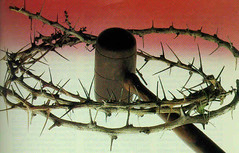
thorns and gavel

Thursday, December 04, 2008

The 4th Wise Guy (A story of Time at Christmas)

time waits on no man


Gentle Reader,

With the season so close and with me not a place to preach, nor a home to call my own. I find I have a lot of time on my hands (so to speak) It's starting to get cold here and Marti wants me to purchase a new winter coat [I really wanted to get a train set] What I want money can't buy.... but that's another time. What I wanted to say is that with all this time I get to read a bit more ( just for the sheer enjoyment which I intend to share). I know, I know its the last few hours of prime time shopping and you haven't gotten Uncle Shamus and Aunt Tody  anything. My advice re-gift! How about that 12 year old fruitcake that your using as a doorstop in the winter and as third base in the summer? 

Well come in and sit, I'll wet some tea and we'll share a story that will entertain you and perhaps give you some last minute ideas . Ready? Ok. hold on here she blows....  

The 4th Wise Guy

I was miles from anywhere when I first saw him. He was walking at the side of the road, gas can in hand, and I assumed that he'd run out of fuel somewhere. I didn't remember passing any stranded cars on the road but figured he could have broken down on a side road. Anyone would have stopped to give him a ride.

Because I had one of those mental debates while deciding whether or not to stop, the car was quite a distance ahead of him when I brought it to a halt. I watched in the mirror as he approached. He was in no hurry, it seemed, just ambling along as though out for a stroll. When he came level with the passenger window, I leaned over and called out to him.

"D'you need a ride to the next gas station, pal?"

He stopped and leaned over so that he could see my face.

"Actually, Denis, I was hoping you'd take me all the way to Akron."

I swear I'd never set eyes on the guy in my life before. How could he know my name? And the fact that I was driving to Akron? I was too dumbfounded to say anything in reply and just watched while he opened the door to get into the car. As he sat down, he threw the gas can into the bushes.

"Aren't you gonna need that?" I asked.

"Oh no, I was only carrying it so you'd take pity on me and stop," he replied. "Bought it at that gas station where you're going to drop me off. But you wouldn't have seen that, of course. You were gone by then."

This was becoming confusing. Was he claiming to have met me before or was he some kind of lunatic with wild delusions?

"Pardon?" I said. "Have we met before or something?"

"Yes and no, Denis. Look, it's complicated. Why don't you get this thing moving and I'll explain as we go, okay?"

I realized then that he was right. If he was a madman, the sooner I got him to where he wanted to go, the better. He didn't look dangerous or anything, in his early twenties but slightly built and pale, as if he'd been locked away out of the sunlight. I could easily win any tussle with him, I figured. So he wanted to talk in riddles? That was fine; it might be amusing and help the journey to go that much faster. I eased the stick into Drive and let the car move off.

"How d'you know my name?" I asked as we reached the speed limit and I hit the cruise control.

"You told me," he replied. When I said nothing but raised one eyebrow a little, he continued, "I'd better explain from the beginning. As I said before... Oh, you won't remember that, of course. Fact is, Denis, I'm living backwards."

A dim memory sparked in my brain. "You mean like Merlin? I read a book once by T.H. White about him. Called The Once and future King, I think. Anyway, it was about King Arthur and all that but I remember Merlin was supposed to be living backwards in it. Is that what you mean?"

"Exactly," he said.

I waited for him to go on but he said no more; just sat there watching my reaction to his ridiculous statement. So I gave him none.

"Am I supposed to believe that?" I asked. "It's a pretty freaky thing to say, you know."

He laughed. "Yup, it's weird alright. Most people would be driving me to the loony bin by now. But that's why I chose you. You're going to believe me by the time we get to Akron."

I don't often snort but I did so then. This guy was a hoot. "Okay, pal, tell me more. I'll listen."

"We'd better get that sorted for a start. I'm not your pal, well, not yet anyway. My name's Merlin."

This time I couldn't hide my disbelief. I turned and looked at him. "Are you serious? Are you trying to tell me that you're the Merlin?"

"That's me," he said, without blinking an eye. "Old Merlin the magician, alive and well in the 21st Century, living backwards and loving it. Quite a kicker, huh?"

I couldn't help but smile. "You're crazy," I said. "Pretty entertaining, I grant you, but crazy as a loon."

He grinned back at me. "Yup, you're right. Nutty as a fruitcake, that's me. But that's got nothing to do with what we're talking about. I'm still living backwards."

There was a sincerity in his voice that stopped me from dropping him off right there and then. Crazy he may have been but I couldn't help liking the guy. I decided to play along and see how good his story was.

"So, okay, you reckon you're Merlin. But how can that be? He lived, oh, about fifteen hundred years ago, I reckon. How could you be that old? Look at you, you're no more than twenty-five at the most."

"Ah," he said, "That's the thing, you see. I'm living backwards so I'm younger now than I was then."

"But more than a thousand years? Come on, even living backwards you're not going to be born for a millennium at least."

"Always with the math," he sighed and eased himself back into the seat to watch the road ahead. "It's hard to understand, Denis, but basically it's like swimming against the tide. Easy enough for you folks just going with the flow; of course you live much faster. But for me it's a struggle. Takes me three hundred years to get ten years older."

I did some quick mental calculations. That would make him about seventy in Arthur's time; about right, I thought. And it also meant...

"So you're not going to be born for another six hundred years?"

"You catch on fast," he said.

There was silence for a long time then. I was trying to think of a way to catch him out and he seemed content to wait. The mid west hurtled by our windows.

Eventually, I thought I had sorted things out and was ready for him again.

"So, to you, the future is like the past? You can remember what's going to happen?"

"Yup," he said.

"And the past is like the future?"

"Just so," he returned.

I thought I had him then. "Ah, in that case, how can you know about King Arthur? How can you make jokes about being the great magician when you can't possibly know that's what he was?"

It was his turn to snort. "Oh come on, Denis; you can do better than that. I can read, can't I? D'you think we don't have books in the future? And, as it happens, I've read Mallory and that guy White you mentioned. Which reminds me..."

"What?" I asked.

"Oh, nothing. Was just thinking that I might drop in on old T.H. in a few years and give him some ideas."

"So now you're the reason he wrote that book?" This was becoming weird. "I suppose you created all our history on your way back to 500 AD?"

"Nah, don't be silly," he said. "Just think I might dabble a bit here and there."

"Oh great. Now we've got a lunatic running around in history, tweaking and fiddling."

He laughed again. "Hey, don't get worried. It's all past to you and anything I do is already incorporated."

We fell silent again as I pondered this. Then he began to speak and I just listened.

"You see, Denis, six hundred years from now we're going to be able to do things that you can't even dream of. Look at the pace of change over the last hundred years or so. It's accelerating all the time. In a few hundred years we're going to prove that time travel is impossible. But we're also going to find a way to turn ourselves around and live in the opposite direction. Not that many will, of course. In fact, I'm the only one. But it's a form of time travel, I suppose."

He paused to see how I'd react to this. Once again, I didn't. So he went on.

"We became aware that there was something that needed doing in the past. And I volunteered. I've always liked history and I wanted to see it for myself. To actually make a contribution to it was an unbelievable dream.

"It's slow, of course. Man, you can't imagine how slow it is. But it's the only way we've got. All to do with changes at the molecular level, you know."

He rambled on into a long explanation of how it worked but I couldn't understand it. He probably knew that but was just enjoying the opportunity to speak. And I turned everything over in my mind as I drove. It was all too much to be believed but he certainly made a pretty airtight story of it. His knowledge of my name and destination was hard to explain away especially. And that strange business of the gas can.

By the time we got to Akron, night had fallen. Merlin directed me through the dark streets towards the gas station and it occurred to me that he seemed to know his way around pretty well.

"You've been here before, haven't you?" I asked.

"Nope. Just remember it from the future. Take a left here."

"I'm sorry but I can't believe that."

He glanced at me then. "Okay, Mr Doubtful, get your head round this. When we get to the gas station there'll be a green SUV filling up. The driver's a young blonde woman in jeans and a pink top. And just after we arrive, a silver Honda will drive in from the opposite direction."

It was just as he said. I stopped the car and began to apologize for my doubts but he shrugged them off. "It's okay, Denis, I get it all the time. Thanks for the ride, by the way."

A thought crossed my mind then. "Oh, uh, Merlin, you said you chose me as your ride. Why was that?"

He winked. "Figure of speech. Actually I just traced you back from this moment."

He opened the door and was getting out when I realized that there was something else I wanted to know.

"And what about Arthur and all that?" I asked. "What was it that you have to change?"

He turned to look at me. For a moment he seemed to be considering something, as though he wasn't sure that I could be trusted with it, but then he shrugged and spoke.

"That Arthur thing wasn't it at all," he said. "It was just one of my little tweaks. After all, we know the Angles and Saxons win in the end, don't we?"

There was a slight pause before he went on. "No, after Arthur, I'm going to wander over to Persia. There's a couple of interesting guys there that I want to meet and get to know. And then, just before I die, the three of us have an appointment in a stable in a little town called Bethlehem..."

He turned away. The last I saw of him was a slight and unimposing figure walking into the bright lights of the service station.

Thanks to Clive Adams (Merlin)for that wonderful story

Time to go, be off with you have you no home?

Denis

wise_men